History of Flight
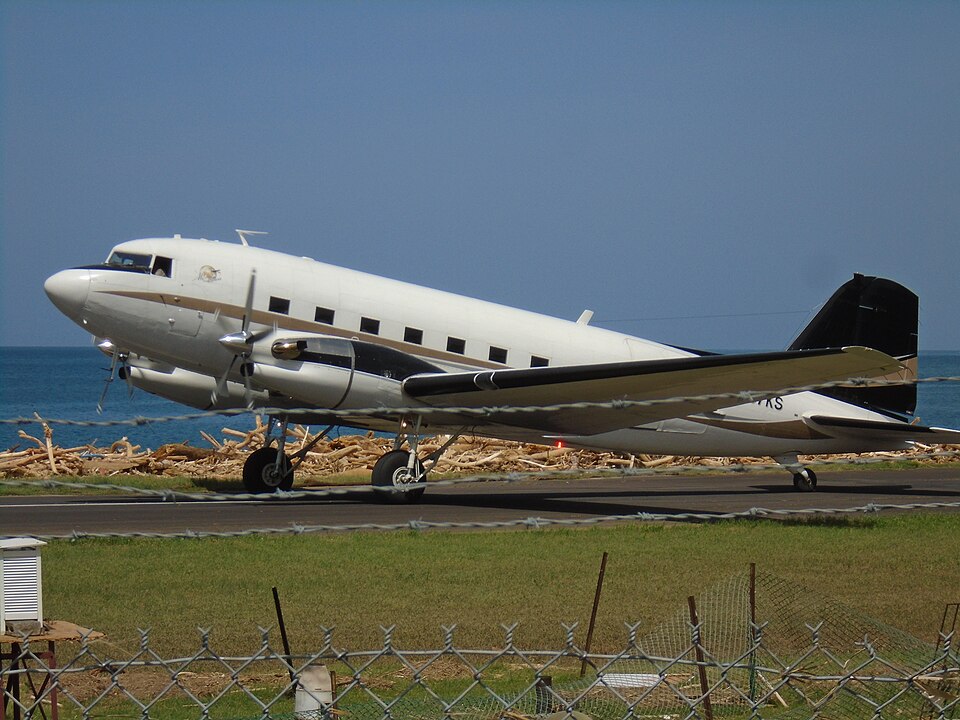
On January 21, 2019, at 0912 eastern standard time, a Douglas DC-3C airplane, registration N467KS, was substantially damaged when it struck terrain in Kidron, Ohio. The two pilots on board were fatally injured. The airplane was operated as a Title 14 Code of Federal Regulations Part 91 positioning flight.
The airplane was the prototype for an amended Supplemental Type Certificate (STC) project to install newer model Pratt and Whitney Canada PT6A series engines and MT propellers. The flight was intended to reposition the aircraft from Stoltzfus Airfield (OH22) in Kidron to Akron Canton Regional Airport (CAK) in North Canton, Ohio, to pick up an FAA test pilot for initial flight testing of stall maneuvers. The airplane was loaded with ballast to maximum gross weight.
According to the cockpit voice recorder (CVR) recording, which began before takeoff around 0902, the captain elected to skip the auto-feather system and overspeed governor tests listed in the run-up section of the normal checklist due to snow-packed conditions on the taxiway and runway. The captain stated all four boost pumps were on and all annunciator panel lights were extinguished. He briefed takeoff decision speed (V1) as 82 knots, rotation speed (Vr) as 84 knots, and climb speed (V2) as 90 knots.
The takeoff roll began. The first officer called out "takeoff power" at 0911:13, "40 knots" at 0911:16, "60 knots crosscheck" at 0911:19, and "V1" at 0911:24. Shortly after liftoff at 0911:27, the captain noted a problem and called for landing gear retraction. At 0911:31, a sound similar to the annunciator panel audible alarm occurred. The captain made brief comments at 0911:35 and 0911:39 indicating difficulty controlling the airplane. At 0911:40, the airplane impacted terrain.
Witnesses observed white smoke exiting the left engine exhaust immediately after takeoff and the airplane banked and yawed left. It then descended, struck power lines and trees, and impacted terrain.
Downloaded automated data acquisition system (ADAS) data showed that left engine torque, fuel flow, gas generator speed (Ng), and propeller rpm (Np) rapidly decreased at 0911:26.5. By 0911:27.2, left engine torque dropped to nearly zero, and Ng continued decreasing until the end of recorded data. Left engine Np dropped to 746 rpm at 0911:30, then increased to 1050 rpm about 4 seconds later. Airspeed reached a maximum of 91 knots at 0911:31. By the end of recorded data at 0911:41, Np and airspeed had decreased to 971 rpm and 73 knots, respectively.
Personnel Information
The captain was a DC-3TP Part 125 check airman and chief pilot for AFM Hardware Inc., holding FAA designated pilot examiner privileges for piston and turboprop DC-3 airplanes. The accident flight was his eighth flight in the accident airplane after the engine installation. The first officer's accident flight was his fourth flight in that airplane.
Aircraft Information
The aircraft had an experimental airworthiness certificate issued on July 27, 2018. The fuel system comprised four auxiliary tanks and two main tanks with a total capacity of 1,041 gallons. Main tanks were mounted in each engine nacelle. Each main tank had a capacity of 116 gallons. Fuel was routed through two boost pumps with check valves to the engine fuel pump, which included a low fuel pressure sensor that activated a cockpit audible warning tone below 5 psi. An electrically operated firewall fuel shutoff valve was mounted on the aft side of the engine firewall. Forward of the firewall was a fuel strainer with a red popup indicator that activated if fuel bypass occurred.
One week before the accident, all six fuel tanks were defueled for weight and balance calculations. On the accident morning, the airplane was towed from a heated hangar and all tanks were filled with Jet A1 fuel, totaling 1,046 gallons. The main tanks were fueled via transfer from the forward auxiliary tanks.
The propellers were composite, five-bladed, constant-speed, full-feathering, single-acting, non-regulated propellers. Oil pressure from the propeller governor decreased blade pitch to maintain selected RPM; increasing pitch was driven by an internal spring and counterweights. An auto-feather system was installed to feather the propeller on loss of engine torque. The system included a feather dump valve on each engine's propeller overspeed governor, high- and low-pressure switches on the torque pressure manifold, an auto-feather switch on each power lever, a panel switch, and relays. When armed and with power lever above 90% Ng, the system automatically feathered the propeller if engine torque dropped below about 200 ft-pounds. Retarding the power lever below 90% Ng interrupted the auto-feather process.
The ignition system for each engine consisted of one exciter box, two ignition leads, and two spark ignitors. A three-position ignition switch selected auto, manual, or off. In auto, ignition energized when the starter was activated. In manual, continuous ignition was provided. The airplane was not equipped with an auto-relight ignition system, which would have been armed at takeoff and triggered by low torque to automatically fire ignitors. The flight manual did not specify the ignition switch position for normal takeoff. After the accident, the operator updated the flight manual to require both ignition systems be set to manual before takeoff.
Wreckage and Impact Information
The airplane came to rest about 600 ft from the end of runway 19 and about 700 ft left of the runway centerline. The main wreckage was upright and oriented northwest, with the fuselage separated forward of the wings. The left wing was broken aft; the right wing's inboard leading edge was crushed aft. The left engine was broken aft and located outboard of the wing's leading edge. The right engine was broken downward at the nacelle. The nose was forward and left of the main wreckage.
The left main tank was inverted and breached. The fuel line from that tank to the engine was crimped during impact. All fuel line fittings were secure. The fuel filter bypass indicator on the engine side of the firewall was in the normal position. Fuel samples from all tanks and the fuel farm showed no anomalies.
The left engine power lever was about 1 inch forward of the idle stop; the right engine power lever was against the idle stop. The left propeller control lever was against the feather detent guard; the right propeller control lever was about 1 inch from full forward. The left fuel condition lever was at ground idle; the right was in the run position.
The left engine propeller was attached, with all five blades fractured near their roots. A dent in the pitch change pin corresponded to about 10-13° in flight, the low pitch hydraulic stop, consistent with a no or low power condition. The left engine propeller governor was fractured; the speed adjust lever and return spring were missing. The input shaft rotated freely; the feathering valve could be actuated. The reverse reset lever and beta valve actuated normally.
The left engine fuel control unit (FCU) was separated from the fuel pump. The fuel pump housing was fractured, but the input spline was undamaged and the shaft rotated freely. The left engine compressor and power section, left engine accessories (FCU, fuel pump, propeller governor, fuel nozzles, flow divider), and right engine FCU were sent to Pratt & Whitney Canada for further testing. Examination of the left engine revealed signatures consistent with very low power at impact. Fuel nozzles and flow divider valve tested normally. The left engine fuel pump, propeller governor, and FCU were damaged and could not be functionally tested, but disassembly showed no pre-impact anomalies that would have precluded normal operation. Fuel testing detected no water. No pre-impact anomalies were found that would have caused an engine flameout.
The right engine's propeller and power turbines rotated freely but lacked corresponding rotation between them, consistent with impact damage. The compressor rotated freely.
Fuel filters and electric boost pumps for the left main tank were tested. Filters met the specification of maximum 0.4 psi pressure drop at 500 gph, no anomalies up to 1,000 gph. Both boost pumps operated normally. The left engine torque pressure transducer met specifications. The auto-feather oil dump solenoid and speed reset solenoid from the left engine propeller overspeed governor tested normally.
Additional Information
Minimum Control Airspeed Issues
According to an FAA test pilot, the minimum control airspeed (Vmc) was to be reevaluated for the accident airplane as part of certification for higher horsepower engines. Vmc with previously approved engines was 67 knots indicated airspeed. Based on similar projects, Vmc was expected to increase about 5 to 6 knots with the new engines. During the accident, with left engine power loss and propeller not feathered, drag equations estimated a Vmc increase of 20 knots. The airplane's yaw and bank to the left was estimated to increase Vmc by 5 to 10 knots. Based on these estimations, the minimum airspeed required to maintain lateral control during the accident sequence was about 97 to 107 knots. ADAS data showed airspeed at engine failure was about 86 knots, reaching a maximum of about 91 knots.
Engine Failure During Takeoff Procedure
The flight manual included a procedure for engine failure during takeoff, with immediate action/memory items in bold.
Startle Effect / Reaction Time Discussion
Pilot response time to an unexpected event can vary, as it includes detection, identification, and initiation. Response times to unalerted events can take up to 3-4 seconds.
Medical and Pathological Information
Autopsies performed by the Office of the Coroner, Stark County, Ohio, determined the cause of death for both pilots was blunt force injury. Toxicology testing on the captain identified methanol in urine, a common ingredient in embalming fluid. Testing on the first officer identified atorvastatin, naproxen, diphenhydramine, and methanol in urine; blood testing was negative for diphenhydramine. Atorvastatin and naproxen are not considered impairing. Diphenhydramine is a sedating antihistamine that can cause cognitive and psychomotor slowing and drowsiness.