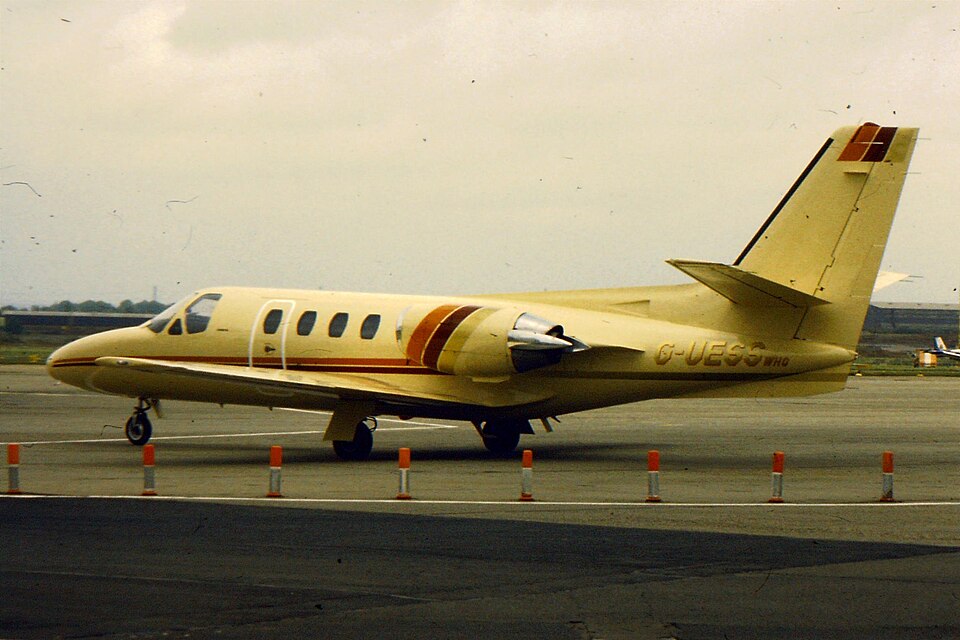
Flight History
On the day of the accident, the aircraft left Biggin Hill, U.K. on a private flight at 12:51 hrs with full fuel tanks to fly to Paris-Le Bourget, France, carrying a pilot, a pilot's assistant, and two passengers. At Le Bourget, two more passengers embarked, and the aircraft departed for Liverpool without refuelling at approximately 13:55 hrs. It landed at Liverpool at 15:25 hrs, where it was refuelled with 800 litres of turbine fuel; the pilot was seen to mix anti-icing additive to the fuel as it was dispensed. Two more adult passengers and two infants were embarked, and the aircraft left Liverpool at 16:32 hrs en route to Stornoway, Outer Hebrides, Scotland. The pilot had submitted an Instrument Flight Rules (IFR) flight plan to fly from Liverpool to Stornoway at Flight Level (FL) 310 via Dean Cross and Glasgow.
At 16:53 hrs, when approximately over Dean Cross, he reported to the Scottish Air Traffic Control Centre (ScATCC) that he was at FL280 climbing to FL310. This radio call was heard by the pilot of another aircraft, registration N40GS, a Citation 11 leased by the operating company of G-UESS, carrying other members of the same private party. N40GS had taken off from Biggin Hill and was also en route to Stornoway via Dean Cross at FL350. When just north of Dean Cross, the pilot of N40GS saw G-UESS ahead and established radio contact on the company discrete frequency. The two aircraft remained in intermittent contact.
After passing Dean Cross, both aircraft were cleared by ScATCC to route direct to Stornoway. At 17:00 hrs G-UESS was asked to climb to FL330 to avoid crossing traffic. At 17:18 hrs the pilot of N40GS reported he still had G-UESS in sight and would be ready to descend in 3 minutes; his aircraft was slowly overtaking G-UESS. At 17:20 hrs ScATCC directed both aircraft to maintain a radar heading of 330° (M) to provide lateral separation during descent and cleared N40GS to descend. Three minutes later, G-UESS was cleared to descend. During the descent, N40GS was cleared progressively to FL65 and G-UESS to FL85. At 17:29 hrs ScATCC released both aircraft from radar headings, advising no other traffic, and noted that G-UESS was 5 miles to the right and slightly behind N40GS. The pilot of G-UESS responded that he had the other aircraft in sight. ScATCC then instructed both to contact Stornoway.
Final Descent
At 17:34 hrs Stornoway ATC passed details of the present weather: fine with a light wind, good visibility, and one eighth of low cloud. The pilot of G-UESS acknowledged the weather but did not repeat back the QNH. At that time, G-UESS was 49 miles from Stornoway descending through FL140. At 17:38 hrs N40GS reported at 25 miles range, and immediately after G-UESS reported 30 miles from the airfield. N40GS was cleared to 2,000 feet on QNH 1001. At 17:40 hrs the pilot of G-UESS reported 25 miles range and that he had N40GS in sight; he asked for clearance to continue descent and was cleared by Stornoway to descend at his discretion with the aircraft ahead in sight. He was then asked to report when he had the airfield in sight for a visual approach to runway 01. He acknowledged. No further communication was received.
At 17:51 hrs, after failing to re-establish contact, the Stornoway controller reported to ScATCC that radio contact with G-UESS was lost. The pilot of N40GS, who landed safely, stated that during the descent from FL350 they had passed through layered stratus cloud and patches of altocumulus and cumulus cloud. The co-pilot in N40GS described a layer of lower cloud over the sea with tops between 3,000 and 4,000 feet lying across the path of their descent into Stornoway. N40GS tracked directly to Stornoway using Omega/VLF area navigation equipment. At 17:45 hrs the pilot of N40GS reported breaking cloud at 1,400 feet but later stated that he had cleared the base of the lowest cloud between 1,100 and 1,000 feet close to Stornoway. Visibility below cloud was very good, though the night was dark and he could not see the sea beneath him. N40GS experienced no icing and no significant turbulence during its descent.
Search and Recovery
An intensive search was made for G-UESS that night. Two bodies were recovered one mile north-west of the last observed radar position. Over the next four days, five more bodies and small pieces of aircraft wreckage were found near the same position. The bodies of two more passengers were recovered from the sea bed on 28 February and 5 June 1984, and that of the pilot's assistant on 18 July 1984. Attempts to recover the main wreckage were not successful.