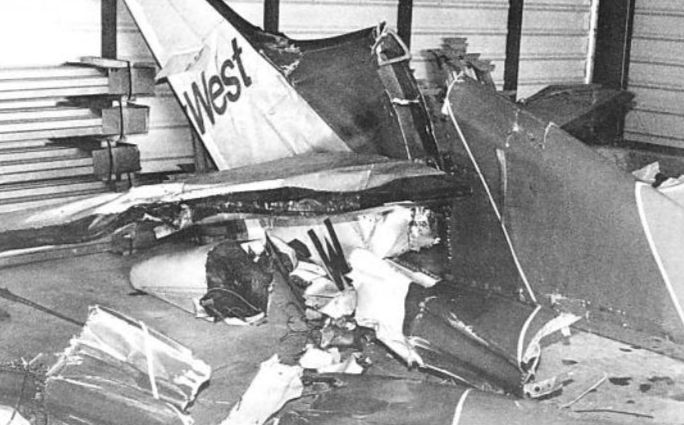
What happened
On January 15, 1987, SkyWest flight 1834, a Fairchild Swearingen SA-226TC (METRO II) with registration Nl635W, was conducting a scheduled passenger service from Pocatello, Idaho, to Salt Lake City, Utah. The aircraft was carrying two pilots and six passengers. While being vectored for a visual approach by Salt Lake City Terminal Radar Approach Control, the crew was repeatedly alerted by the controller to traffic in their vicinity. Despite these warnings regarding nearby aircraft, the flight crew reported they were unable to establish visual contact with the reported traffic.
Simultaneously, a Mooney M20C, registration N6485U, was operating under visual flight rules near Salt Lake City Municipal 2 Airport. After performing several touch-and-go landings, the Mooney departed the local traffic pattern and traveled south before turning northwest toward the approach path of the SkyWest flight. Radar data indicated that the two aircraft paths merged at approximately 12:57 MST.
Witnesses observed the Fairchild Swearingen SA-226TC (METRO II) pitching up just prior to the impact. The collision occurred at 7,000 feet MSL, with the nose of the Mooney striking the right forward fuselage of the SkyWest aircraft. Both planes crashed in a residential area of Kearns, Utah, scattering wreckage over two square miles. The accident resulted in 10 fatalities, including all occupants of both aircraft, though no individuals on the ground were injured.
Findings
Investigations determined that the primary cause was a lack of navigational vigilance by the instructor pilot operating the Mooney. This failure allowed the unauthorized entry of the aircraft into the Salt Lake City airport radar service area. The accident was further compounded by the fact that the Mooney lacked a Mode-C transponder and by the inherent limitations of the air traffic control system to ensure separation under these specific conditions.