Background
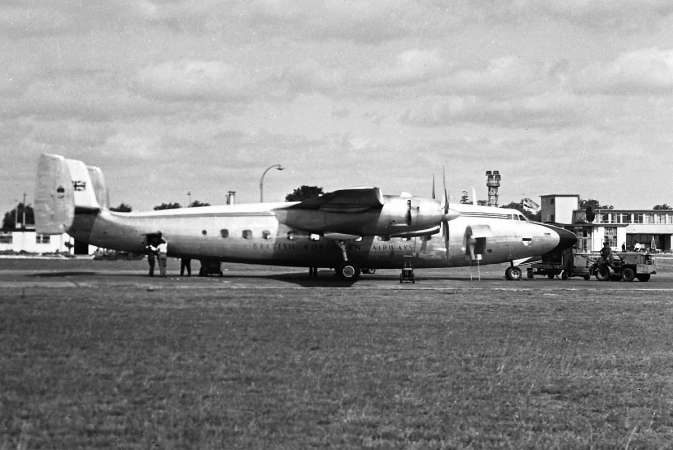
The aircraft, registration G-ALZU, operated a special flight on 3 February 1958 from England to Belgrade with an intermediate landing at Munich-Riem Airport for refueling. On 6 February, the aircraft departed Belgrade for Manchester, again making a planned refueling stop at Munich-Riem, landing at 1417 LT.
Accident Sequence
The aircraft made three takeoff attempts. The first attempt was abandoned by the copilot because boost pressure readings on both engines showed upward variations, rising 2–3 inches above the usual 57.5 inches. After taxiing back to the runway start without repeating the engine run-up, the second attempt was abandoned by the captain when the port engine boost pressure rose to 60 inches. Both abandonments occurred approximately halfway down the runway. After the second attempt, the aircraft rolled to the runway end and proceeded to the terminal building, where passengers disembarked. The BEA station engineer boarded and noted that the boost pressure variations were related to the airport elevation. Following a short discussion, the pilots decided to make a third takeoff. Passengers reboarded, and a further engine run-up was performed. During the third takeoff, the port engine boost pressure fluctuated but ceased after the captain briefly reduced throttle. After full throttle was reapplied, no further fluctuations occurred.
The aircraft never became airborne. It traveled the entire runway and the adjoining 250-meter grass-covered stopway. At the stopway end, it crashed through a wooden fence marking the aerodrome boundary, cleared a secondary road, and struck a house on the opposite side. The left wing tore off outboard of the engine mounting, and parts of the tail unit detached. The house caught fire. The aircraft then struck a wooden hut on a concrete base about 100 meters further, hitting it with the right side of the rear fuselage. The fuselage tore away at the trailing edge of the wing; the hut and torn fuselage section caught fire. The remaining wreckage slid another 70 meters.
Casualties and Damage
Of the 44 occupants (6 crew, 38 passengers), 21 were killed instantly. Others sustained injuries of varying severity. Two additional occupants died later in the hospital. Among the deceased were eight football players and their trainer. The club president and ten other players survived. The house struck by the aircraft was severely damaged by fire, and the hut was destroyed.
Probable Cause
During the stop of almost two hours at Munich, a rough layer of ice formed on the upper surface of the wings as a result of snowfall. This layer of ice considerably impaired the aerodynamic efficiency of the aircraft, had a detrimental effect on the acceleration of the aircraft during the take-off process and increased the required unstick-speed. Thus, under the conditions obtaining at the time of take-off, the aircraft was not able to attain this speed within the rolling distance available. It is not out of the question that, in the final phase of the take-off process, further causes may also have had an effect on the accident. British tests on the effect of slush on the takeoff process of an aircraft led the Luftfahrt-Bundesamt to decide to re-open the investigation in November 1964. In August 1966 the Commission arrived at the view that in the runway conditions obtaining at Munich-Riem at the time of the accident, the aircraft G-ALZU without ice on the wing upper surfaces could have attained the required unstick-speed and would have been bound to have done so. The failure to unstick, and hence the accident, are thus to be attributed to a series of inter-related causal factors viz.: - Decrease in the lift coefficient resulting from ice on the wing upper surfaces and a consequent increase in the minimum unstick speed, - Increase in drag caused by ice accretion, particularly at the higher angle of incidence during the unstick process, - Reduction by slush and spray of the margin of performance of the aircraft and effect of the slush on the trim. The differing assessments of the situation by the two pilots during the final phase of the take-off to be inferred from Captain Thain's statements resulted in their acting in opposition which probably increased the severity of the accident.