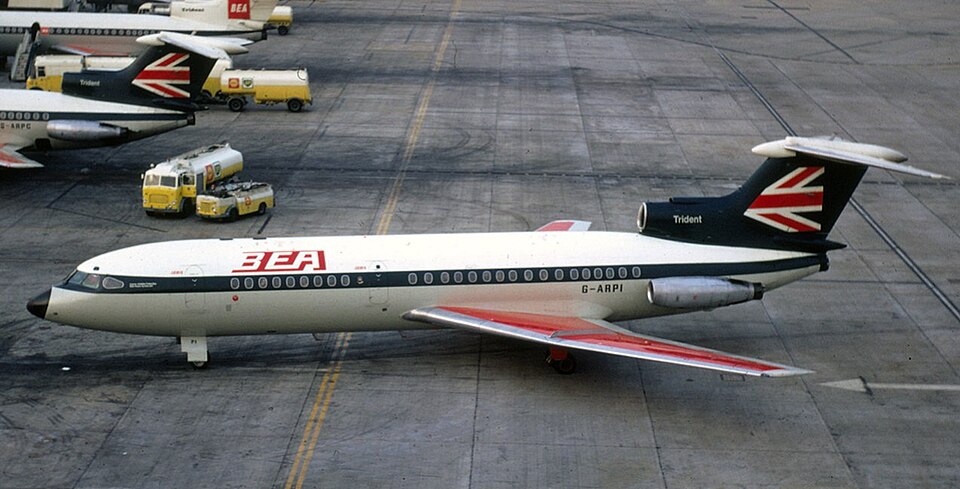
Takeoff and Initial Climb
After a normal takeoff roll on runway 28R, the aircraft rotated 42 seconds after brakes release and lifted off 2 seconds later at 145 knots IAS. At 63 seconds, the autopilot was engaged 355 feet above the runway at 170 knots IAS, and the IAS speed lock was selected shortly thereafter. At 74 seconds, the aircraft started a 20° banked turn to port toward the Epsom Non-Directional Beacon (NDB).
Crew Communications and Noise-Abatement
At 83 seconds, the captain reported "Climbing as cleared" and was instructed to change frequency to London Air Traffic Control Centre. The noise-abatement procedure was initiated at 93 seconds. On the assumption that the captain was the handling pilot, this involved the second officer selecting flaps fully up and reducing power to a pre-calculated figure. At 100 seconds, the captain called "Passing 1500" and at 103 seconds received clearance to climb to Flight Level 60, which he acknowledged at 108 seconds with "up to 60."
Stall Sequence
At 114 seconds, with airspeed 162 knots and altitude 1,772 feet, the droop lever was selected up, moving the aircraft into the stall regime as the droop started to retract. At 116 seconds, the stick-pusher stall recovery device operated, causing the autopilot to disengage and the nose to pitch down. The stick-push ceased as incidence decreased, but because the elevator trim remained at its autopilot-disengaged position, incidence increased again, leading to a second stick-push at 124 seconds and a third at 127 seconds. At 128 seconds, the crew manually inhibited the stall recovery system by pulling the lever. The aircraft then pitched up rapidly, losing speed and height, and entered first a true aerodynamic stall, then a deep stall from which recovery was impossible at that altitude.
Impact
Impact occurred at 150 seconds in a field next to the A30 motorway. The aircraft was totally destroyed and none of the 118 occupants survived.
Probable Cause (Official Findings)
The immediate causes of the accident were:
- A failure by Captain Key to achieve and maintain adequate speed after noise-abatement procedures.
- Retraction of the droops at some 60 knots below the proper speed, causing the aircraft to enter the stall regime and the stick-shaker and pusher to operate.
- Failure by the crew to monitor the speed errors and to observe the movement of the droop lever.
- Failure by the crew to diagnose the reason for the stick-shaker operation and the concomitant warnings.
- The dumping by the crew of the stall recovery system.
The underlying causes were:
- The abnormal heart condition of Captain Key leading to lack of concentration and impaired judgment sufficient to account for his toleration of the speed errors and to his retraction of, or order to retract, the droops in mistake for the flaps.
- Some distraction, the nature of which is uncertain, possibly due to the presence of Captain Collins as a passenger on the flight deck, which caused S/O Ticehurst's attention to wander from his monitoring duties.
- Lack of training directed at the possibility of 'subtle' pilot incapacitation.
- Lack of experience of S/O Keighley.
- Lack of knowledge in the crew of the possibility or implication of a change of configuration stall.
- Lack of knowledge on the part of the crew that a stick-shaker and push might be experienced almost simultaneously and of the probable cause of such an event.
- Lack of any mechanism to prevent retraction of the droops at too low a speed after flap-retraction.