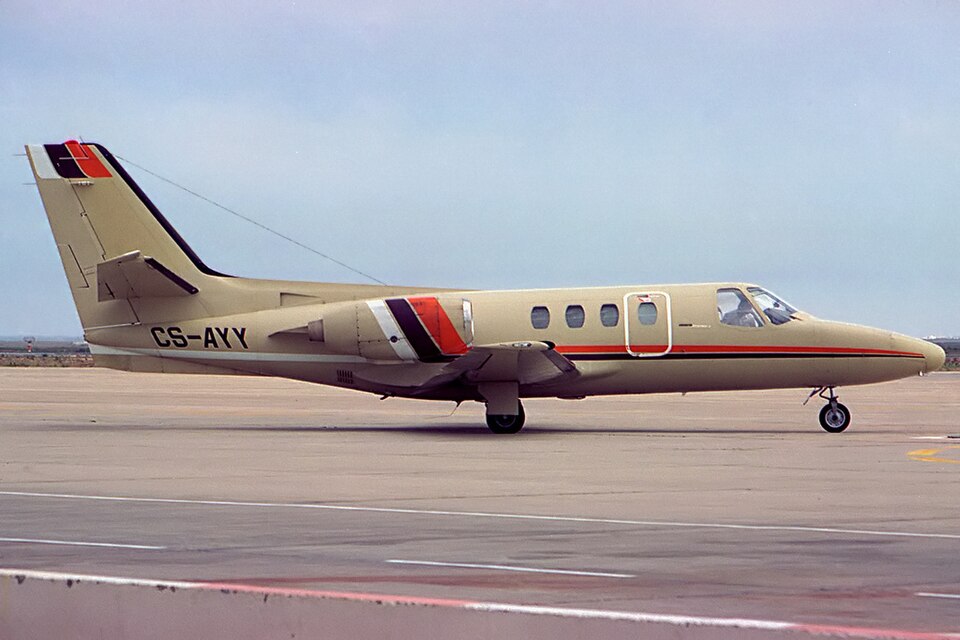
Incident Overview
On 16 January 1999, at 02:05 UTC, a Cessna 501, registration CS-AYY, operated by Helisul, departed from Faro Airport on a non-regular passenger transport flight to Cascais Municipal Aerodrome. The aircraft carried 8 persons on board, including 2 pilots and 6 passengers.
Approach and Landing Sequence
The pilot-in-command contacted Lisbon Approach Control (APP LISBOA) and received approval for the approach and descent procedure to Runway 35 at Cascais. The co-pilot commenced landing maneuvers for Runway 35. During the approach, the pilot-in-command observed that the aircraft was low relative to the glideslope and instructed the co-pilot to make corrections. Despite corrections, the aircraft continued to sink. The pilot-in-command then took control, applied nose-up trim and power, but could not correct the trajectory. The aircraft struck the runway surface with the lower rear fuselage (tail strike) on Runway 35.
Damage and Injuries
The aircraft sustained damage to the fuselage structure, including buckling of the tail cone and lower fin. All 8 occupants reported no injuries. No other damage occurred.
Weather and Aerodrome Conditions
At the time of landing (02:33 UTC), weather at Cascais was: wind 270° at 1 knot, QNH 1022. The aerodrome runway 35 is 1,200 meters long, 30 meters wide, asphalt surface, with an elevation of 295 feet and 1% slope.
Conclusion
The incident resulted from a tail strike during landing, with no injuries. The probable cause was not determined by the investigation.