Boeing 757 — safety record, routes and airlines
The Boeing 757 is the transatlantic narrow-body: long legs, steep-climb performance, and the last US-built single-aisle jet for charter and legacy operators.
See Boeing 757 routes on the mapEvery event on record for the type, worldwide — incidents as well as accidents, grouped so one event reported by several sources counts once. Not adjusted for fleet size, so the counts reflect how widely a type flies as much as how it performs. We publish no score or grade.
Methodology →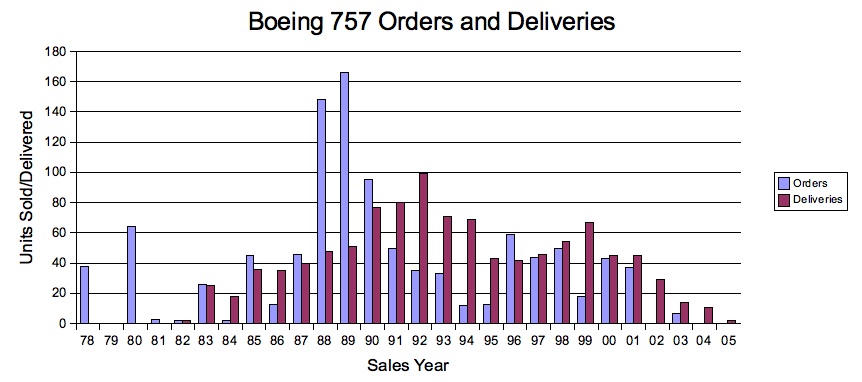
About the Boeing 757
The 757 was produced from 1982 until 2004 and was never directly replaced, which is why it remains in service. The 757-200 seats around 180 to 200 passengers in a standard two-class layout and has a range of roughly 3,900 nautical miles, enough for US-to-Europe transatlantic flying. Its combination of twin-aisle-like range on a single-aisle airframe and strong hot-and-high performance keeps it valuable on routes that are too thin for a wide-body but too long for most other narrow-bodies. The 757-300 is a stretched variant rarely used outside leisure operators.
Who flies it?
Delta Air Lines and United Airlines operate the largest remaining 757 fleets, using them on US transcontinental flying and thinner transatlantic routes to Europe. Icelandair has flown the 757 for decades as the perfect aircraft for the North Atlantic via Keflavik. FedEx operates a very large 757 freighter fleet. A handful of leisure and charter carriers in Europe and Central Asia continue to operate the type, though replacements with the A321neo and A321XLR are accelerating fleet retirements.
Recent safety events for the Boeing 757
Loading safety records…
Sign in to get an email when a new safety record for Boeing 757 lands.
View full safety record →Frequently asked questions about the Boeing 757
Is the Boeing 757 safe?
The Boeing 757 has 30 occurrences in our most recent five-year window. It has 16 hull losses and 390 recorded occurrences in total. 16 of them were fatal, the most recent in 2018. These are counts from the public record, not a rating: they reflect how widely a type flies as much as how it performs, and they do not predict any individual flight. The methodology page explains how we count.
Is the Boeing 757 still flying in 2026?
Yes, though fleets are shrinking each year. Delta, United, and Icelandair remain significant passenger operators, and FedEx flies a large 757 freighter fleet. The A321neo and A321XLR are the most common replacements on passenger routes, so expect retirements to continue into the late 2020s, particularly for the older -200s.
Why do airlines use the 757 on transatlantic routes?
The 757-200 has range around 3,900 nautical miles and strong climb performance, which lets it fly routes from the US East Coast to Western Europe with a full passenger load. Its single-aisle operating cost is significantly lower than a wide-body, making it ideal for thin transatlantic markets that could not profitably support a 767 or 787.
How many passengers does the 757 carry?
A typical two-class 757-200 seats 180 to 200 passengers, with charter layouts reaching around 230. The stretched 757-300 carries up to about 243 in a two-class configuration and was used mostly by leisure and holiday operators rather than legacy carriers.
Engines
Fleet age (observed)
The observed Boeing 757 fleet averages 30.2 years old, with the oldest flying example N650DL (1986) (sample of 302 tracked aircraft).
Fleet age is not a safety indicator. Sourced from the FAA aircraft registry and OpenSky/ADS-B Exchange metadata; the observed fleet reflects live ADS-B sightings over the last 12 months.
See airline fleet ages →Embed this safety badge

See how the Boeing 757 compares
Put it side by side with another commercial type — key specs and recorded safety history, not a ranking.
Boeing 757 — safety & facts
Safety record
- Occurrences, last 5 years
- 30
- Airworthiness directives
- 114
- Recorded occurrences
- 390
- Hull losses
- 16
- Fatal accidents
- 16
- Total fatalities
- 545
- Last fatal accident
- 2018
- Records span
- 1985–2026
- Fatal accidents in the US per 1M US departures
- 0.000 (2016–2025, US flights)
Based on 390 occurrences across NTSB, ASN, MAK, ATSB & Wikidata records. See full safety record →
Key facts
- Manufacturer
- Boeing
- Typical seats
- 200-295 pax
- Range
- 7,600 km
- First flight
- 1982-02
Flying soon? Check your own flight
Every record above is searchable — but the fastest answer is your actual flight.
Or look up the record behind it: