Bombardier CRJ (all variants) — safety record, routes and airlines
The Bombardier CRJ family (CRJ-200, 700, 900, 1000) serves short-haul regional routes across North America and Europe.
See Bombardier CRJ (all variants) routes on the mapEvery event on record for the type, worldwide — incidents as well as accidents, grouped so one event reported by several sources counts once. Not adjusted for fleet size, so the counts reflect how widely a type flies as much as how it performs. We publish no score or grade.
Methodology →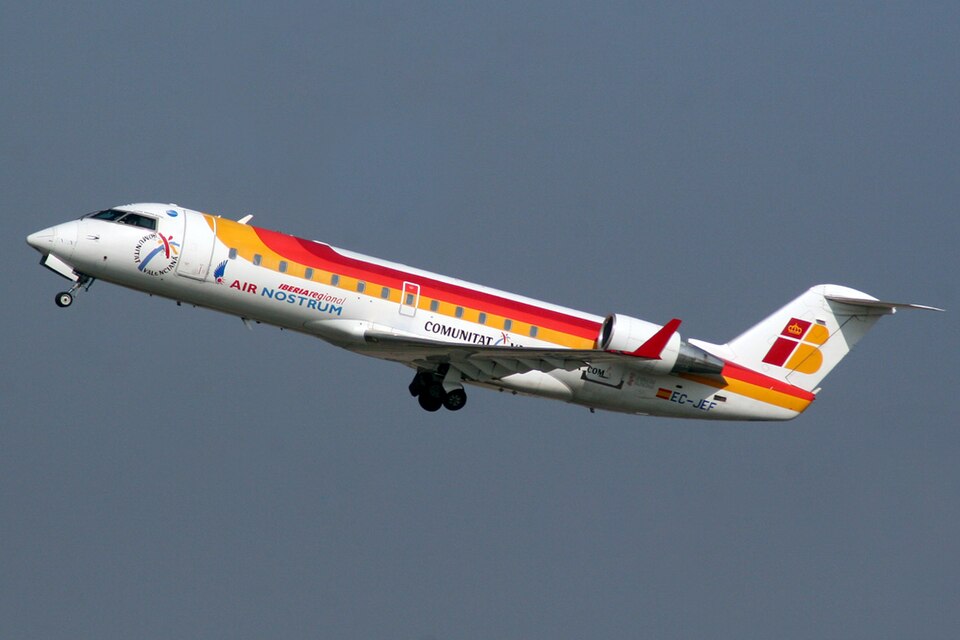
About the Bombardier CRJ (all variants)
The CRJ family is a stretched derivative of the Challenger business jet, produced by Bombardier until the program was sold to Mitsubishi and later wound down. The CRJ-200 seats 50 and is mostly used on thin regional US routes. The CRJ-700, 900, and 1000 seat 66, 76, and up to 100 respectively, with the CRJ-900 being the most common variant in current service. Range is around 1,500 to 2,000 nautical miles. The 2-2 layout has no middle seats. The type has been critiqued for tight overhead bin space and small cabin dimensions compared to the Embraer E-Jets.
Who flies it?
In the United States, the CRJ-900 is flown by Endeavor Air (Delta Connection), SkyWest, GoJet, Mesa, and PSA Airlines (American Eagle) on short regional routes. The CRJ-200 remains in service at SkyWest and Air Wisconsin on thin routes but is being progressively retired. In Europe, Lufthansa CityLine historically operated the CRJ-900 before transitioning to E190 and E195 equipment. Air Canada Express and several Asian and Middle East carriers also operate the type in regional roles. Production ended in the early 2020s.
Recent safety events for the Bombardier CRJ (all variants)
Loading safety records…
Sign in to get an email when a new safety record for Bombardier CRJ (all variants) lands.
View full safety record →Frequently asked questions about the Bombardier CRJ (all variants)
Is the Bombardier CRJ (all variants) safe?
The Bombardier CRJ (all variants) has 24 occurrences in our most recent five-year window. It has 12 hull losses and 147 recorded occurrences in total. 13 of them were fatal, the most recent in 2026. These are counts from the public record, not a rating: they reflect how widely a type flies as much as how it performs, and they do not predict any individual flight. The methodology page explains how we count.
What's the difference between the CRJ variants?
Fuselage length and capacity. The CRJ-200 seats 50, the CRJ-700 seats 66 to 78, the CRJ-900 seats 76 to 90, and the CRJ-1000 seats 97 to 104. The CRJ-700 and later variants share a common type rating. The CRJ-200 is a much older design and is being progressively retired across most fleets.
Is the CRJ still being produced?
No. Bombardier sold the CRJ program to Mitsubishi Heavy Industries, and production ended in the early 2020s. The existing fleet continues to operate at regional carriers in North America and Europe, but new deliveries are not happening. Replacements at most US regional carriers are E175s, which have a larger cabin and better passenger comfort.
Why is the CRJ cabin so tight?
The CRJ is derived from the Challenger business jet, so fuselage diameter is smaller than the Embraer E-Jet. Overhead bin space is very limited, and many full-size carry-on bags have to be gate-checked. Cabin ceiling is low enough that tall passengers often have to stoop in the aisle. It remains in service largely because operators already own the fleet, not because passengers prefer it.
Engines
Fleet age (observed)
The observed Bombardier CRJ (all variants) fleet averages 17 years old, with the oldest flying example N707SK (1999) (sample of 522 tracked aircraft).
Fleet age is not a safety indicator. Sourced from the FAA aircraft registry and OpenSky/ADS-B Exchange metadata; the observed fleet reflects live ADS-B sightings over the last 12 months.
See airline fleet ages →Embed this safety badge

See how the Bombardier CRJ (all variants) compares
Put it side by side with another commercial type — key specs and recorded safety history, not a ranking.
Bombardier CRJ (all variants) — safety & facts
Safety record
- Occurrences, last 5 years
- 24
- Airworthiness directives
- 0
- Recorded occurrences
- 147
- Hull losses
- 12
- Fatal accidents
- 13
- Total fatalities
- 255
- Last fatal accident
- 2026
- Records span
- 1998–2026
- Fatal accidents in the US per 1M US departures
- 0.080 (2016–2025, US flights)
Based on 147 occurrences across NTSB, ASN, MAK, ATSB & Wikidata records. See full safety record →
Key facts
- Manufacturer
- Bombardier
- Typical seats
- 50-104 pax
- Range
- 3,650 km
- First flight
- 1991-05
Flying soon? Check your own flight
Every record above is searchable — but the fastest answer is your actual flight.
Or look up the record behind it: