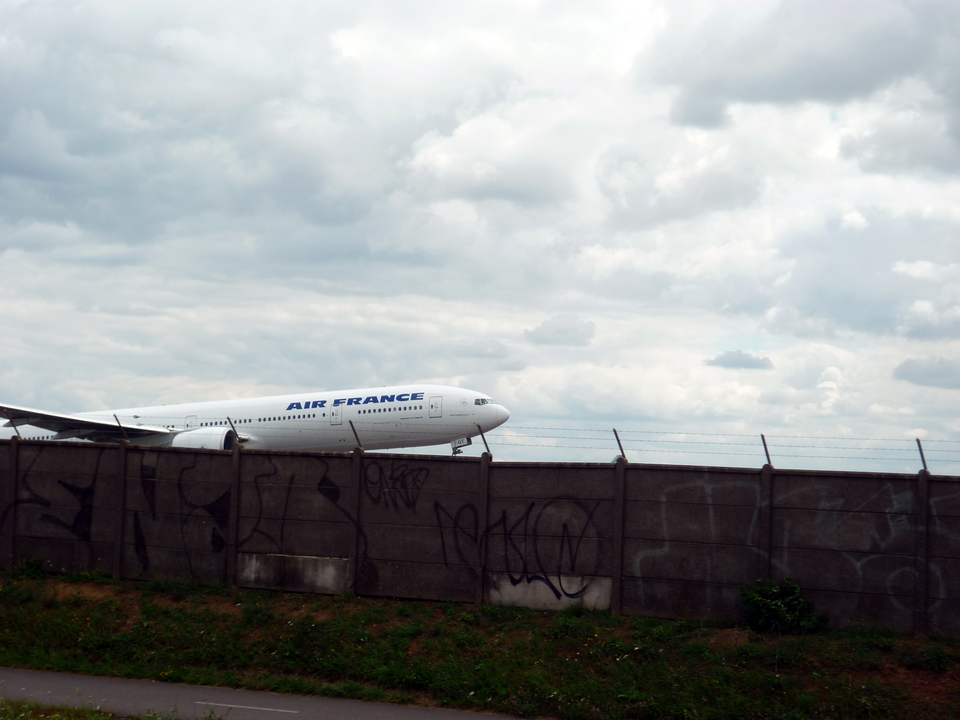
Incident Overview
On 29 March 2008, a Boeing 777-328 ER aircraft, registered F-GSQT, operated by Société Air France, experienced an in-flight engine failure during an international passenger flight. The aircraft was cruising at Flight Level 320 within the New York FIR at the time of the incident.
Sequence of Events
While in cruise, the flight crew heard several low bangs and observed that the engine #2 exhaust gas temperature (EGT) indicator showed swift variations. The crew immediately performed the "µ ENG LIM/SURGE/STALL L, R" checklist. The thrust lever was retarded to the idle position, and the affected engine indications remained within appropriate limits. However, when the throttle was advanced again, the engine #2 indications became unstable, returning vibrations and loud bangs upon reaching approximately 60% N1.
As a result, the crew decided to divert to Lajes International Airport at Terceira Island in the Azores (Portugal). The pilot executed an uneventful landing on runway 33 at 18:08 hours, with the engine #2 thrust lever kept in the idle position throughout the approach and landing.
Aircraft and Occupants
The aircraft, a Boeing 777-328 ER with registration F-GSQT, was carrying 448 persons on board. According to the official report, there were no injuries and zero fatalities. The aircraft damage was confined to the internal components of engine #2.
Investigation Findings
The investigation determined that the in-flight engine failure resulted from internal damage to the high-pressure compressor of engine #2. Borescope inspection revealed that one blade of the HPC4 rotor was half missing, and other blades exhibited cracks, missing material, dents, and notches. Similar damage was observed in HPC stages 5 to 8. The engine had been replaced on the aircraft in January 2008 due to a prior maintenance issue.
Despite these findings, the probable cause of the incident was not formally stated in the official report. The crew's actions in performing the appropriate checklist and diverting to the nearest suitable airport were consistent with standard operating procedures.