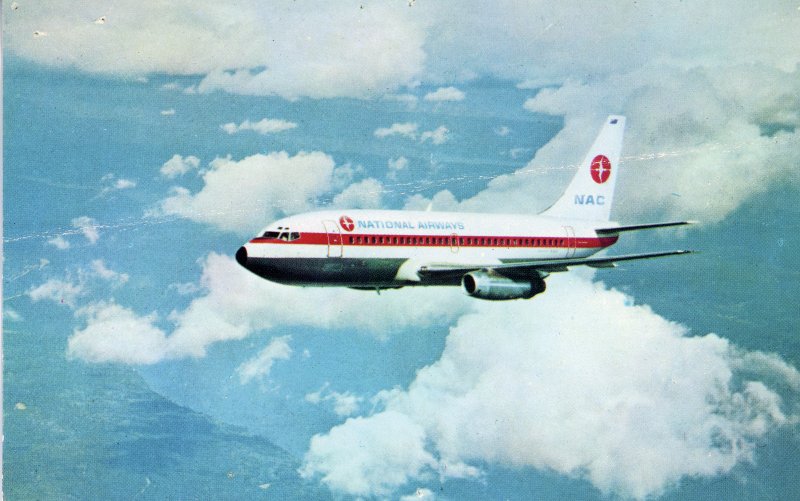
2 Jan 1988: Boeing 737-230 Advanced — Condor Flugdienst

16 fatalities • near Seferihisar

Accident narrative

Condor Flugdienst Flight 3782 was an international charter flight from Stuttgart-Echterdingen Airport, West Germany to Adnan Menderes Airport, Turkey that crashed near Seferihisar, Turkey on 2 January 1988. At the time, Condor was a 100% subsidiary of Lufthansa.

== Aircraft == The aircraft was a Boeing 737-230 with the serial number 22635/774 and it was registered D-ABHD. Its first flight was on June 15, 1981, and it was delivered in July of the same year to the airline. The aircraft was equipped with 2 Pratt & Whitney JT8D-17A engines. The captain, Wolfgang Hechler (48), was a former Starfighter pilot. The First Officer was Helmut Zöller (33).

== Accident description == The flight was uneventful until final approach, when the aircraft, with the co-pilot acting as Pilot flying, was cleared for an ILS approach to the Outer Marker (Non-Directional Beacon) and then on to Runway 35. The aircraft's ILS was switched on after it had passed the NDB, therefore missing the turn. The crew, confused, then followed the wrong side beam of the ILS, and struck Dümentepe Hill, 10.5 nautical miles (12.1 mi; 19.4 km) from the airport, killing all 16 people on board.

== Investigation == According to the evaluation of the cockpit voice recorder, captain Hechler continuously talked to First Officer Zöller, even in the approach phase and kept on criticising, lambasting and insulting him, partly without reference to duty or work subjects. The investigation concluded that the accident occurred due to the incorrect use of navigation aids. The cause is attributed mainly to the lack of adherence to company procedures, especially with respect to crew coordination during approach and basic instrument flying procedures.

== See also == American Airlines Flight 965, another aircraft that crashed due to navigational errors.

== References ==

Contributing factors

  • [object Object]

Investigation report by Wikidata contributors. Original record: https://www.wikidata.org/wiki/Q5159340. This page is a structured re-presentation; facts and quotes are in the CC0 (Wikidata).

Loading the flight search…

What you can do on Flight Finder

  • Search flights between any two airports with live fares.
  • By aircraft — pick a plane model (e.g. Boeing 787, Airbus A350) and see every route it flies from your origin.
  • Route map — click any airport worldwide to explore its destinations, or draw a radius to find nearby airports.
  • Global aviation safety — aviation accident database, 40,000+ records since 1980, with map and rankings by aircraft and operator.
  • NTSB safety feed — recent U.S. aviation accidents and incidents from the official NTSB CAROL database, updated daily.

Frequently asked questions

How do I search flights by aircraft type on FlightFinder?

Pick an aircraft model — Boeing 737, Airbus A320, A380, Boeing 787 Dreamliner and more — enter your origin airport, and FlightFinder shows every route that plane flies from there with live fares.

Which aircraft types can I filter by?

We support Boeing 737/747/757/767/777/787, the full Airbus A220/A319/A320/A321/A330/A340/A350/A380 family, Embraer E170/E175/E190/E195, Bombardier CRJ and Dash 8, and the ATR 42/72 turboprops.

Is FlightFinder free to use?

Search and schedules are free. Pro ($4.99/month, $39/year, or $99 one-time lifetime) unlocks the enriched flight card — on-time stats, CO₂ per passenger, amenities, live gate & weather — plus My Trips with push alerts.

Where does the route data come from?

Live schedules come from Amadeus, AeroDataBox and Travelpayouts. Observed routes (which aircraft actually flew a given city pair) are crowdsourced from adsb.lol ADS-B data under the Open Database License.