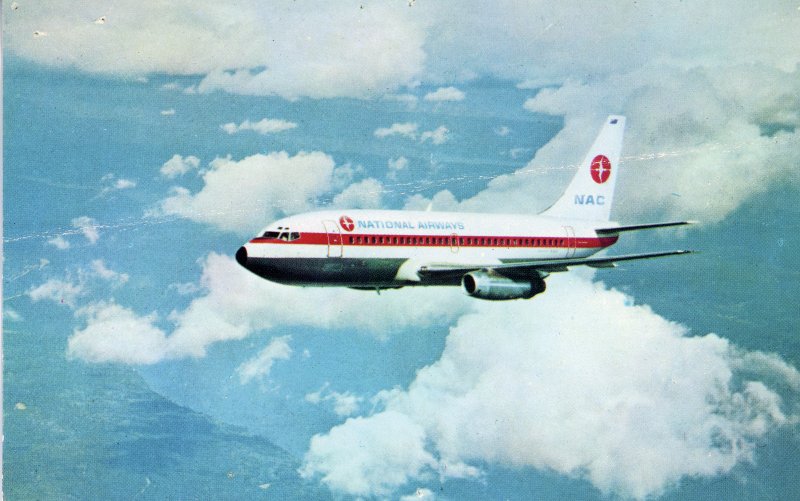
18 Apr 2009: BOEING 737-724 — Continental Airlines

18 Apr 2009: BOEING 737-724 (N27722) — Continental Airlines

No fatalities • McAllen, TX, United States

Probable cause

The injured passenger's failure to comply with the requirement to remain seated with a fastened seatbelt.

— NTSB Determination

Accident narrative

On April 18, 2009 at 0152 (Unless otherwise noted, all times in this report are central daylight time based on a 24-hour clock) a Boeing 737-724, N27722 encountered severe turbulence while descending for approach to McAllen Miller International Airport (KMFE). The flight was being operated by Continental Airlines as Flight 511, a Title 14 Code of Federal Regulations (CFR) Part 121 scheduled domestic passenger flight from George Bush Intercontinental/Houston Airport (KIAH), Houston, Texas, to McAllen Miller International Airport (KMFE), McAllen, Texas. The flight was being conducted during night instrument conditions with an active instrument flight rules (IFR) flight plan. A total of 109 people were on board consisting of 2 flight crew, 3 flight attendants, and 104 passengers. One flight attendant sustained minor injuries, 2 passengers sustained minor injuries, and 1 passenger was critically injured. The airplane landed at KMFE at 0216, and arrived at the gate at 0220.

In a written report the captain stated that he had briefed all crew members not to perform any services and remain in their jump seats for the duration of the flight due to the possibility of severe weather. The lead flight attendant made a public address announcement to the passengers that due to possible bad weather there would be no service and the seat belt sign would remain on during the entire flight and stressed the need for the passengers to remain in their seats. The flight took off from Houston approximately 3 hours later than scheduled and climbed to 38,000 feet. While en route to KMFE, the pilot had to circumnavigate to avoid thunderstorm cells. The first officer made a similar announcement to the crew and passengers stressing the need to remain seated for their safety. A total of 4 or 5 announcements were made to passengers during the flight to please remain in their seats as several passengers attempted to get up to use the lavatories. The seat belt sign was illuminated for the entire flight.

The descent to KMFE began, with the airplane at an airspeed of 280 knots and a descent rate of approximately 1,000 feet per minute. A line of precipitation about 5 to 10 nautical miles wide was indicated on the airplane's weather radar. The depiction was green in color from -2 to +2 degrees. The airplane entered a cloud formation about 20,000 feet mean seal level (MSL) and encountered severe turbulence for about 15 seconds. This included up and down drafts and a roll of about 30 degrees. During the turbulence encounter a passenger, who had gotten up and went into the lavatory, sustained serious injuries. In addition, two passengers and a flight attendant not wearing their seatbelts sustained minor injuries. The descent continued to 10,000 feet MSL as cleared. At that time the lead flight attendant called the captain and notified him of injuries in the aft cabin. The captain continued to the approach and communicating with Air Traffic Control (ATC) the need to land as quickly as possible for a medical emergency.

The flight data recorder was removed and secured for further analysis and the airplane was inspected for damage in accordance with Continental and Boeing maintenance manuals. There was no damage noted and the airplane was released for further flight.

Contributing factors

  • Compliance w/ procedure
  • cause Passenger
  • Effect on personnel

Conditions

Weather
VMC, wind 120/14kt, vis 7sm

Loading the flight search…

What you can do on Flight Finder

  • Search flights between any two airports with live fares.
  • By aircraft — pick a plane model (e.g. Boeing 787, Airbus A350) and see every route it flies from your origin.
  • Route map — click any airport worldwide to explore its destinations, or draw a radius to find nearby airports.
  • Global aviation safety — aviation accident database, 5,200+ records since 1980, with map and rankings by aircraft and operator.
  • NTSB safety feed — recent U.S. aviation accidents and incidents from the official NTSB CAROL database, updated daily.

Frequently asked questions

How do I search flights by aircraft type on FlightFinder?

Pick an aircraft model — Boeing 737, Airbus A320, A380, Boeing 787 Dreamliner and more — enter your origin airport, and FlightFinder shows every route that plane flies from there with live fares.

Which aircraft types can I filter by?

We support Boeing 737/747/757/767/777/787, the full Airbus A220/A319/A320/A321/A330/A340/A350/A380 family, Embraer E170/E175/E190/E195, Bombardier CRJ and Dash 8, and the ATR 42/72 turboprops.

Is FlightFinder free to use?

Search and schedules are free. Pro ($4.99/month, $39/year, or $99 one-time lifetime) unlocks the enriched flight card — on-time stats, CO₂ per passenger, amenities, live gate & weather — plus My Trips with push alerts.

Where does the route data come from?

Live schedules come from Amadeus, AeroDataBox and Travelpayouts. Observed routes (which aircraft actually flew a given city pair) are crowdsourced from adsb.lol ADS-B data under the Open Database License.