History of the Flight
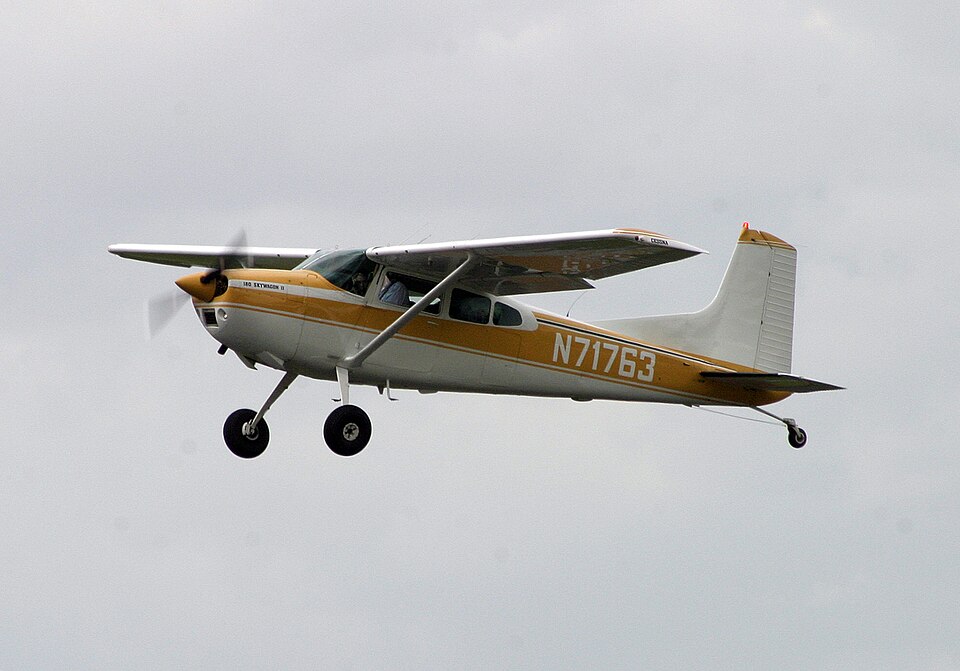
On 9 August 2009, at approximately 1900 UTC, a Cessna 180K (N71763) was on approach to a private airfield 2.5 nautical miles east of Kinnegad, Co. Meath, when it struck electricity supply cables. The aircraft was travelling in loose formation behind another Cessna 180 (N180WJ). The lead aircraft, piloted by Pilot A, landed first on runway 20. A pilot on the ground observed that the following aircraft was low on approach and radioed a warning about obstacles. The pilot of N71763 pulled up, but the wheels contacted the cables, breaking them. The aircraft climbed away and landed safely at Milltownpass airfield. The aircraft sustained minor damage: a missing brake line clip and a fractured portion of the VOR aerial. No injuries were reported.
Notification and Reporting
The Air Accident Investigation Unit (AAIU) became aware of the occurrence on 10 August 2009, the day after the event. The airfield owner was interviewed but could not identify the aircraft. The AAIU made enquiries to identify it. On 18 August 2009, the pilot of N71763 emailed a notification to the AAIU, followed by a phone call on 20 August to confirm receipt. The initial email stated no damage, but a subsequent pilot report form noted the missing clip and aerial part. The aircraft left the AAIU's jurisdiction before the report was submitted, so the FAA was requested to survey it; an FAA inspector confirmed no major structural damage and no propeller marks from striking cables.
Permission to Land
The airfield is a privately owned 400 m grass strip with published arrival instructions requiring prior permission (PPR). The VFR Flight Guide Ireland lists "wires on 20 end" as an obstacle. In the weeks before, Pilot A had requested permission for a group of Cessna 180s to land, but the owner declined due to noise concerns and a policy to accompany first-time visitors. On the day of the incident, the owner's son again declined permission. However, a passenger in Pilot A's aircraft called the owner by mobile phone; the owner thought the caller was in a car and said he would return the call. The passenger later stated that permission was granted during the call. Pilot B, the pilot of N71763, stated he knew he did not have permission to land.
Aftermath
After the cable strike, Pilot B applied power and climbed away. The airfield owner and his son, hearing the aircraft, returned to the field and saw N71763 climb away. Pilot A, who had landed, taxied and took off without speaking to the owner. Pilot A then led N71763 to Milltownpass airfield and landed first. Pilot B handled the aircraft alone. Pilot A contacted ESB Networks (the electricity provider) to report the damage and arranged to pay repair costs of €1,110. ESB Networks was not provided with Pilot B's contact details and could not deliver a safety pack. Neither pilot contacted the airfield owner afterwards. N71763 and Pilot B left Ireland on 11 August 2009, returning to their base in England.
Medical and Briefing
The sole occupant of N71763, Pilot B, suffered no injuries. He is required to wear spectacles when flying and was wearing them at the time. Pilot A had flown into the airfield before and was familiar with the cable hazard but did not brief Pilot B. Both pilots had copies of the VFR Flight Guide Ireland, which describes hazards. Pilot B stated he briefed himself using that guide. The UK CAA's General Aviation Safety Information Leaflet encourages pilots to telephone aerodromes for permission and safety information.
Damage and Engineering
The aircraft log for N71763 had an entry dated 9 August 2009 by Pilot B noting a consultation with a third party and a recommendation for a prop track check and visual inspection. The entry listed a missing VOR antenna and brake line clip, signed on 11 August 2009. Pilot B does not hold engineering certificates but communicated with his engineer on 10 August and inspected the aircraft on his advice. A subsequent log entry on 11 August by a licensed engineer confirmed the damage. Between the two entries, the aircraft flew 3.7 hours, crossing the Irish Sea.
Legislation
Statutory Instrument (SI) 205 of 1997, Regulation 11, requires pilots to report an accident or serious incident as soon as practicable. SI 355 of 2008 requires pilots to obtain prior permission from the owner or occupier when using an unlicensed aerodrome.