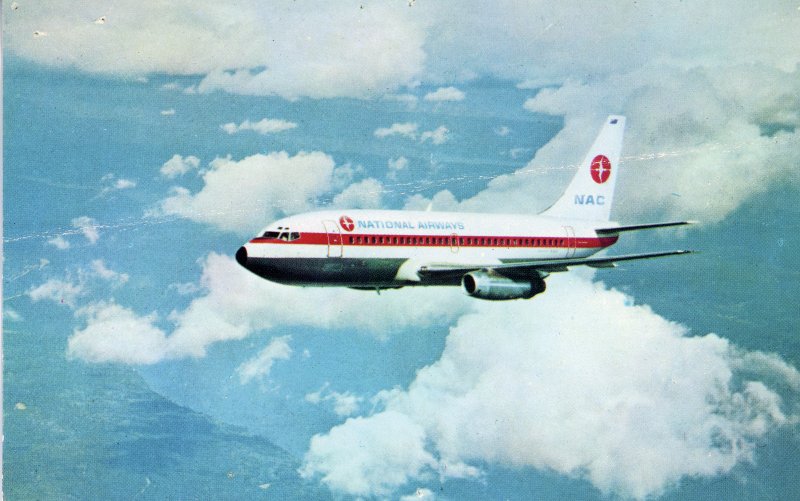
10 Apr 2010: BOEING 737-3H4 — SOUTHWEST AIRLINES CO

10 Apr 2010: BOEING 737-3H4 (N624SW) — SOUTHWEST AIRLINES CO

No fatalities • Los Angeles, CA, United States

Probable cause

The tug operator’s failure to comply with company procedures when parking an unoccupied baggage tug, and the failure of the tug’s seat switch to disengage the electric motor when weight was removed from the driver’s seat.

— NTSB Determination

Accident narrative

HISTORY OF FLIGHT

On April 9, 2010, about 1930 Pacific daylight time, a Boeing 737-3H4, N624SW, sustained substantial damage when it was struck by a runaway baggage tug at the Los Angeles International Airport, Los Angeles, California. At the time, the airplane had one engine operating and was being pushed back for its flight by a pushback tug. None of the 2 airline transport pilots, the 3 flight attendants, or the 104 passengers were injured. There were no reported ground injuries. The airplane was registered to and operated by Southwest Airlines as flight number 579, under the provisions of Title 14 Code of Federal Regulations Part 121. Visual meteorological conditions prevailed and an instrument flight rules flight plan was filed. The scheduled domestic passenger flight had a planned destination of the Tucson International Airport, Tucson, Arizona.

In a written statement, an airline ground service employee reported he drove a baggage tug close to gate 3, terminal 1, whereupon he exited the tug with the gear selector in forward and without setting the parking brake or turning off its electric motor. The employee reported he then walked around the tug to pick up two bags that were placed on the ramp. He picked up one of the bags and placed it on the passenger's seat of the unoccupied tug.

As the employee was handling the second bag, he observed that the tug had started to move and was traveling in the direction of a hydrant fueling cart that was parked between gates 3 and 5. The ground service employee ran after the tug to get aboard it and attempt to stop its movement. He attempted to apply the brakes but had to exit the tug before it impacted the airplane. He stated that prior to exiting the tug, he noticed that the first bag he had placed on the tug was on the floor and likely resting on the accelerator pedal. The company issued a Safety Advisory (SA 10-06) on the accident that stated that the bag fell off the seat and onto the tug’s accelerator.

Ground service employees located on the ramp near gate 3 stated that, initially, the tug rolled forward about 30 feet until it struck a hydrant fueling cart. The runaway tug veered off the side of the cart and continued rolling about 130 feet until it impacted the airplane’s number 1 engine. Subsequently, the tug impacted the left, lower side of the airplane's fuselage and belly, and proceeded beneath the airplane and came to a stop upon impacting the number 2 engine.

DAMAGE TO AIRCRAFT

Examination of the airplane by maintenance personnel revealed that the fuselage exhibited various skin punctures, dents and an internal frame shear tie was bent. The number 1 engine sustained damage to its cowl. The number 2 engine sustained damage to the engine, engine components, engine cowl and the engine pylon (including wing fairings, pylon structure, and mid-spar fitting to under wing fitting fuse pins).

PERSONNEL INFORMATION

The 47 year-old tug operator was on his first day back to work following an extended leave of about 2 months. He has been employed with the company for about 7 ½ years. He received his initial Powered Industrial Truck Training (PITT) on December 13, 2006, and his three year refresher PITT training was completed on October 16, 2009.

TESTS AND RESEARCH

Examination of the tug by a National Transportation Safety Board (NTSB) investigator revealed that the seat switch was inoperative. According to the tug operator’s guide, when weight is removed from the driver's seat, the seat switch is designed to open the electric circuit thereby disengaging the tug's electrical motor. The weight activated switch is located beneath the driver's seat. Post-accident testing revealed that the tug would not move while pushing down on the accelerator pedal if the parking brake was set or the brakes applied, or with the directional control level in the neutral position.

The company ground equipment general driving rules require unoccupied vehicles on the ramp to be placed in park or neutral, with the parking brake set and the engine turned off.

The company ground equipment general driving rules has a caution which states never to transport any items (e.g., baggage, freight) on top of or in the passenger seating area of a vehicle.

Contributing factors

  • cause Ground crew
  • cause Ground crew
  • cause Contributed to outcome

Conditions

Weather
VMC, wind 240/10kt, vis 8sm

Loading the flight search…

What you can do on Flight Finder

  • Search flights between any two airports with live fares.
  • By aircraft — pick a plane model (e.g. Boeing 787, Airbus A350) and see every route it flies from your origin.
  • Route map — click any airport worldwide to explore its destinations, or draw a radius to find nearby airports.
  • Global aviation safety — aviation accident database, 5,200+ records since 1980, with map and rankings by aircraft and operator.
  • NTSB safety feed — recent U.S. aviation accidents and incidents from the official NTSB CAROL database, updated daily.

Frequently asked questions

How do I search flights by aircraft type on FlightFinder?

Pick an aircraft model — Boeing 737, Airbus A320, A380, Boeing 787 Dreamliner and more — enter your origin airport, and FlightFinder shows every route that plane flies from there with live fares.

Which aircraft types can I filter by?

We support Boeing 737/747/757/767/777/787, the full Airbus A220/A319/A320/A321/A330/A340/A350/A380 family, Embraer E170/E175/E190/E195, Bombardier CRJ and Dash 8, and the ATR 42/72 turboprops.

Is FlightFinder free to use?

Search and schedules are free. Pro ($4.99/month, $39/year, or $99 one-time lifetime) unlocks the enriched flight card — on-time stats, CO₂ per passenger, amenities, live gate & weather — plus My Trips with push alerts.

Where does the route data come from?

Live schedules come from Amadeus, AeroDataBox and Travelpayouts. Observed routes (which aircraft actually flew a given city pair) are crowdsourced from adsb.lol ADS-B data under the Open Database License.