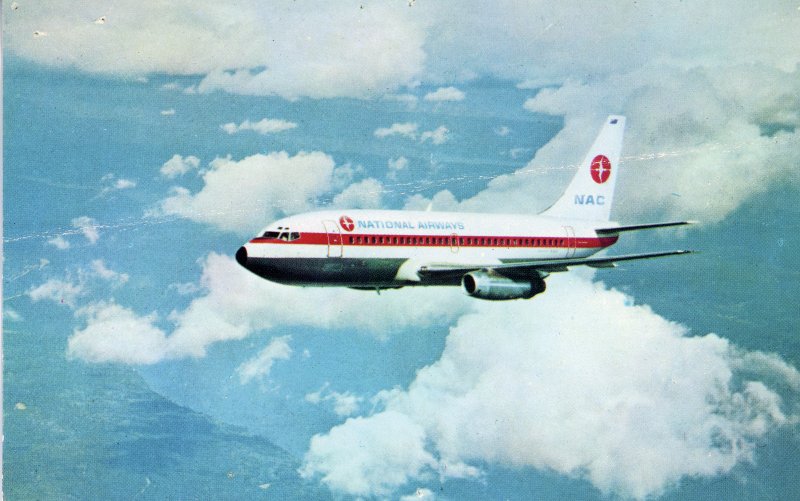
28 Apr 2010: BOEING 737-7H4 — SOUTHWEST AIRLINES CO

28 Apr 2010: BOEING 737-7H4 (N242WN) — SOUTHWEST AIRLINES CO

No fatalities • Houston, TX, United States

Probable cause

The failure of the local controller to issue control instructions necessary to ensure positive control/standard separation of traffic operating within the Class B airspace.

— NTSB Determination

Accident narrative

On Monday, April 28, 2010, at approximately 1225 central daylight time, a Boeing B737-700, N242WN, operating as Southwest Air Lines (SWA) flight 1322, and a Bell 207, N6YJ, operating as Sky2 were involved in a near mid-air collision at the William P. Hobby Airport (HOU), Houston, Texas. The B737 was departing from runway 12R, and the Bell 207 was departing from the south helipad on a north-bound departure route, when the aircraft came within approximately 125 feet vertically and 100 feet laterally at the departure end of runway 12R. The incident occurred during daytime visual meteorological conditions (VMC).

The B737 was on a regularly scheduled passenger flight from HOU to Baltimore/Washington International Thurgood Marshall Airport (BWI), and was operating under the provisions of 14 Code of Federal Air Regulation Part 121. The B737 had 135 passengers and a crew of five onboard. The Bell 207 was departing from the south of the airport on an established departure route, and was operating under the provisions of 14 Code of Federal Regulations Part 91. The Bell 207 had one person onboard. No injuries were reported on either aircraft. At approximately 1224, the local controller issued takeoff clearance to the B737 on runway 12R, with departure instructions to turn left to the north. Approximately, twenty six seconds later the Bell 207 contacted the tower requesting a departure route to the north (cougar departure) from the south helipad. The local controller directed the Bell 207 to “use caution from the south pad, cougar departure is approved”. Approximately three seconds later, the local controller instructed the Bell 207 that he had “no restrictions”. The pilot immediately read back the “no restrictions” instructions and proceeded on the departure route.

Approximately 20 seconds later the B737 reported to the tower “Hey tower that helicopter is going right across us” and “we made a pretty good duck to miss him”. Simultaneously the Bell 207 had conducted a sharp turn to the right to avoid overflying the departing B737. The aircraft came within an estimated 125 feet vertically and 100 feet laterally from each other, at approximately the 1,000-foot remaining section of runway 12R. The local controller did not issue traffic advisories to the B737 or the Bell 207. The B737 continued on the regularly scheduled flight to BWI, and the Bell 207 continued northbound to operate under visual flight rules (VFR).

Radar Data

Radar data for this report was obtained from the ASR-9 sensor located at HOU. A graphic showing a close-up view of the two aircraft and their minimum separation have been entered in the docket. The applicable separation standard between VFR and IFR aircraft in class B airspace is visual separation or 500 feet vertically and 1½ miles laterally. At the closest point the aircraft were separated by approximately 100 feet vertically and 125 feet laterally. The controller did not issue any traffic advisories or control instructions to establish and maintain visual separation.

Contributing factors

  • cause ATC personnel
  • cause ATC personnel

Conditions

Weather
VMC, wind 010/10kt, vis 10sm

Loading the flight search…

What you can do on Flight Finder

  • Search flights between any two airports with live fares.
  • By aircraft — pick a plane model (e.g. Boeing 787, Airbus A350) and see every route it flies from your origin.
  • Route map — click any airport worldwide to explore its destinations, or draw a radius to find nearby airports.
  • Global aviation safety — aviation accident database, 5,200+ records since 1980, with map and rankings by aircraft and operator.
  • NTSB safety feed — recent U.S. aviation accidents and incidents from the official NTSB CAROL database, updated daily.

Frequently asked questions

How do I search flights by aircraft type on FlightFinder?

Pick an aircraft model — Boeing 737, Airbus A320, A380, Boeing 787 Dreamliner and more — enter your origin airport, and FlightFinder shows every route that plane flies from there with live fares.

Which aircraft types can I filter by?

We support Boeing 737/747/757/767/777/787, the full Airbus A220/A319/A320/A321/A330/A340/A350/A380 family, Embraer E170/E175/E190/E195, Bombardier CRJ and Dash 8, and the ATR 42/72 turboprops.

Is FlightFinder free to use?

Search and schedules are free. Pro ($4.99/month, $39/year, or $99 one-time lifetime) unlocks the enriched flight card — on-time stats, CO₂ per passenger, amenities, live gate & weather — plus My Trips with push alerts.

Where does the route data come from?

Live schedules come from Amadeus, AeroDataBox and Travelpayouts. Observed routes (which aircraft actually flew a given city pair) are crowdsourced from adsb.lol ADS-B data under the Open Database License.