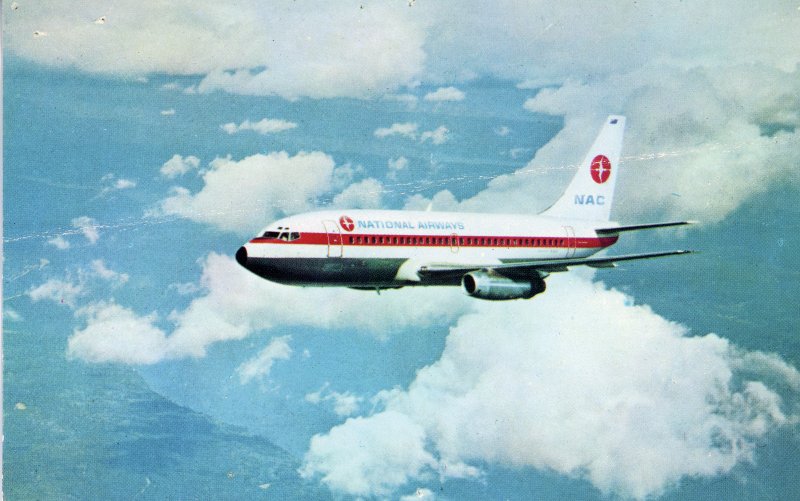
17 Feb 2014: BOEING 737 724 — United

17 Feb 2014: BOEING 737 724 (N23708) — United

No fatalities • Kaycee, WY, United States

Probable cause

an encounter with severe mountain wave turbulence during cruise flight.

— NTSB Determination

Accident narrative

On February 17, 2014, about 1254 mountain standard time (MST), United Airlines flight 1676, a Boeing 737-724, N23708, encountered severe turbulence about flight level 340 near Kaycee, Wyoming. Of the 120 passengers and crew onboard, two flight attendants were seriously injured, and one FA and nine passengers received minor injuries. The airplane was not damaged. The flight was operating under the provisions of 14 Code of Federal Regulations Part 121 as a regularly scheduled passenger flight from Denver International Airport (DEN), Denver, Colorado, to Billings Logan International Airport (BIL), Billings, Montana.

The flight departed DEN normally and climbed to a cruising altitude of flight level (FL) 380. The flight encountered light turbulence and the crew requested, and was granted, a descent to FL360 followed by a descent to FL340. The flight crew extinguished the seat belt sign when the ride smoothed out. Flight data recorder (FDR) data indicated the airplane was cruising about FL340 when it encountered an area of severe turbulence for about 55 seconds. The most severe turbulence occurred for about 10 seconds when the vertical acceleration fluctuated between about -1.23 g's and +2.05 g's, the lateral acceleration fluctuated between about -0.27 g's and +0.23 g's, the pitch fluctuated between about +5.8° (nose up) and -1.8° (nose down), and the roll fluctuated between about 14° left and 20° right.

At the time of the turbulence encounter, the two flight attendants (FA) in the forward galley and the one FA in the aft galley were injured. during the turbulence encounter and suffered. The aft FA was unconscious after the event and tended to by medical personnel passengers until landing. After being notified of the serious injuries, the flight crew declared an emergency with air traffic control and arranged for medical personnel to meet the aircraft at BIL. The three FAs were transported to the hospital. One FA was diagnosed with a fractured fibula; one was diagnosed with fractures of her scapula, a rib, cervical vertebrae, and thoracic vertebrae; and one was treated and released with minor injuries.

Contributing factors

  • cause Effect on personnel

Conditions

Weather
Unk

Loading the flight search…

What you can do on Flight Finder

  • Search flights between any two airports with live fares.
  • By aircraft — pick a plane model (e.g. Boeing 787, Airbus A350) and see every route it flies from your origin.
  • Route map — click any airport worldwide to explore its destinations, or draw a radius to find nearby airports.
  • Global aviation safety — aviation accident database, 5,200+ records since 1980, with map and rankings by aircraft and operator.
  • NTSB safety feed — recent U.S. aviation accidents and incidents from the official NTSB CAROL database, updated daily.

Frequently asked questions

How do I search flights by aircraft type on FlightFinder?

Pick an aircraft model — Boeing 737, Airbus A320, A380, Boeing 787 Dreamliner and more — enter your origin airport, and FlightFinder shows every route that plane flies from there with live fares.

Which aircraft types can I filter by?

We support Boeing 737/747/757/767/777/787, the full Airbus A220/A319/A320/A321/A330/A340/A350/A380 family, Embraer E170/E175/E190/E195, Bombardier CRJ and Dash 8, and the ATR 42/72 turboprops.

Is FlightFinder free to use?

Search and schedules are free. Pro ($4.99/month, $39/year, or $99 one-time lifetime) unlocks the enriched flight card — on-time stats, CO₂ per passenger, amenities, live gate & weather — plus My Trips with push alerts.

Where does the route data come from?

Live schedules come from Amadeus, AeroDataBox and Travelpayouts. Observed routes (which aircraft actually flew a given city pair) are crowdsourced from adsb.lol ADS-B data under the Open Database License.