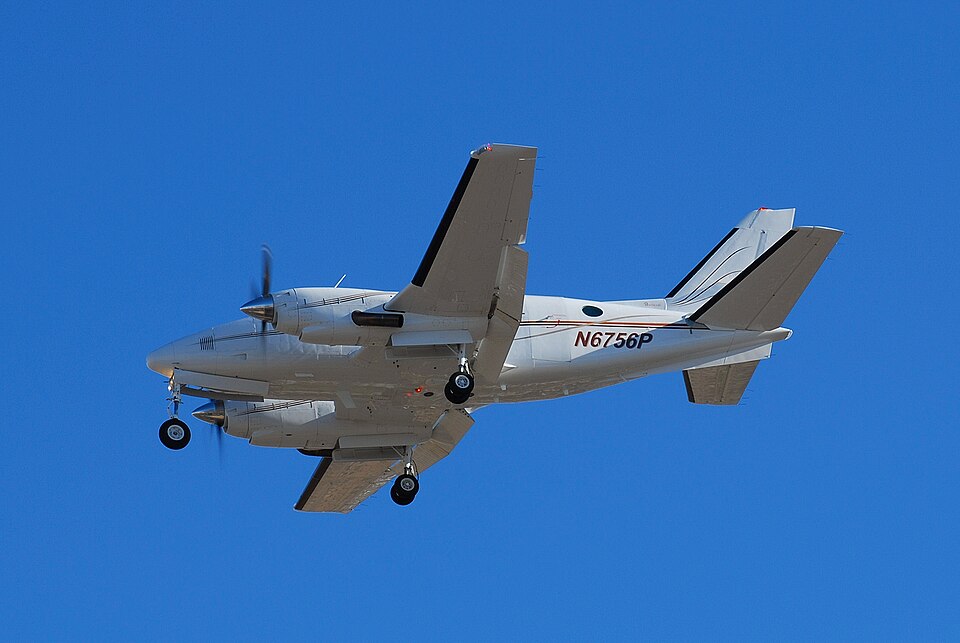
17 Jul 2014: BEECH B100 NO SERIES

17 Jul 2014: BEECH B100 NO SERIES (N6756P) — Unknown operator

No fatalities • Bakersfield, CA, United States

Probable cause

The failure of the 2nd-stage turbine wheel due to an improper repair of the 2nd-stage stator assembly, which the manufacturer does not consider a repairable item. Contributing to the incident was the designated engineering representative's approval of the repair process.

— NTSB Determination

Accident narrative

On July 16, 2014, at 2130 Pacific daylight time, a Beech B100, N6756P, was not damaged after it experienced an uncontained failure of its left engine in flight near Bakersfield, California. The commercial pilot was not injured. The airplane was operated as a Title 14 Code of Federal Regulations Part 91 personal flight.

The pilot reported to the NTSB investigator-in-charge (IIC) that he was cruising at flight level 190 (19,000 feet mean sea level (msl)), about 30 miles east-northeast of Bakersfield, when the left engine spooled back. The pilot executed the engine failure in-flight procedures and landed uneventfully at Meadows Field Airport. Post flight inspection revealed damage, consistent with an uncontained engine event, to the left nacelle and external damage to the left engine.

Examination of the engine by a Safety Board powerplants specialist and the engine manufacturer identified failure of the second stage turbine wheel. The 2nd stage turbine wheel assembly is a repairable assembly of two parts: the 2nd stage turbine wheel and the 2nd stage rotating labyrinth curvic seal (referred to as the 'knife edge seal ring' for the remainder of this report) and they are assembled using a tight interference fit. The knife edge seal ring was fractured and was separated from the 2nd stage turbine wheel hub. The knife edge seal ring was severely scored rotationally on the inner minor assembly faying diameter. Approximately 1/3 of the forward edge was heat eroded, resulting in a wedge shape eroded edge. The knife edge seal ring features 2 castellations, used for assembly ease. One castellation was completely hot gas eroded. A small crack was found on each of the inner corners of the remaining castellation. Only the hub portion of the 2nd stage turbine wheel was found with the web, platform and blades missing. A fractured surface through 360o remained. The forward outer curvic shaft diameter was severely rotationally scored, consistent with contact against the fractured knife edge seal ring. The curvic teeth of the forward and aft coupling were undamaged.

A materials laboratory evaluation of the thermally degraded 1st stage stator vanes revealed that weld repairs had been done to the part. Additionally, a microstructure analysis indicated that the metal had sustained operational temperatures in excess of 1650°F in 1840°F for a long period of time at the outboard leading edges and trailing edge regions respectively.

The 2nd stage stator assembly is an assembled part consisting of a main nozzle casting, onto which an outer support baffle with outer flange is brazed. The outer support baffle, when brazed onto the main nozzle casting, defines an inner cavity with the main nozzle casting that acts as a passage for compressor discharge air which cools the aft face of the 1st stage turbine wheel and the knife edge seal ring and honeycomb seal. Additionally, it is also a structural component since it is along the load path between the outer mounting flange/forward ring/baffle assembly to the nozzle casting. The braze thickness is a tightly controlled dimension during the fabrication of the part. Due to the close proximity of any weld repair of the leading edge of the vane to the forward braze joint presents a risk of oxidation and porosity of the braze material due to the high temperature induced in the braze joint as part of the welding repair.

The cooling airflow that is directed to the back face of the 1st stage turbine wheel and the knife edge seal ring comes from the compressor discharge air through the second stage stator outer housing, through the internal passages of the stator vanes and into the cavity. If areas of the braze joint became separated at any location around the circumference of the nozzle during service prior to the uncontained event, these areas would account for the loss of secondary cooling to the nozzle cavity. Instead of the cooling air being directed to the knife edge seal ring cavity, some of the air would escape the outer support cavity and be drawn to the lower pressure areas near the internal turbine temperature (ITT) probes and into the gas flow path. The loss of cooling flow will result in increased gas flow path ingress into the seal cavity and a corresponding rise in temperature. To further exacerbate the situation, the secondary cooling air passing by the ITT probes will cause a lower ITT indication than the true operating temperature of the engine, causing the pilot to be unaware of the increased engine operating temperature and the resulting insufficient cooling of the knife edge seal ring.

The 2nd stage turbine wheel outboard of the curvic hub exhibited wear/rub that reduced the web thickness by over 0.4 inches at the separation location. The wear/rub was consistent with contact against the fractured and expanded knife edge seal ring. The fracture surface exhibited indications of overload separation in the area of the reduced web thickness.

According to the Honeywell laboratory report, metal temperatures of the knife edge seal ring at the forward and aft ends were estimated to be 1446 °F and 1263 °F respectively. Intergranular fractures were initiated after exposure to these high temperatures. The nominal cavity temperature should be 1060°F.

Repair History

A review of the Authorized Release Certificate Federal Aviation Administration (FAA) Form 8130-3, Airworthiness Approval Tag reveals that the 2nd stage stator assembly, P/N 894528-15, S/N 0-01345-3454, was repaired by Texoma Turbines, in Durant, Oklahoma in accordance with process 72-IR-10 #9 and repair process specification (RPS) SP003 Rev. 2 on February 17, 2009.

At the time this part was repaired, the RPS applicability was for repairing only 2nd stage turbine stator assemblies part numbers 894528 -1, -2, -3, -5, -6, -10, and -11. It was not applicable to the -15 & -16 parts, making the event part, repaired by Texoma Turbines, unapproved.

According to Honeywell's Instructions for Continuing Airworthiness (ICA), there are no instructions or authorizations for vane weld repairs on the 2nd stage stator. When this component fails its respective service limit criteria, Honeywell guidance states that it should be removed from service.

The entire powerplants group chairman factual report is contained in the official docket of this investigation.

Record Retention Requirements

The owner of the repair station stated that he had destroyed the documentation of the repaired part after the FAA prescribed 2-year retention limit. The component was repaired February 17, 2009.

CFR Part 145.219 is applicable for the 2-year retention of records for Repair Station repaired parts/articles.

Sec. 145.219 Record keeping. (a) A certificated repair station must retain records in English that demonstrate compliance with the requirements of Part 43. The records must be retained in a format acceptable to the FAA. (b) A certificated repair station must provide a copy of the maintenance release to the owner or operator of the article on which the maintenance, preventive maintenance, or alteration was performed. (c) A certificated repair station must retain the records required by this section for at least 2 years from the date the article was approved for return to service. (d) A certificated repair station must make all required records available for inspection by the FAA and the National Transportation Safety Board. (Amdt. 145-27, Eff. 1/31/2004)

The regulatory requirement allows for the disposal of these records and the true history, which could have helped to understand the problem, is no longer available.

FAA Designated Engineering Representative (DER) Process and Procedures

The original technical documents used to substantiate the repair processes in the RPS could not be located, therefore a review of it could not be done. An FAA technical staff member interviewed from the Fort Worth ACO Branch, believed that there was no technical substantiation data written for this repair and that only the process steps were written by the original DER because the technical substantiation data was not included in the DER's approval. It is not known if the DER considered (1) the braze joint oxidation and porosity sensitivity to welding and heat-treatment heat or (2) of the impact of loss of cooling air of this part on any adjacent or downstream components of the engine.

The technical substantiation data should have been retained by the original DER and the original Repair Station; however, he was no longer a DER and not in the DER directory. Guidance for the retention of technical substantiation documents is defined in FAA Order 1350.15C, Records Management, Chapter 11, Flight Safety, Item 8113 Designated Engineering Representative states that original document destruction is not authorized. There is no guidance for the transfer of documents when a DER quits or dies.

Contributing factors

  • cause Turbine section — Failure
  • cause Incorrect service/maintenance
  • factor FAA/Regulator

Conditions

Weather
VMC, wind 300/11kt, vis 5sm

Loading the flight search…

What you can do on Flight Finder

  • Search flights between any two airports with live fares.
  • By aircraft — pick a plane model (e.g. Boeing 787, Airbus A350) and see every route it flies from your origin.
  • Route map — click any airport worldwide to explore its destinations, or draw a radius to find nearby airports.
  • Global aviation safety — aviation accident database, 5,200+ records since 1980, with map and rankings by aircraft and operator.
  • NTSB safety feed — recent U.S. aviation accidents and incidents from the official NTSB CAROL database, updated daily.

Frequently asked questions

How do I search flights by aircraft type on FlightFinder?

Pick an aircraft model — Boeing 737, Airbus A320, A380, Boeing 787 Dreamliner and more — enter your origin airport, and FlightFinder shows every route that plane flies from there with live fares.

Which aircraft types can I filter by?

We support Boeing 737/747/757/767/777/787, the full Airbus A220/A319/A320/A321/A330/A340/A350/A380 family, Embraer E170/E175/E190/E195, Bombardier CRJ and Dash 8, and the ATR 42/72 turboprops.

Is FlightFinder free to use?

Search and schedules are free. Pro ($4.99/month, $39/year, or $99 one-time lifetime) unlocks the enriched flight card — on-time stats, CO₂ per passenger, amenities, live gate & weather — plus My Trips with push alerts.

Where does the route data come from?

Live schedules come from Amadeus, AeroDataBox and Travelpayouts. Observed routes (which aircraft actually flew a given city pair) are crowdsourced from adsb.lol ADS-B data under the Open Database License.