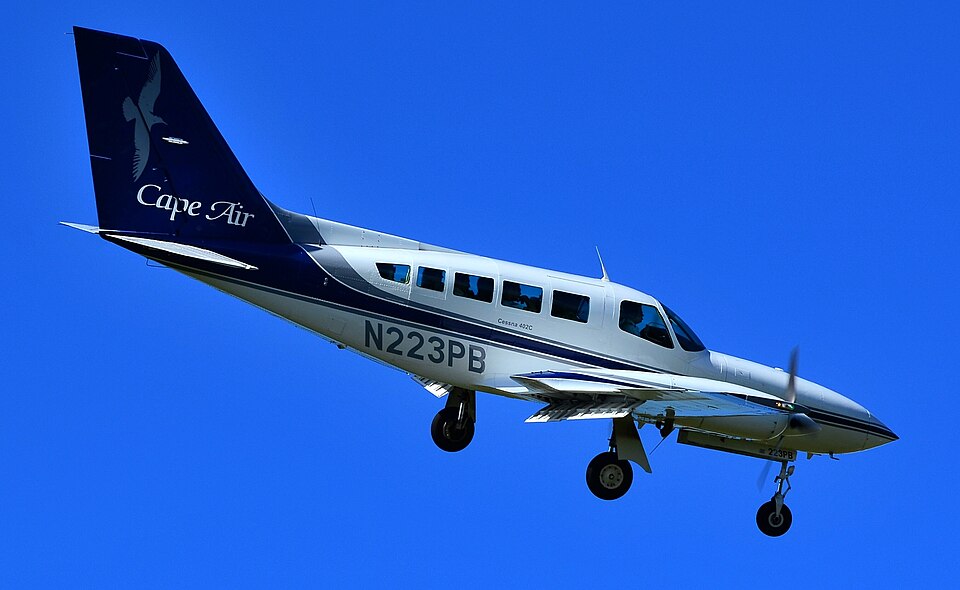
Accident Overview
On February 10, 2015, at approximately 1139 Atlantic standard time, a Cessna 402C, registration N223PB, was substantially damaged during a landing at Antonio Rivera Rodriguez Airport (TJVQ), Isla de Vieques, Puerto Rico. The airline transport pilot and six passengers were not injured. The aircraft was operated by Cape Air as flight number 2811 under Title 14 Code of Federal Regulations Part 135, and was registered to Hyannis Air Service Incorporated. Visual meteorological conditions prevailed, and a company visual flight rules flight plan had been filed for the scheduled commuter flight from Luis Munoz Marin International Airport (TJSJ), San Juan, Puerto Rico, which departed at 1115.
Landing and Incident
The pilot reported a normal landing approach to runway 9. Shortly after touchdown, the airplane encountered a gust of wind, causing the nose to veer to the right. Despite the pilot's attempt to regain directional control, the airplane skidded off the left side of the runway into the grass.
Post-Accident Examination
A Federal Aviation Administration (FAA) inspector conducted a post-accident examination. Damage included the left wing spar and a collapsed left main landing gear, which had broken away from the trunnion mounts along with the brake lines. Fresh tire skid marks were observed on the runway and in the grass leading to the aircraft's final position. The inspector noted no anomalies with the brake or landing gear systems.
Weather Conditions
The nearest weather reporting station, Jose Aponte de la Torre Airport (TJRV/TJNR) in Ceiba, Puerto Rico, located 11 miles northwest of the accident site at an elevation of 38 feet, reported at 1153: winds from 180 degrees magnetic at 20 knots, visibility 10 statute miles, few clouds at 2,600 feet, temperature 29°C, dew point 22°C, and altimeter setting 29.91 inches of mercury. According to the Cessna 402C pilot's operating handbook, the maximum demonstrated crosswind velocity is 15 knots.