Accident Overview
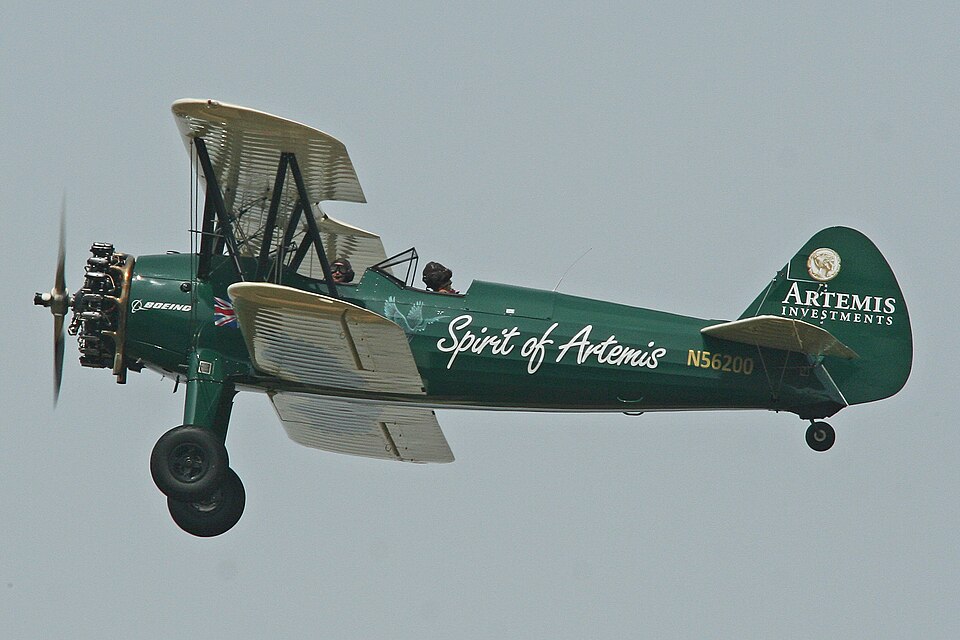
On May 11, 2016, at about 1710 mountain standard time, a Boeing B75N1, registration N56200, was substantially damaged during a forced landing following a partial loss of engine power during takeoff initial climb at the Winslow-Lindbergh Regional Airport (INW), Winslow, Arizona. The airplane was registered to 3G Classic Aviation LLC and operated by the pilot under Title 14 Code of Federal Regulations Part 91. The private pilot and her passenger were not injured. Visual meteorological conditions prevailed, and no flight plan was filed for the personal flight. The cross-country flight was originating at the time of the accident with an intended destination of Phoenix, Arizona.
Pilot Report
In a written statement to the National Transportation Safety Board (NTSB) investigator-in-charge (IIC), the pilot reported that prior to takeoff, she conducted an engine run up and pre-takeoff checks, which included leaning for density altitude, and conducted a static power check, which was in the normal range. During takeoff from runway 29, the airplane accelerated and climbed out normally, with the tachometer indicating 2,250 rpm. As the airplane was about 50 feet above ground level, it began to descend. To avoid powerlines, the pilot performed a left turn to maintain clearance and verified the throttle, mixture, propeller, fuel, and carburetor heat settings. Subsequently, the airplane struck the ground, rolled about 20 feet, the right main landing gear impacted vegetation, and the airplane cartwheeled. The pilot reported that just prior to landing, she observed the tachometer indicating 2,000 rpm. Earlier in the day, they had flown three flights, totaling about 5 hours of flight time, including uneventful takeoffs from two airports with a higher density altitude.
Aircraft Damage
Postaccident examination of the airplane by the pilot revealed that all four wings, tail, and fuselage were structurally damaged. The airplane was recovered to a secure location for further examination.
Wreckage Examination
Examination of the recovered wreckage revealed that the upper and lower wings were removed by the wreckage recovery company to facilitate transport. The empennage and right gear leg were also separated from the fuselage. The engine, a Lycoming R-680-E3B rated at 300 horsepower, remained attached to the fuselage via its mounts. The fuselage was hoisted by a forklift, and the right gear leg was subsequently removed. Throttle, mixture, and propeller control continuity was established from the rear cockpit controls to the engine.
Front spark plugs were removed and examined. All nine spark plugs were intact and undamaged. The number one and two spark plugs exhibited black deposits within the electrode area, and the remaining spark plugs exhibited gray deposits. All engine accessories remained attached and exhibited no damage. The carburetor was intact with all linkages secure. The carburetor fuel screen was removed, and a gray/tan liquid was drained from the carburetor; the fuel screen was free of debris. The liquid smelled similar to 100 Low Lead fuel and tested negative for water. The air filter was removed, and a red dirt substance was observed within the housing, but the filter element appeared mostly free of debris. The gascolator screen and bowl were free of debris.
The propeller remained attached to the crankshaft and exhibited an approximate 20-degree bend aft from about mid-span on either blade.
Engine Run
The spark plugs and carburetor fuel screen were reinstalled. About 8 gallons of fuel was added to the center wing fuel tank. The engine was primed using the airframe fuel pump and subsequently started. It was run for about 10 minutes at various power settings. During the engine run, a maximum power setting of 2,200 rpm and 28 inches of manifold pressure was obtained. A magneto test was performed at 1,500 rpm with a drop of about 75 to 100 rpm noted. The engine was manually shut off using the mixture.
Density Altitude
Using the reported airport elevation of 4,941 feet and recorded weather conditions from about 14 minutes prior to the accident, the NTSB IIC calculated the density altitude to be about 7,223 feet and a pressure altitude of 4,757 feet.