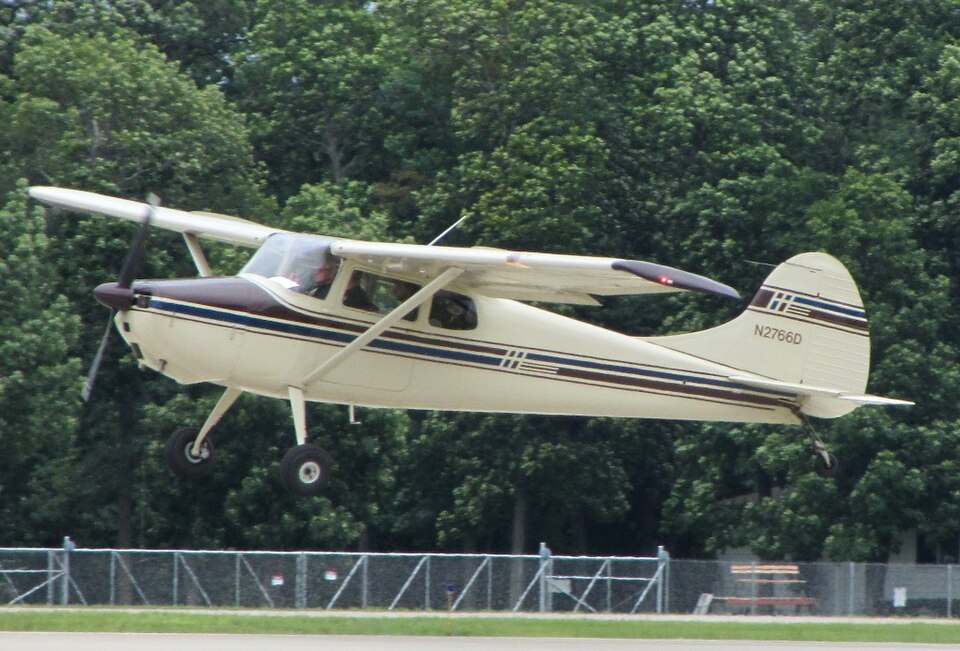
Accident Overview
On November 8, 2017, about 1630 central standard time, a Cessna 170B airplane, registered N2766D, experienced a flight control failure while landing at Dacy Airport (0C0) in Harvard, Illinois. The private pilot was not injured. The personal flight was conducted under 14 Code of Federal Regulations Part 91 in visual meteorological conditions. No FAA flight plan had been filed. The flight departed Poplar Grove Airport (C77) at about 1615 and was en route to Dacy Airport.
According to the pilot, during the landing flare to runway 27 (3,589 ft. by 105 ft., turf), about 6 to 12 inches above the runway, he experienced a "complete loss of flight controls," and the nose of the airplane dropped. The main landing gear settled to the runway; during the landing roll the pilot reached the copilot control yoke and completed the landing roll without further incident.
Examination Findings
An examination of the airplane revealed that the rivet in the universal joint (u-joint) for the pilot-side control tee (flight control yoke) had failed. The u-joint assembly was sent to the NTSB Materials Laboratory for further examination and testing.
As received, the swivel block on half of the u-joint could be rotated, but the center pin could not be rotated about its main axis. Galling and material transfer wear scars were observed on the mating surfaces of the swivel block. The center pin exhibited wear scars and accumulated particulate debris consistent with adhesive wear. The outside diameter of the half pins showed material loss and wear debris deposits. The ends of the half pins that contacted the center pin exhibited adhesive wear. The rivet shank fractured due to fatigue crack propagation consistent with reversed bending. The vertical and horizontal yoke ears exhibited galling and adhesive wear signatures. No lubricant was visible during the examination.
Engineering data from McFarlane Aviation indicated the block was manufactured from 17-4PH stainless steel alloy, and the rivet was 300-series stainless steel with a nominal diameter of 3/32.
Maintenance History
According to airplane maintenance records, the universal joint had been replaced with a McFarlane Aviation, Inc. universal joint (part number MC6183) on April 1, 2016. The airplane accumulated 119.1 flight hours between replacement and the failure. The airplane was sold in October 2017, and the new owners flew it approximately 6 hours prior to the failure without detecting any change in control characteristics.
According to the Cessna Service Manual, the joint should be inspected at every annual/100-hour inspection for "…security, binding, cracks, looseness, and restricted travel…" Lubrication requirements per the Cessna 170B owner's manual are as required or every 1,000 hours.
Manufacturer Service Bulletin
McFarlane Aviation, Inc. reported that 500 u-joints were manufactured in a batch that could potentially experience seizure and subsequent failure. On December 11, 2017, McFarlane issued Service Bulletin SB-9, Revision A, calling for "mandatory and immediate" inspection of the u-joint, and replacement within 100 flight hours (or 1 calendar year) after initial inspection if the u-joint passed. Immediate replacement was required for u-joints that did not pass. The SB-9 also recommended a rubber boot or sleeve to prevent debris entry and maintain lubrication, though this was not part of the original Cessna design and was not required.