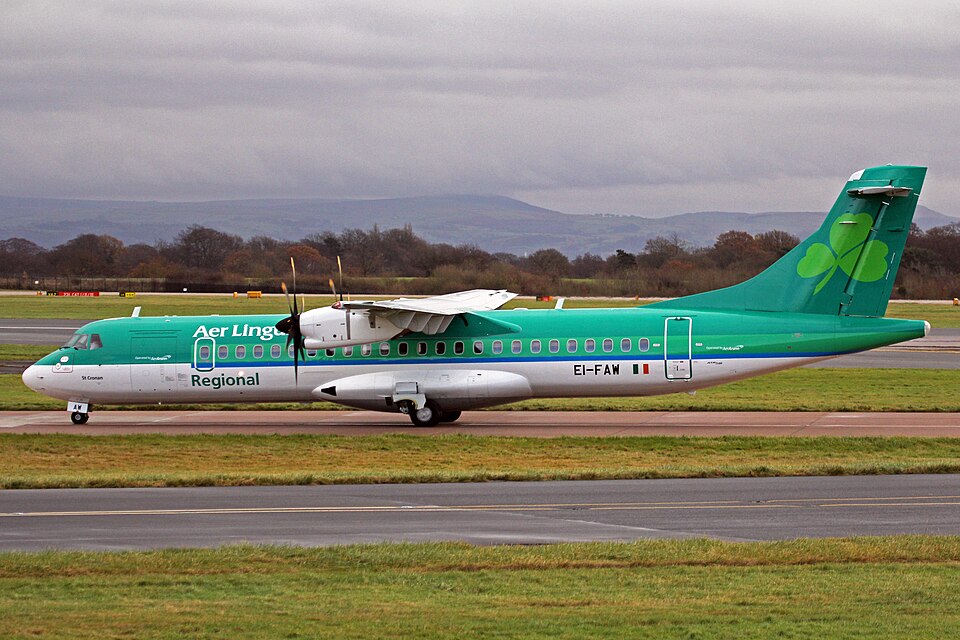
History of the Flight
On 2 September 2016, an ATR 72-212A, registration EI-FAW, was conducting a scheduled passenger flight from Edinburgh Airport (EGPH) to Dublin Airport (EIDW). The co-pilot was the pilot flying and the commander was the pilot monitoring. The aircraft departed EGPH at 15:47 UTC and entered the Dublin Control Area at 16:29 UTC.
Air Traffic Control (ATC) cleared the aircraft to descend to 3,000 ft and route to waypoint LAPMO. The aircraft was then directed to waypoint MAXEV for an Instrument Landing System (ILS) approach to Runway 28, with a further descent to 2,000 ft. A speed restriction of 190 kts was given, later reduced to 160 kts upon reaching MAXEV.
At 16:38 UTC, the aircraft reached 2,000 ft approximately 2.5 NM before MAXEV, with a descent rate of 2,000 ft per minute and an indicated airspeed (IAS) of 185 kts. At 16:39:07 UTC, the aircraft passed MAXEV at 1,670 ft and 181 kts IAS while turning right onto a heading of 284°. The descent rate then reduced to 1,200 ft per minute.
At 16:39:26 UTC, as the aircraft passed 1,200 ft, a Minimum Safe Altitude Warning (MSAW) activated on the ATC radar screen. The ATCO asked the crew to confirm established on the localiser. The commander responded that they were going around. The aircraft continued descending to a minimum altitude of 1,082 ft at 1.75 NM west of MAXEV, with an IAS of 168 kts. At this point, the expected altitude on the ILS glideslope was 1,975 ft. During the approach, flaps remained at zero degrees and the landing gear was up.
The aircraft then executed a go-around, climbing to 3,000 ft. During the climb, flaps were selected from zero to 15 degrees at 1,390 ft and 177 kts, then retracted to zero after three minutes. The ATCO provided radar vectors for a second ILS approach, which was completed without incident. The aircraft landed and taxied to the parking stand. Passengers disembarked normally.
Notification and Investigation
The ATCO submitted a Mandatory Occurrence Report on 5 September 2016 describing the MSAW activation and the aircraft's descent. The flight crew had submitted a report on 2 September 2016 stating the go-around was due to an unstable approach caused by a Travel Limitation Unit (TLU) fault. The operator did not initially notify the AAIU because the crew's report did not match the ATCO's description of events. Upon reviewing the ATCO's report, the AAIU commenced an investigation.
Injuries and Damage
No injuries were reported to the Investigation. The aircraft was undamaged.
Aircraft Information
The aircraft, an ATR 72-212A (commercial designation ATR 72-600), serial number 1122, was manufactured in 2013. It is a twin-turbo-prop aircraft powered by two Pratt & Whitney PWC 127M engines. The ATR 72-212A '600 version' features upgraded cockpit avionics (New Avionic Suite). The rudder control system includes a Travel Limitation Unit (TLU) to prevent excessive rudder movement at high speeds, controlled by the Multi-Function Computer.