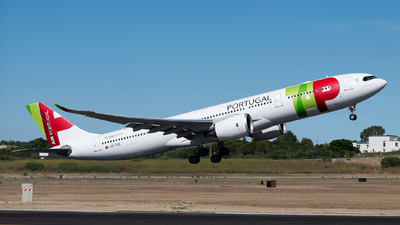
Event Description
On April 12, 2022, the flight crew of an Airbus A330-900, registration CS-TUL, operated by TAP Air Portugal, prepared for a take-off from runway 23 at Luanda International Airport (FNLU) bound for Lisbon Airport (LPPT). Due to ongoing infrastructure works, the take-off was performed at intersection E.
After lining up and starting the take-off roll, the flight crew observed that the end of the runway was approaching. The pilot-in-command applied full power (TOGA), reaching rotation speed (Vr) near the end of the runway. The cabin crew reported dust observed outside the aircraft during rotation, a condition later confirmed by the control tower.
The aircraft proceeded to its destination and landed without any reported anomalies following a detailed maintenance inspection.
Injuries and Damage
No injuries were recorded. The aircraft sustained no damage.
Relevant Findings
The operator's Flight Operations and Engineering departments, along with Safety, had developed procedures to mitigate risks before the start of the Luanda airport works, including a Fleet Tech Com (No. 04/2022/A330 of February 28, 2022). Measures included daytime operations, captain experience requirements of 500 hours on type, and mandatory self-briefing diagrams for ground routes.
The crew reported performing and reviewing take-off calculations several times but did not identify intersection E as the correct take-off position, instead calculating performance for the entire runway length. Using FLX Temp (85% N1) for the full runway, they later selected TOGA (≈94% N1) at 147 knots, achieving lift-off at 163 knots near the runway edge. The take-off mass was 191,314 kg.
GPIAAF Comments
The investigation noted that incorrect trim or flap settings, erroneous performance calculation parameters, late runway changes, or take-off from an intersection with data for the full runway are examples of safety events that increase the risk of runway overrun or tail strikes. Such events can be avoided by complying with Standard Operating Procedures (SOP) and ensuring crosschecks. The Airbus TOS2 (Take-off Surveillance second generation) system, which checks runway positioning and performance compatibility, was not installed on the operator's A330neo fleet.
Operator Mitigation Actions
After the event, the operator reinforced mitigation measures for Luanda operations and issued a new Fleet Tech Com (No. 10/2022/A330 of April 13, 2022). Actions included updating the EFB TOP TR RWY 23 (TWY E) for better information presentation and conducting a feasibility study for retrofitting the A330neo fleet with TOS2.
Conclusion
No probable cause was stated in the report.