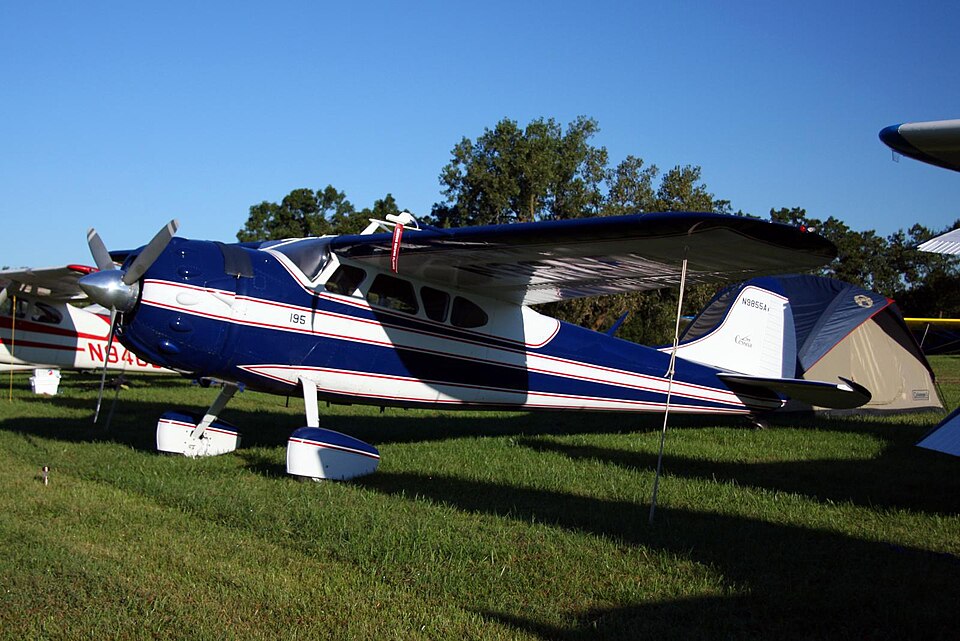
Accident Overview
On July 30, 2023, at 2030 eastern daylight time, a Cessna 195A, N9855A, sustained substantial damage during a ground loop on landing at an airport near Laconia, New Hampshire. The airline transport pilot was not injured. The airplane was operated as a Title 14 Code of Federal Regulations Part 91 personal flight.
Pilot Statement
In a written statement, the pilot reported that he had just completed the final, 3-hour leg of a multi-leg cross-country flight and landed 1 hour after official sunset. He described a “routine” 3-point landing in the tailwheel-equipped airplane under “perfect” weather conditions. During the landing roll, about 1,200 ft down runway 26, the airplane “suddenly turned sharply to the right.” The pilot applied “full brakes” but was unable to arrest the turn. The airplane departed the right side of the runway and came to rest on a 160° heading, with the left main landing gear folded beneath the fuselage.
Investigation
No witnesses were present. Surveillance video of the final approach, captured by a camera about 1 mile from the approach end of the runway, lacked the definition to depict the accident sequence. In an interview with a Federal Aviation Administration (FAA) aviation safety inspector, the pilot initially reported that the airplane ground looped, then later suggested the “left main gear wheel locked up” and then suggested the “right brake likely stuck.”
Photographs of the accident site showed dark, arcing tire marks on the runway surface that continued into the grass and ended at the left main landing gear. Tire marks aligned with the right main landing gear began in the grass at the runway edge and terminated at the right main landing gear tire. Buckling of the right wing, fuselage, and the main landing gear mount structure revealed substantial damage in those areas.
Pilot and Aircraft Information
The pilot held airline transport and flight engineer certificates with ratings in both single and multiengine airplanes. He completed BasicMed requirements on June 3, 2022, and declared 20,941 total flight hours, with 953 hours in the accident airplane make and model. According to the FAA inspector and the pilot’s reported flight time, the pilot lacked recent night flight time experience.
The airplane, manufactured in 1950, was powered by a Jacobs R755S, 350-horsepower engine. Its most recent annual inspection was completed May 23, 2023, at 3,370.5 total aircraft hours.
Examination Findings
An FAA inspector examined the airplane and found no preimpact mechanical anomalies. The left main landing gear wheel and tire, mounting hardware, and shims were forwarded to the NTSB Materials Laboratory. Examination revealed that two of the three mounting studs were fractured with features consistent with “shear/bending overstress fractures.” The third stud remained intact, but its attachment nut was missing, and the threads were “stripped” and “smeared.”