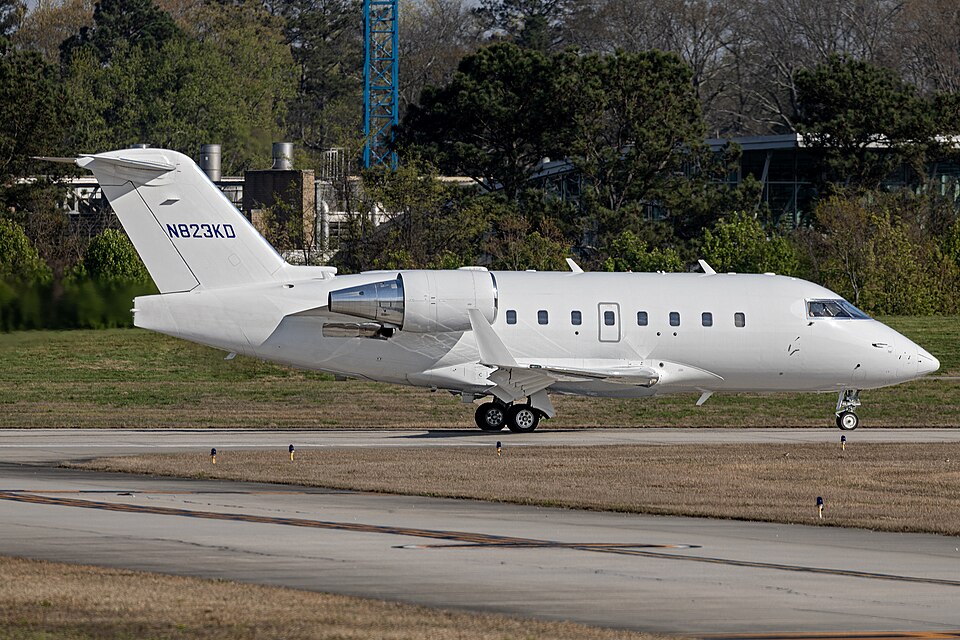
9 Feb 2024: BOMBARDIER INC CL-600-2B16 — Hop-A-Jet

9 Feb 2024: BOMBARDIER INC CL-600-2B16 (N823KD) — Hop-A-Jet

2 fatalities • Naples, FL, United States

Probable cause

Corrosion of both engines’ variable geometry (VG) system components, which led to their operation in an off-schedule position and resulted in near-simultaneous sub-idle rotating compressor stalls on approach, subsequent loss of thrust in both engines, and an off-airport landing. Contributing to the accident was inadequate fault isolation guidance from the engine manufacturer, which prevented the identification of corrosion buildup in VG system components during troubleshooting of hung start events of both engines about 1 month before the accident.

— NTSB Determination

Accident narrative

HISTORY OF FLIGHTOn February 9, 2024, about 1511 eastern standard time, a Bombardier CL-600-2B16 airplane, N823KD, was destroyed when it was involved in an accident near Naples, Florida. The two airline transport pilots were fatally injured. The cabin attendant and the two passengers sustained minor injuries, and one person on the ground suffered a minor injury. The airplane was operated by Ace Aviation Services (doing business as HopAJet) as a Title 14 Code of Federal Regulations Part 135 on-demand passenger flight. The airplane was returning to Naples Municipal Airport (APF), Naples, Florida, from Ohio State University Airport (OSU), Columbus, Ohio, where it had flown earlier in the day. The airplane was serviced with 350 gallons of fuel before departure from OSU. ADS-B flight track data and downloaded cockpit voice recorder (CVR) communications revealed that the flight crew contacted the APF air traffic control tower while on a right downwind leg of the approach to the airport and maneuvering for a 5-mile final approach to runway 23. About 1509, the tower controller cleared the flight to land. The airplane was about 6.5 miles north of APF, about 2,000 ft geometric altitude, and 166 kts ground speed, as it turned onto final approach for runway 23. Review of the data recovered from the airplane’s flight data recorder revealed that the first of three master warnings was recorded at 1509:33 (L ENGINE OIL PRESSURE), with the second immediately following at 1509:34 (R ENGINE OIL PRESSURE), and the third at 1509:40 (ENGINE). These warnings were annunciated by illumination of a “Master Warning” light on the glareshield, a corresponding red message on the EICAS, and a triplechime voice advisory (“Engine oil”). Twenty-three seconds later, at 1510:03, about 1,000 ft pressure altitude and 122 kts, on a shallow intercept angle for the final approach course, the crew announced, “…lost both engines… emergency… making an emergency landing” (see figure 1). The tower controller acknowledged the transmission and cleared the airplane to land. At 1510:12, about 900 ft and 115 kts, the crew replied, “eh we’re clear to land but we’re not gonna make the runway uh we’ve lost both engines.”

Figure 1. ADS-B ground track (blue dots) with annotations of specific events during the approach, including time and the airplane’s geometric altitude and ground speed (source: FAA). There were no further transmissions from the flight crew, and the ADS-B track data ended at 1510:47, which was the time the airplane touched down on Interstate 75 in Naples, Florida. Dashcam video from a vehicle driving in a southerly direction on Interstate 75 captured the final seconds of the flight. The airplane descended into the camera’s view while in a shallow left turn and then aligned with traffic travelling in the southbound lanes of Interstate 75. The left main landing gear touched down first in the center of the three lanes, and then the right main landing gear touched down in the right lane. The airplane continued to the right, through the breakdown lane and down a slight embankment, then struck a non-frangible highway sign, causing it to veer further right and impact a concrete sound barrier wall. The airplane was then obscured by dust, fire, smoke, and debris until the video ended. After the airplane came to rest, the cabin and emergency exits were blocked by fire and the cabin attendant coordinated the successful egress of her passengers and herself through the baggage compartment door in the tail section of the airplane. AIRCRAFT INFORMATIONAccording to FAA and maintenance records, the airplane was manufactured in 2004 and was powered by two GE CF34-3B turbofan engines. It was operated by the previous owner from 2005 to 2020, during which time it was primarily based at Grantley Adams International Airport (BGI), Bridgetown, Barbados. The airplane was registered to the accident operator on May 21, 2020. It was then transferred to the accident operator’s FAA Part 135 certificate on June 3, 2021. At that time, the airplane and engines had accumulated about 6,939 hours since new (TSN) and 2,653 cycles since new (CSN). When the airplane departed OSU on the day of the accident, it had accumulated about 9,761 hours TSN and 4,444 CSN. During its duration with the accident operator, the airplane was primarily based at Fort Lauderdale Executive Airport (FXE), Fort Lauderdale, Florida, about 4 nautical miles west of the shoreline of the Atlantic Ocean. The airplane and engines were maintained under the operator’s FAA approved Continued Airworthiness Maintenance Program, which was established in accordance with Bombardier’s CL-604 Time Limits/Maintenance Checks Manual and GE’s service manual (SM) SEI-780. The accident engines were maintained and inspected on an “On-Condition” basis. (“On-Condition” refers to the corrective action required when testing or inspection finds an indication of a potential problem.) Previous Hung Start Event On January 15, 2024, (25 days before the accident), pilots reported intermittent hung starts on both engines while preparing for taxi. (A “hung start” is identified by light-off followed by abnormally slow acceleration and rotor speed [rpm] stabilization below idle. Hung starts may result from a variety of conditions, such as starter air pressure too low to accelerate the engine to a self-sustaining speed, premature starter deactivation, a poorly performing or damaged compressor, incorrect scheduling of bleeds or stator vane position, and fuel issues.) As part of the troubleshooting, fuel was drained from the engines and tested for contamination; none was found. The operator, in consultation with the engine manufacturer, spent several days troubleshooting the engines. Both engine fuel filters were replaced, and visual inspection of the old filters revealed no defects. On the following day (January 16, 2024), both engines started normally, and multiple functional checks were performed with no anomalies noted. The operator used GE SM SEI-780 72-00-00 (dated February 1, 2022 and titled “Fault Isolation 07 Hung Start or Slow Start”) to troubleshoot the engine. The troubleshooting fault isolation logic flowchart had 27 main logic blocks requiring a “YES” or “NO” response. Main logic block 21 referenced MP 68 to pressure check the VG system. The MP 68 pressure test was one of the last items in the troubleshooting tree. During the troubleshooting of the hung start events, MP 68 was not performed because the criteria of the flowchart were met to discontinue the testing (that is, the engines started and no anomalies were identified). With the concurrence of the engine manufacturer, the airplane was returned to service and both engines started and operated without issues for 33 flights over the next 25 days until the accident. Engine Trend Monitoring The operator participated in an engine trend monitoring program managed by the engine manufacturer. Certain engine parameters (such as N1 and N2 speeds, vibration levels, and oil temperature and pressure) and ambient conditions (such as airspeed and altitude) were collected and recorded for every flight, which the engine manufacturer analyzed to calculate takeoff exhaust gas temperature hot day margin and to monitor shifts in engine performance. For the CF34-3B task-oriented “On-Condition” maintenance program, Service Bulletin (SB) 71-1000 R01 directed the download and calculation of engine performance every 50 flight cycles for early detection of engine deterioration. The engine manufacturer did not issue any notices to the operator regarding trend monitoring data before or after the January 2024 hung starts on the accident engines. AIRPORT INFORMATIONAccording to FAA and maintenance records, the airplane was manufactured in 2004 and was powered by two GE CF34-3B turbofan engines. It was operated by the previous owner from 2005 to 2020, during which time it was primarily based at Grantley Adams International Airport (BGI), Bridgetown, Barbados. The airplane was registered to the accident operator on May 21, 2020. It was then transferred to the accident operator’s FAA Part 135 certificate on June 3, 2021. At that time, the airplane and engines had accumulated about 6,939 hours since new (TSN) and 2,653 cycles since new (CSN). When the airplane departed OSU on the day of the accident, it had accumulated about 9,761 hours TSN and 4,444 CSN. During its duration with the accident operator, the airplane was primarily based at Fort Lauderdale Executive Airport (FXE), Fort Lauderdale, Florida, about 4 nautical miles west of the shoreline of the Atlantic Ocean. The airplane and engines were maintained under the operator’s FAA approved Continued Airworthiness Maintenance Program, which was established in accordance with Bombardier’s CL-604 Time Limits/Maintenance Checks Manual and GE’s service manual (SM) SEI-780. The accident engines were maintained and inspected on an “On-Condition” basis. (“On-Condition” refers to the corrective action required when testing or inspection finds an indication of a potential problem.) Previous Hung Start Event On January 15, 2024, (25 days before the accident), pilots reported intermittent hung starts on both engines while preparing for taxi. (A “hung start” is identified by light-off followed by abnormally slow acceleration and rotor speed [rpm] stabilization below idle. Hung starts may result from a variety of conditions, such as starter air pressure too low to accelerate the engine to a self-sustaining speed, premature starter deactivation, a poorly performing or damaged compressor, incorrect scheduling of bleeds or stator vane position, and fuel issues.) As part of the troubleshooting, fuel was drained from the engines and tested for contamination; none was found. The operator, in consultation with the engine manufacturer, spent several days troubleshooting the engines. Both engine fuel filters were replaced, and visual inspection of the old filters revealed no defects. On the following day (January 16, 2024), both engines started normally, and multiple functional checks were performed with no anomalies noted. The operator used GE SM SEI-780 72-00-00 (dated February 1, 2022 and titled “Fault Isolation 07 Hung Start or Slow Start”) to troubleshoot the engine. The troubleshooting fault isolation logic flowchart had 27 main logic blocks requiring a “YES” or “NO” response. Main logic block 21 referenced MP 68 to pressure check the VG system. The MP 68 pressure test was one of the last items in the troubleshooting tree. During the troubleshooting of the hung start events, MP 68 was not performed because the criteria of the flowchart were met to discontinue the testing (that is, the engines started and no anomalies were identified). With the concurrence of the engine manufacturer, the airplane was returned to service and both engines started and operated without issues for 33 flights over the next 25 days until the accident. Engine Trend Monitoring The operator participated in an engine trend monitoring program managed by the engine manufacturer. Certain engine parameters (such as N1 and N2 speeds, vibration levels, and oil temperature and pressure) and ambient conditions (such as airspeed and altitude) were collected and recorded for every flight, which the engine manufacturer analyzed to calculate takeoff exhaust gas temperature hot day margin and to monitor shifts in engine performance. For the CF34-3B task-oriented “On-Condition” maintenance program, Service Bulletin (SB) 71-1000 R01 directed the download and calculation of engine performance every 50 flight cycles for early detection of engine deterioration. The engine manufacturer did not issue any notices to the operator regarding trend monitoring data before or after the January 2024 hung starts on the accident engines. WRECKAGE AND IMPACT INFORMATIONExamination of the accident site revealed tire marks on the southbound lanes of Interstate 75 consistent with the left main landing gear (see figure 2). The airplane came to rest about 1,000 ft past the initial touchdown point, upright in the grass area between the breakdown lane and the sound barrier wall and facing north, opposite the direction of travel.

Figure 2. Initial touchdown point on Interstate 75. The forward portion of the fuselage was consumed by postimpact fire (see figure 3). All major components of the airplane were accounted for at the scene, and the ground surrounding the wreckage was fuel-soaked, having an odor consistent with Jet A fuel. The cockpit center console was found separated from the main wreckage. Both engine thrust levers were found near the IDLE stop position. The flap selector handle was found in a position consistent with 45° flap extension.

Figure 3. Main wreckage as found. The left wing was nearly entirely consumed by postimpact fire. The flap actuator jack screws were consistent with 45° flap extension. The left wing fuel boost pump was not found. The right wing exhibited leading edge damage consistent with impact with the vertical steel I-beam of a highway sign; the front spar was severed in the area of the impact. The outer portion of the wing was impact-separated; the inboard portion was thermally damaged. The right wing fuel boost pump was located in the vicinity of the right wing and right main landing gear and exhibited thermal damage. The tail section of the airplane was largely intact but was damaged by the postimpact fire. The aft-mounted engines were secure in their mounts. The vertical stabilizer, horizontal stabilizer, and elevator control surfaces were all intact. About 16 ounces of liquid with an odor and appearance consistent with Jet A fuel was drained from the aft tail fuel tank; the sample contained about ½ ounce of what appeared to be water. The auxiliary power unit fuel filter bowl was removed for visual inspection of the fuel and fuel filter. No debris was noted in the drained fuel and the filter appeared clean. The fuel was retained for further analysis. The engines and their respective pylons were cut from the airplane to facilitate recovery. A fuel sample was collected from the No. 1 engine main supply when the line was cut; however, no fuel was released when the No. 2 engine main supply line was cut. No. 1 (Left) Engine The left engine fan and core assemblies displayed thermal damage consistent with postimpact fire, with some of the cowling consumed. When viewed from the front, all fan blades appeared full length and intact, with no evidence of impact damage to the fan blade leading edges. When viewed from the rear, the stage 4 low-pressure turbine blades appeared intact, straight, and undamaged. The cowl doors were opened to facilitate examination; there was no evidence of case uncontainment. No thermal distress was noted aft of the gearbox. The MFC throttle lever spindle, lever arm, and push/pull rod were connected to the throttle linkage/bellcrank and appeared undamaged. The red alignment marks on the throttle lever spindle and lever arm were consistent with an IDLE throttle position. The fuel filter appeared clean, and no evidence of debris or foreign material was observed within the filter pleats. Fuel samples were collected from points throughout the fuel system; all samples appeared clear and consistent in odor with Jet A fuel. The fuel flow transmitter was removed and examination of the inlet and outlet ports revealed them to be unobstructed. Examination of the fuel injectors revealed normal operating signatures. One of the fuel igniters was removed and displayed no anomalies. Visual examination of the MFC, main fuel pump, and main fuel inlet port revealed no anomalies. The oil filter appeared in good condition, and no particles were observed within the pleats. No. 2 (Right) Engine The right engine spinner cone, access cowls, translating assembly cowls, and exhaust fairing displayed thermal damage. When viewed from the front, all fan blades appeared full length with minimal leading edge or blade tip damage. The stage 4 low-pressure turbine blades appeared full length and undamaged when viewed from the rear. The MFC throttle lever and throttle linkage/bellcrank was observed in a position consistent with being forward of the IDLE stop. The core cowl doors were removed to facilitate examination; no evidence of case uncontainment was observed. The fuel filter bowl displayed evidence of thermal discoloration. The filter appeared clean with no debris or foreign material within the pleats. Fuel samples were collected from various points throughout the fuel system. The fuel from the fuel filter bowl and heat exchanger displayed a yellowish tint, while the other fuel samples were clear. The odor of the samples was consistent with Jet A fuel. Samples collected from the MFC and main fuel pump exhibited some small black debris; however, the debris was consistent with having been introduced during removal of the components. Examination of the fuel injectors revealed normal operating signatures; one of the two fuel igniters was removed and exhibited no anomalies. Visual examination of the MFC and main fuel pump revealed no anomalies. The main fuel inlet port exhibited a small, yellow debris particle. The oil filter appeared in good condition, and no particles were observed within the pleats. ADDITIONAL INFORMATIONThe engine manufacturer made several safety changes during the investigation, including: 1) On May 14, 2024, the engine manufacturer issued SB 72-0345 R00, titled “Engine – Compressor Stator – One-Time Variable Geometry System Functional Check.” The intent of the SB was to perform a one-time inspection of CF34-BJ (business jet) engines that have had a hung start in the last 24 months, to identify possible interface corrosion/obstruction between the HPC case, HPC case bushing, VG stator vane spindle, and VG stator vane, which could lead to operational disruptions. As of May 2025, 34 engines were inspected; seven failed the inspection and were removed from service. Four of the seven engines were from the accident operator’s fleet, while the other three were from two other operators. 2) On May 30, 2025, the engine manufacturer published SB 72-0347 R00, titled “Engine – Compressor Stator (72-32-00) – One-Time Compressor Inner Diameter Inspection For Corrosion And Variable Geometry System Functional Check.” The intent of the SB was to provide instructions for a borescope inspection (BSI) of the compressor case inner diameter front side of HPC stage 6 and accessible flow-path surface of HPC stage 5. The SB recommended all CF34-3BJ engines to be inspected as soon as practical within the next 48 months, following a priority timing based on when the engines were installed and how often they are operated. As of March 2026, 1,085 engines were inspected; one failed the inspection and was removed from service. 3) The engine manufacturer issued SB 71-0000 R03, titled “Consolidated On-Wing Inspection Recommendations and Servicing Tasks List,” on February 6, 2026, which introduced changes to special requirements for sea/salt environments or if the engine presents corrosion on the external areas. 4) The engine manufacturer will be introducing a periodic “HPC case localized BSI and VG Functional Check (MP 68)” task to the Chapter 05 Airworthiness Limitations section of CF34-BJ SM SEI-780. These tasks are to be conducted every 48 months. 5) SM SEI-780 72-00-00, titled “Fault Isolation 07 Hung Start or Slow Start,” dated February 1, 2022, was in effect at the time of the accident. The troubleshooting fault isolation logic flowchart had 27 main logic blocks requiring a “YES” or “NO” response. Main logic block 21 is the block that references MP 68 to pressure check the VG system. On August 12, 2024, the engine manufacturer issued an incremental change to Fault Isolation 07, making the MP 68 pressure check of the VG system one of the first tasks to be performed before removal of any line-replaceable unit. FLIGHT RECORDERSThe airplane was equipped with an L3 FA2100 FDR, which was downloaded and analyzed by the NTSB Vehicle Recorder Division. The FDR recording contained more than 150 hours of data spanning 56 flights, including the accident flight; its duration was about 2 hours and 20 minutes. The FDR did not capture thrust lever position, as it was not a required parameter, and no parameters related to the autothrottle system were recorded by the FDR. The data revealed the following: During the descent, the decrease in power was similar in rate to previous power decreases. o At 15:09:22, N2 increased to 65.0% (No. 1 engine) and 64.6% (No. 2 engine), consistent with the thrust lever command increasing. Following that, at 15:09:23, N2 rolled back on both engines and decreased to a sub-idle state, and ITT increased for the rest of the recording. The airplane began to decelerate immediately consistent with engine power loss. Flaps were selected to 45, and the selected airspeed changed to 140 kts. o At 15:09:33, a No. 1 engine oil pressure warning was recorded, followed by a No. 2 engine oil pressure warning at 15:09:34. Airspeed had reduced to less than 130 kts. Pitch was commanded down, and the airplane began to descend at a rate of more than 1,500 ft per minute. o An engine warning was recorded at 15:09:40, consistent with engine ITT exceeding the redline of 889°C. o Starting at 15:09:50, recorded values for fuel flow for both engines became intermittent. The engine manufacturer reported that the flowmeter does not report fuel flow values less than 200 pounds per hour. o Stick shaker activation was recorded for two seconds at 15:10:21, at an altitude and airspeed of 490 ft and 112.5 kts. The airplane’s pitch reduced following the stick shaker activation. o The airplane touched down at 15:10:47, about 110 kts in a 15° left bank, and with about 1.5° of nose-up pitch.

Historical FDR Data Review In addition to data recorded during the accident flight, engine data was also reviewed for all 56 flights recorded by the FDR to compare the accident flight engine data to recorded historical engine data. Specifically, the operation of the engine was characterized during descents with both steady state and transient engine maneuvers like those during the accident flight. Also, engine start data for the accident flight were compared to previous engine starts. The NTSB conducted a study to determine whether engine operation before the accident flight was typical in terms of engine core speed deceleration and fuel flow. The results of the study showed that the deceleration rate seen in the accident flight was similar to previous decelerations, and engine performance during the accident flight was not consistent with a fuel cutoff event, combustor blowout, or engine flameout event. Comparison of Accident Flight Data to Previous Hung Starts A series of hung engine starts were recorded by the FDR on January 15, 2024. There were ten hung starts in total between the two engines, with one successful start on the No. 1 engine occurring during these start attempts. Of the eleven total start attempts, eight resulted in fully stagnated starts, where the engine reached a sub-idle peak N2 value but could not continue increasing rotational speed to idle without exceeding the start redline of 700°C. A comparison of this data to the data from the accident flight revealed the engines’ fuel and ITT behavior during the accident flight was consistent with the behavior of the engines during the hung start rollbacks. In addition to the hung starts on January 15, 2024, maintenance records noted 7 additional hung start events during the 10 years before the accident. MEDICAL AND PATHOLOGICAL INFORMATIONCaptain The District Twenty Medical Examiner, Collier County, Florida, performed an autopsy of the captain. According to the autopsy report, the cause of death was inhalation of superheated gases and the manner of death was accident. Toxicology testing performed by the FAA Forensic Sciences Laboratory identified elevated carboxyhemoglobin at 25% and cyanide at 1.24 ug/mL in heart blood. Elevated carboxyhemoglobin and cyanide commonly are attributable to smoke inhalation, such as the autopsy report indicated occurred for the captain during the fire. In addition, quinine was detected in heart blood and urine. Quinine is the ingredient in tonic water that gives the beverage its bitter taste; it may also be used as a prescription medication. Although medicinal use of quinine may be associated with some adverse side effects, quinine is not typically impairing at levels associated with casual consumption of tonic water beverages. First Officer The District Twenty Medical Examiner, Collier County, Florida, performed an autopsy of the first officer. According to the autopsy report, the cause of death was catastrophic blunt force injuries, and the manner of death was accident. Postmortem toxicological testing conducted for the District Twenty Medical Examiner was unable to measure carboxyhemoglobin due to an unsuitable blood specimen; however, carboxyhemoglobin was reported to be elevated in congealed blood from the thermally injured heart, as assessed by a technique (microdiffusion) that relies on adding a chemical and observing a color change. Such a result can be attributed to effects of postcrash fire. Toxicology testing performed by the FAA Forensic Sciences Laboratory found no tested-for substances. The laboratory did not have blood available for carboxyhemoglobin testing. SURVIVAL ASPECTSThe cabin attendant stated that before landing, she relocated from the passenger cabin to the jumpseat, which was a standard procedure for the operator. The cabin attendant first recognized there was a malfunction when she saw red writing on the screens in the cockpit. She overheard one of the pilots state “we’re in an emergency,” followed by “we just lost both engines.” She then asked the pilots if she should prepare the cabin and was told “brace for impact.” There was no further communication between the pilots and cabin attendant. She then relocated from the cockpit jumpseat to the cabin and took a seat on the forward bulkhead. The cabin attendant briefed the passengers to get in the brace positions and announced “brace, brace, brace.” Shortly after, the airplane impacted the ground. After it came to a stop, the cabin was rapidly filling with smoke, and she could see “neon flames.” She unsuccessfully attempted to open the forward door and overwing emergency exit. The cabin attendant stated it was good the overwing exit didn’t open, as there was fire outside the window. She then realized that the only viable exit was the baggage door. Once she got to the baggage door, one of the passengers was already there, possibly attempting to open the door. The cabin attendant instructed him to get out of her way, and she began moving objects out of the baggage compartment. After struggling with the door, she successfully opened it. She got out of the airplane; after a slight delay, the passengers followed her out, and she directed them to move away from the aircraft. According to the cabin attendant, her training did not include how to open the baggage door. She reported that she knew how to open it because, in the past, she had helped pilots load baggage. The cabin attendant additionally reported the safety briefing was performed electronically on the entertainment system in the cabin before the flight. Additionally, there were safety briefing cards at all the seats; however, she was unsure if the cards gave instructions on how to open the doors or the overwing exit. TESTS AND RESEARCHFuel Sample Testing Fuel samples were taken from both engines, the tail aft fuel tank, and the APU; they were analyzed at the FAA Technical Center Aviation Fuels Research Laboratory for fuel contamination and fuel quality. The fuel samples were tested using the American Society for Testing and Materials D1655 standard, which serves as a checklist of testing standards to determine fuel quality, such as composition, volatility, combustibility, and fluidity. The test results indicated that all the fuel samples were consistent with normal Jet A fuel. A few irregularities were noted; however, they were consistent with the engine and fuel being exposed to elevated temperature, such as the postimpact ground fire. Fuel samples were also sent to the engine manufacturer’s research laboratory for dedicated fuel contamination tests to detect specific types of fuel contamination that in recent years have resulted in in-flight engine flameout or failure events. These additional tests specifically looked for the presence of sodium polyacrylate (also referred to as Super Absorbent Polymers [SAP]), Kathon FP 1.5 (a fuel biocide), and diesel exhaust fluid (DEF). No compounds that could be attributable to Kathon FP 1.5, SAP, or DEF were detected in the fuel samples, and no evidence of biological compounds were observed in any of the fuel samples. Solid particles were observed in several of the fuel samples; however, further examination revealed the quantity and size of the solid particles did not represent fuel contamination levels expected to result in a problem with engine operation. The fuel filters from each engine and the APU were also examined; all the fuel filters were clean with no obvious debris between the pleats. However, after the filters were disassembled and flushed, a few tiny particles were found. Further testing revealed the quantity and size of the solid particles found in the engine and APU filters were insufficient to have resulted in performance issues with the engines. MFC Examinations The investigation examined the MFCs for each engine at the manufacturer. They were tested by following the manufacturer’s standard as-received acceptance test procedure. The results of the testing were typical of an in-service MFC, and no preimpact mechanical anomalies were noted. Specialized testing was developed to simulate the flight conditions at the time both engines lost power (specifically, the deceleration characteristics observed from the FDR). Both accident MFCs and an in-service exemplar MFC with similar operational time were tested, and the results were consistent with one another. All three MFCs operated similarly, and nothing was found that would have precluded normal operation of the accident MFCs. Engine Examinations The engines were shipped to their manufacturer for disassembly and examination under Federal oversight. Both engines were placed in vertical disassembly stands with the compressor inlets facing down, and a series of VG system tests were performed on both engines before disassembly. The VG system controls the amount of airflow through the HPC by altering the stator vane position in the compressor air stream. This ensures the engine obtains the required airflow at a given temperature and speed to optimize the compressor performance and prevents compressor stalls and surges at low power settings. The VG system consists of 1) the VG linkage assembly; 2) right and left hydraulic actuators; 3) the MFC; and 4) a mechanical VG feedback cable. The VG system tests were completed to assess the VG actuators’ total travel, actuation pressures, and rotational forces, and the VG system’s OPENED and CLOSED positions and drag torques. The examination noted, for both engines: 1) Corrosion in the HPC case flow path area, with the most significant corrosion found in the VG stage 5 area, 2) Extensive corrosion in the HPC case VG stage 5 stator vane spindle bores, 3) Reduced angle swing range of the VG stage 5 stator, resulting in the VG position to be more open when commanded fully CLOSED and more closed when commanded fully OPENED, 4) Higher than normal actuation pressures to move the VG hardware through its full range, compared to other engines without corrosion on the HPC spindle bores, 5) Slower than normal VG system response when tested with pressurized air, and 6) VG stage 5 stator vanes unable to fully travel (distance from fully OPENED to fully CLOSED) as specified by Maintenance Practice 68. Corrosion Analysis The engine compressor cases were made of stainless steel, and corrosion was found in the HPC vane bores in each of the accident engines and along the compressor case inner diameter; most of the VG stage 5 stator vane bores showed a higher amount of corrosion and an additional oxide layer compared to upstream stages. The oxide layer was also observed in the compressor case-to-combustion case air cavity. Chemical analysis of the corrosion and debris collected from the compressor case and VG system hardware revealed corroded steel and elements commonly found in seawater, such as chlorine, sulfur, sodium, calcium, potassium, and magnesium. The elements were all consistent with exposure to a saltwater environment. Operator’s Fleet Inspection The operator had a fleet of six airplanes (including the accident airplane); all were powered by CF34-3BJ engines. Following the accident, the operator inspected all 12 engines in accordance with SB 72-0345 R00 or a similar requirement. In total, four engines from two different airplanes were removed and sent to a certified maintenance, repair, and overhaul shop for evaluation. All the others were deemed to be acceptable. Of the four engines that were further evaluated, corrosion was found on two of the engines. FDR Analysis of Accident Engines vs. Other Engines The engine manufacturer’s Engine Operability Team compared FDR data from the accident engines with 1) data from other CF34 engines from the accident operator; 2) data from other operators’ CF34 engines that had hung starts and HPC case corrosion; and 3) data from other operator’s CF34 engines with no hung starts and no HPC case corrosion. The engine manufacturer concluded that engines with HPC case corrosion tended to have higher fan (N1) speeds at the same core (N2) speed during all start-to-idle operations and had higher fan speeds at the same core speed when approaching idle during deceleration compared to engines without HPC corrosion. The effect of increased fan speed for a given core speed translated to an equivalent effect of more open VG stator vanes. More open VG stator vanes at the CLOSED position created an off-schedule condition that would negatively impact compressor stability during startup and idle; the effect on engine performance was stronger at sub-idle than idle, with no effect observed at high-power operation, based on CF34-3B fleet experience. The engine manufacturer noted that other engine factors, such an engine deterioration and control tolerances, can contribute to compressor instability and result in engine stalls.

Contributing factors

  • Fatigue/wear/corrosion
  • Malfunction
  • Maintenance — Other
  • Manufacturer
  • Contributed to outcome

Conditions

Weather
VMC, wind 180/09kt, vis 10sm

Loading the flight search…

What you can do on Flight Finder

  • Search flights between any two airports with live fares.
  • By aircraft — pick a plane model (e.g. Boeing 787, Airbus A350) and see every route it flies from your origin.
  • Route map — click any airport worldwide to explore its destinations, or draw a radius to find nearby airports.
  • Global aviation safety — aviation accident database, 5,200+ records since 1980, with map and rankings by aircraft and operator.
  • NTSB safety feed — recent U.S. aviation accidents and incidents from the official NTSB CAROL database, updated daily.

Frequently asked questions

How do I search flights by aircraft type on FlightFinder?

Pick an aircraft model — Boeing 737, Airbus A320, A380, Boeing 787 Dreamliner and more — enter your origin airport, and FlightFinder shows every route that plane flies from there with live fares.

Which aircraft types can I filter by?

We support Boeing 737/747/757/767/777/787, the full Airbus A220/A319/A320/A321/A330/A340/A350/A380 family, Embraer E170/E175/E190/E195, Bombardier CRJ and Dash 8, and the ATR 42/72 turboprops.

Is FlightFinder free to use?

Search and schedules are free. Pro ($4.99/month, $39/year, or $99 one-time lifetime) unlocks the enriched flight card — on-time stats, CO₂ per passenger, amenities, live gate & weather — plus My Trips with push alerts.

Where does the route data come from?

Live schedules come from Amadeus, AeroDataBox and Travelpayouts. Observed routes (which aircraft actually flew a given city pair) are crowdsourced from adsb.lol ADS-B data under the Open Database License.