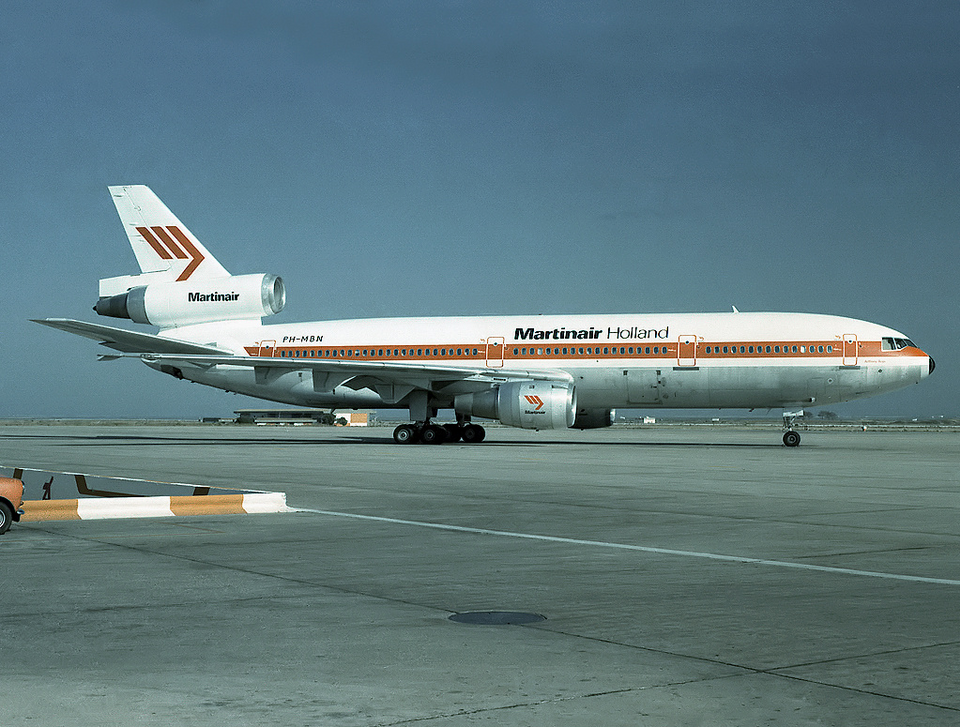
Windshear leads to fatal crash of Martinair DC-10 at Faro Airport

Casualties unknown • Faro, PT

A Martinair Holland DC-10-30F crashed during landing at Faro Airport, Portugal, resulting in 56 fatalities after encountering sudden windshear.

What happened

On December 21, 1992, a Martinair Holland N.V. McDonnell Douglas DC-10-30F, registration PH-MBN, was performing a non-scheduled passenger flight from Amsterdam to Faro, Portugal. As the aircraft approached runway 11 at Faro Airport, the area was experiencing convective activity, including thunderstorms and heavy showers.

During the final stage of the approach, the aircraft encountered a sudden and unexpected windshear event. This caused a high rate of descent and significant lateral displacement. The aircraft performed a hard landing on the right side of the runway. The impact caused the right main landing gear to fracture, which subsequently led to the right wing separating from the fuselage. The aircraft then underwent a longitudinal rotation and slid off the right side of the runway, breaking into two main sections. A large fire broke out following the rupture of the integral fuel tanks in the right wing, contributing to the high number of casualties.

The investigation

The GPIAAF investigation examined the wreckage, flight recorders (DFDR, CVR, and AIBS), and meteorological data. Investigators analyzed the aircraft's performance, specifically looking at the behavior of the auto-throttle and Control Wheel Steering (CWS) systems. The investigation also reviewed the meteorological sensor installation at the tower and the coordination between air traffic control and meteorological services. Technical analysis of the right main gear fracture was conducted to determine the structural limits exceeded during the impact.

Findings

  • The primary cause of the accident was a sudable and unexpected windshear in the final approach phase.
  • The aircraft experienced a high rate of descent and extreme lateral displacement, leading to a hard landing on the right main gear.
  • The combination of the landing impact and a significant crab angle exceeded the aircraft's structural limitations.
  • The crew had performed a premature and large power reduction, maintaining flight idle thrust during a critical phase.
  • The CWS mode disengaged at 80 feet radio altitude, leaving the aircraft in manual control during a critical moment of the landing.
  • The crew did not expect windshear due to the prevailing weather forecasts.
  • The post-impact fire, caused by the rupture of the right wing fuel tanks, significantly impacted the survivability of the occupants.

Safety action

  • Civil Aviation Authorities should review procedures for using ATS and CWS during approaches and landings in extreme weather.
  • Martinair should review flight crew training and procedures regarding landing/take-off maneuvers in marginal weather and the use of thrust reversers.
  • Improvements were recommended for Faro Airport's approach lighting system and the installation of standardized wind displays in the control tower.
  • Recommendations were made to improve emergency access paths for fire services and to enhance the coordination and synchronization of meteorological and air traffic control services.

Probable cause

The accident was initiated by sudden windshear during the final approach, which caused a high rate of descent and a hard landing on the right main gear. Contributing factors included a premature reduction of engine power to idle by the crew and the disengagement of the CWS mode at a critical altitude.

Frequently asked questions

What happened in the 1992-12-21 McDonell Douglas DC10-30F accident near Faro, PT?

A Martinair Holland DC-10-30F crashed during landing at Faro Airport, Portugal, resulting in 56 fatalities after encountering sudden windshear.

What aircraft was involved and where did it happen?

The accident on 1992-12-21 involved a McDonell Douglas DC10-30F, registration PH-MBN, at Faro, PT.

What was the probable cause of the accident?

The accident was initiated by sudden windshear during the final approach, which caused a high rate of descent and a hard landing on the right main gear. Contributing factors included a premature reduction of engine power to idle by the crew and the disengagement of the CWS mode at a critical altitude.

Loading the flight search…

What you can do on Flight Finder

  • Search flights between any two airports with live fares.
  • By aircraft — pick a plane model (e.g. Boeing 787, Airbus A350) and see every route it flies from your origin.
  • Route map — click any airport worldwide to explore its destinations, or draw a radius to find nearby airports.
  • Global aviation safety — aviation accident database, 40,000+ records since 1980, with map and rankings by aircraft and operator.
  • NTSB safety feed — recent U.S. aviation accidents and incidents from the official NTSB CAROL database, updated daily.