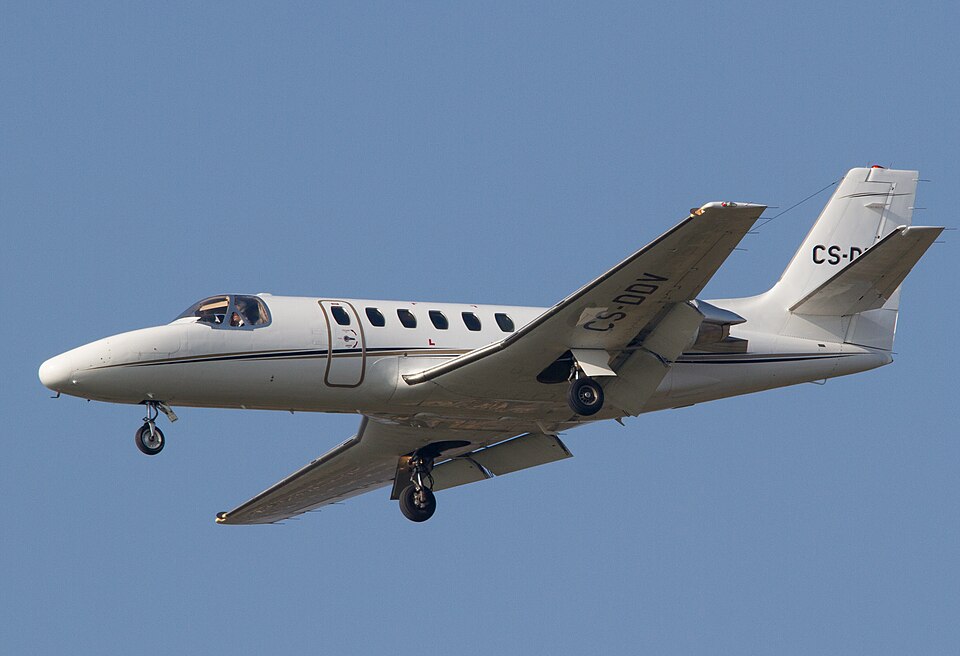
Summary of Event
At 16:22 UTC on 21 July 2005, a Cessna C550 Citation S II, registration CS-DDV, operated by Air Jetsul, landed on runway 35 at Cascais Municipal Aerodrome (LPCS) after a positioning flight from Faro Airport (LPFR). During the landing, the right main wheel tire burst, and the left main wheel tire sustained pronounced wear. The commander, who was piloting, maintained directional control using the rudder and steering, bringing the aircraft to a stop within the runway. The runway was temporarily obstructed until the wheel was replaced, and the aerodrome was closed to traffic during that period.
Investigation Findings
The aircraft was a twin-engine business jet with retractable tricycle landing gear and hydraulic brakes on the main wheels. It was equipped with an anti-skid system that activates when wheel speed reaches 35 knots and deactivates below 12 knots. Examination of the right tire revealed localized cuts through the rubber and eight successive plies, indicative of a locked wheel situation. The left tire showed similar but more superficial wear. Marks on the runway confirmed the tire damage patterns.
Maintenance personnel inspected the braking system, including the anti-skid unit, and found no anomalies. The aircraft's documentation showed no previous malfunctions of the braking system. The anti-skid switch was found in the ON position, and no warning lights were detected during the approach and landing checks.
Probable Cause
The investigation concluded that the commander inadvertently rested his feet on the brake pedals, maintaining slight pressure. This pressure activated the brake master cylinders upon touchdown, preventing the wheels from rotating. Because the anti-skid system only becomes active after wheel speed exceeds 35 knots, it could not release the brake pressure. Consequently, the right tire burst due to friction-induced wear, and the left tire sustained accelerated wear.