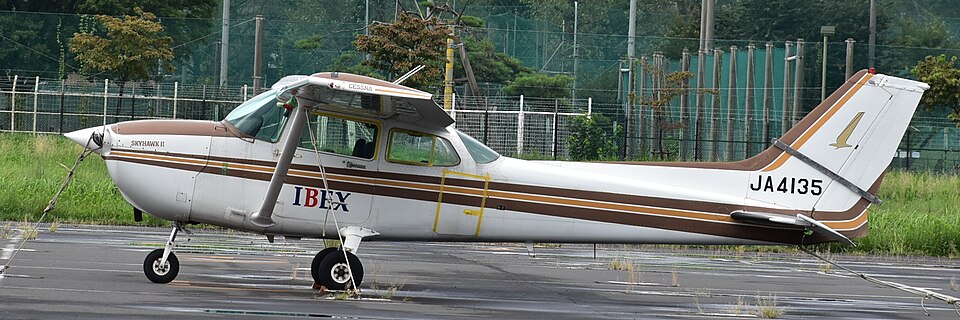
Accident Overview
On June 18, 2012, at approximately 14:40 local time, a Cessna 172P registered as JA4135 and operated by IBEX Aviation Co., Ltd. was conducting touch-and-go training on Runway 08 at Ryugasaki Airfield in Ryugasaki City, Ibaraki Prefecture, Japan. The aircraft was being flown by a 47-year-old flight instructor (PIC) and a 44-year-old student pilot. According to the pilot's statement, during the third takeoff climb at an altitude of about 200 ft and an airspeed of 75 kt, two birds suddenly appeared from underneath the aircraft. The instructor held the control wheel steady to prevent the student from making an abrupt pull. One bird passed below the aircraft, but the other rose to the height of the aircraft and collided with the leading edge of the left wing.
Damage and Injuries
The impact caused a dent on the underside of the left wing leading edge, measuring 63 cm wide and 2 cm deep, located 146 cm from the wing tip. Two ribs, which are primary structural components, were deformed in that area. The aircraft was determined to be substantially damaged. No injuries were reported among the two occupants.
Flight After the Event
After the collision, the aircraft climbed to a downwind leg altitude and entered a holding pattern. The pilots observed a dent on the wing but found that the aircraft's controls and engine were operating normally. After receiving confirmation from Ryugasaki Flight Service that no debris had fallen on the runway, the instructor decided to continue the flight to Chofu Airfield. The aircraft landed there at 15:16.
Bird Information
The administrator of Ryugasaki Airfield recovered the body of the bird from the runway. It was identified as a gray heron, approximately 80 cm in length and weighing 1.4 kg. This species is a resident bird commonly found in many parts of Japan, including paddy fields and waterfronts in the Ryugasaki area.
Weather and Other Conditions
Weather conditions at Ryugasaki Airfield at 12:00 and 15:00 reported visibility greater than 10 km. The pilot stated the wind was from 160° at 10 kt.