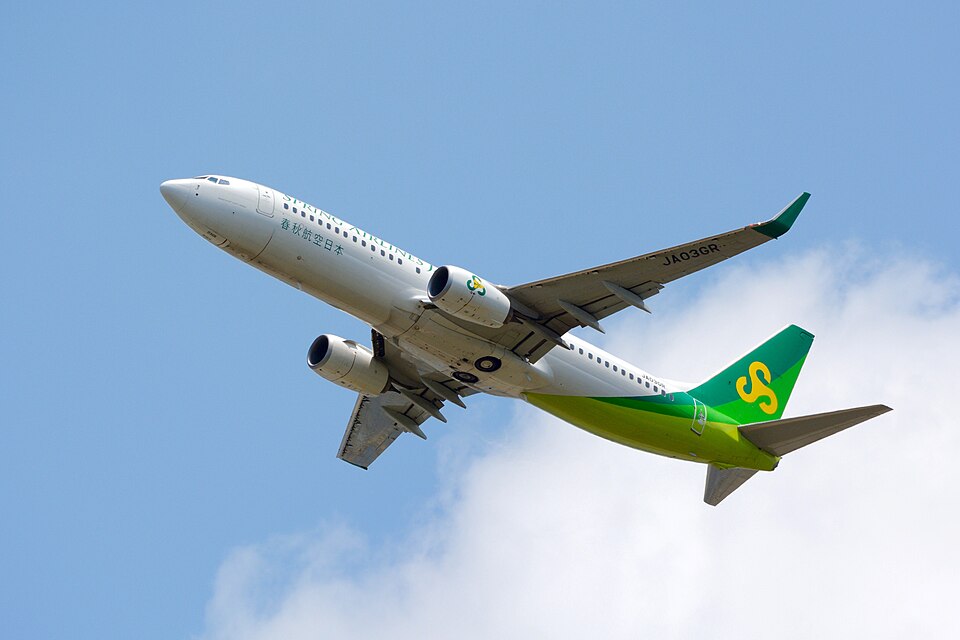
Accident Overview
On Sunday, October 22, 2017, a Boeing 737-800, registered JA03GR, operated by Spring Airlines Japan Co., Ltd., took off from Narita International Airport as scheduled flight 701 bound for Saga Airport. The aircraft carried 134 people: the Pilot in Command (PIC), five other flight crew members, and 128 passengers. During the flight, at about 13:38 Japan Standard Time, while flying at an altitude of around 12,000 ft over Aso City, Kumamoto Prefecture, the aircraft experienced severe shaking. One cabin attendant sustained a serious injury.
Flight History
According to statements from the PIC, the First Officer (FO), and cabin attendants, as well as QAR records, the PIC anticipated bad weather due to Typhoon No. 21 and the front. The PIC informed cabin attendants during pre-flight briefing that the seat belt sign would be turned off only during cruising and instructed them not to leave their seats for passenger seat belt checks but to use announcements. During cruising at Flight Level 360, the PIC said he would turn on the seat belt sign before descent and instructed the crew to finish their work. The cabin attendant assigned to the left side of the aft cabin (Cabin attendant A) finished her duties and sat in the rear-facing L2 seat, fastening her seat belt and shoulder harness.
At about 13:25, the PIC turned on the seat belt sign and the aircraft began descending from FL 360 in autopilot mode. Soon after, the aircraft started shaking. At around 13:32, while flying near OOITA waypoint at FL 226, the aircraft entered clouds. The PIC checked weather radar but saw no strong echoes requiring a route change. At about 13:34, around FL 180, wind direction and speed changed from southeast at 50 kt to calm, then to westerly at 35 kt near ASONO waypoint.
At about 13:38, at around 12,200 ft, the aircraft shook badly. The PIC reduced speed from 280 kt to 250 kt. Cabin attendant A and another cabin attendant (Cabin attendant B) confirmed verbally and visually that their seat belts were tight and low on the hips. During intense shaking, Cabin attendant A grabbed the seat bottom with her left hand, planted her feet on the floor, and grabbed the galley frame with her right hand. Shortly after, at around 12,000 ft, the aircraft shook very hard again; Cabin attendant A hit her buttock hard on the seat and said "Ouch, painful." Cabin attendant B heard her. The PIC and FO reported the shaking felt like ordinary turbulence. Intermittent shaking continued until about 10,000 ft. The aircraft landed on Runway 29 at Saga Airport at about 14:01.
Injuries
Cabin attendant A was seriously injured with a lumbar compression fracture.
Aircraft Information
The aircraft was a Boeing 737-800, serial number 41272, manufactured February 26, 2014. Total flight time was 6,390 hours 49 minutes. The weight and center of gravity were likely within allowable limits at the time of the accident. The flight data recorder and cockpit voice recorder data were overwritten and erased.
Meteorological Information
General weather: At 09:00 JST on October 22, 2017, an autumnal rain front activated by Typhoon No. 21 caused widespread rain in Japan. Upper wind conditions: Wind profiler data from Oita (near the accident site) showed wind direction and speed changed from east-southeast at 30 kt to north-northwesterly at 30 kt between about 17,000 ft and 13,000 ft. Vertical wind shear of the horizontal wind was observed to change about 10 to 12 kt per 1,000 ft at around 12,000 ft.
Additional Information
QAR records indicated that after the aircraft initiated descent, vertical acceleration began fluctuating in short cycles around FL160, and especially at 13:38 when passing that altitude.