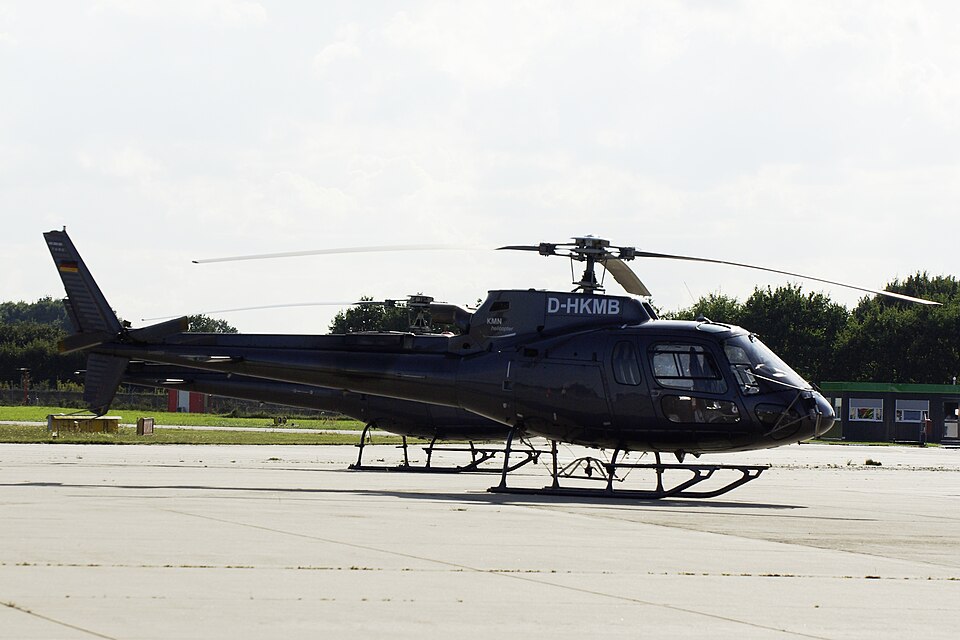
Incident Overview
On 17 September 2022, an AS350 helicopter (registration D-HKMB) operating a geophysical survey struck an electricity supply pylon with its underslung antenna array. The impact severed the power cables, interrupting electricity supply to 1,682 properties. The pilot was unaware of the collision and continued the planned sortie.
Flight History
The helicopter departed from a field location near Auchmahoy, Aberdeenshire at 1002 hrs. It was conducting a survey operation requiring flight on closely-spaced parallel tracks at low height. The underslung antenna was suspended 50 m below the helicopter, and the planned antenna height above ground was 35 to 45 m, corresponding to a helicopter altitude of approximately 280 to 300 ft agl. The planned survey speed was 35 to 45 kt.
At 1045 hrs, during a turn between two survey tracks, the pilot reduced speed to minimise the turning radius and avoid buildings. As speed decreased, the power required to maintain level flight increased due to reduced translational lift. During the manoeuvre, the helicopter lost height, and the underslung antenna array struck an 8 m tall electricity supply pylon north of Balmedie. The pilot stated he was unaware of the strike and only learned of it after landing.
Aircraft and Equipment
The AS350 (year of manufacture 2013) was equipped with one Arriel 2D turbine engine. The underslung antenna array weighed 780 kg, including its internal generator. The antenna frame was 28 m long and 16.5 m wide, covering an area of 340 m². The operator had no specific flight test data for the load; the Rotorcraft Flight Manual limited speed to 80 kt for underslung loads but gave no limit for angle of bank. The system had been operated globally for 17 years and covered 1.3 million km of survey lines.
Organisational Information
The operator applied to the CAA for a permission to operate below the standard 500 ft separation from structures. The application requested to operate the underslung load at 80 ft agl and the helicopter at 100 to 200 ft agl, with no overflight of built-up areas. The operator submitted a Standard Operating Procedure (SOP) that included a risk register. Contact with obstacles was rated as high risk, with mitigations such as flight experience, procedure, and flight preparation. These mitigations were generic and did not include identification of specific obstacles in the survey area, such as using maps with powerline overlays.
CAA Permission
The CAA granted permission with conditions including: flights not closer than 60 m (200 ft) to any person, vessel, vehicle, or structure; no flight under any structure or wires; and adherence to the submitted SOP. The operator complied with requirements to file NOTAMs and inform local authorities. Following the incident, the CAA withdrew the permission to operate at 200 ft from structures and issued enhanced risk mitigation requirements.
Analysis
The underslung antenna struck an electricity pylon as the helicopter manoeuvred between survey lines. It is likely that as speed reduced and power demand increased, the pilot did not accurately control the helicopter's height, allowing a descent. The maps available to the pilot showed only major power cables, so the pylon involved was not identified in pre-flight preparation. Avoiding lower-height power cables relied on the pilot visually acquiring the obstructions, but the high workload of the task may have prevented recognition of the pylon's proximity. The generic mitigations in the risk register, particularly flight preparation, were ineffective at identifying the obstacle. Additionally, at low speed and height, the helicopter operated within the unsafe area of the Height/Velocity diagram, where an engine failure would make a safe landing unlikely. The suggested mitigations of training and experience would not be effective in that scenario.
Conclusion
As stated in the investigation, the pilot was not aware of a height loss during a low speed manoeuvre between planned lines of an aerial survey. As a result of the height loss, the aircraft’s underslung load was below its intended height and struck an electricity pylon that had not been identified as a relevant obstacle on the route.