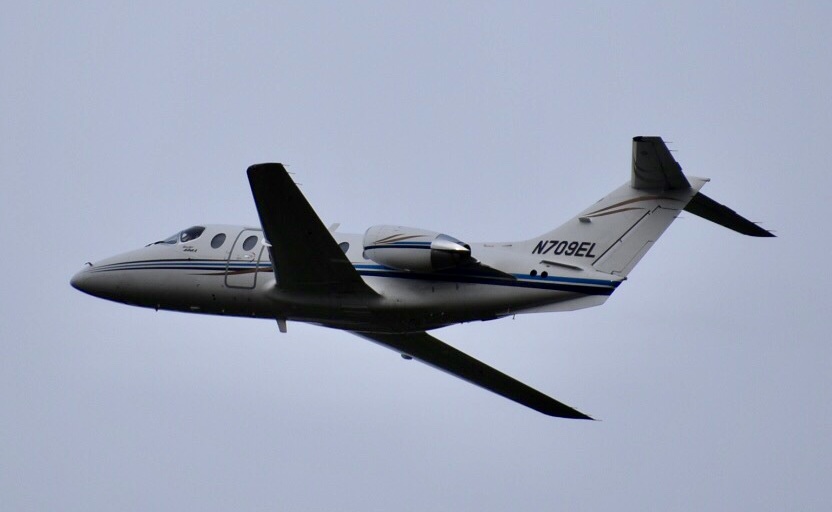
Incident Overview
On 7 October 2022, a Beech 400A (registration N709EL) experienced a serious incident during landing at Newquay Airport, Cornwall. The aircraft, manufactured in 1992 and powered by two Pratt & Whitney Canada JT15D turbofan engines, was conducting a private flight with two crew and one passenger onboard. None of the occupants were injured, but the mainwheel tyres sustained damage.
History of the Flight
During the takeoff roll from East Midlands Airport, the commander noted a hesitation in acceleration at about 95 kt. After a normal rotation and climb, the after-takeoff checks showed no abnormalities. The commander initially suspected a loss of nosewheel tyre pressure or a gust of wind, as the wind was 22 kt gusting 33 kt.
Prior to descent, the commander noticed the parking brake handle on the lower left side of the instrument panel was not fully pushed in. He pushed it in, requiring some force. He then realised that the reduced acceleration was likely caused by the parking brake remaining on with partial brake pressure, leading to brake heating during the takeoff roll. The heat may have melted the thermal relief plugs in the wheel hubs, releasing mainwheel tyre pressure.
The commander did not recall setting the parking brake at the holding point but assumed he probably did. He noted that normal break-away thrust was required to leave the holding point, suggesting only partial brake pressure was applied. The flight crew briefed for possible loss of tyre pressure on landing, lowered the gear early for cooling, and planned to land close to the threshold at Newquay, where the landing distance available was 8,000 ft.
The ILS approach to Runway 30 was normal. On touchdown, deceleration was greater than normal. Reverse thrust and speed brakes were applied. As the aircraft slowed below about 50 kt, it drifted right (downwind). The crew used weathercocking and left pedal to return to the centreline, where the aircraft came to rest angled about 45° left of the centreline. The crew shut down engines, advised ATC of evacuation, and exited via the cabin door. The mainwheel tyres were fully deflated and smoking, but no fire occurred. Airport fire services arrived shortly.
Recorded Information
The cockpit voice recorder (CVR) was downloaded, but audio quality was poor, rendering most speech unintelligible. Tests on the CVR revealed no faults, indicating an issue with the aircraft's system. The operator reinstalled the CVR and performed normal maintenance checks, but the procedure did not include listening to a sample recording. The aircraft was being sold, so further investigation was left to new owners.
Aircraft Information
The Beech 400A (later renamed Hawker 400) is a light business jet with a maximum takeoff weight of 7,303 kg and capacity for seven to nine passengers. The parking brake handle is located on the lower left side of the instrument panel. The parking brake is set by pulling the handle fully out and depressing the toe brakes, locking the applied pressure. Releasing the brake requires pushing the handle in, which releases the hydraulic pressure. There is no indication of applied brake pressure in the flight deck, and no light or caption warns that the parking brake is applied. There is no aural or visual warning if takeoff power is applied while the parking brake is on. The Pilot's Operating Manual states that the parking brake should not be set if the brakes are very hot, as it can increase cool-down time and potentially cause heat transfer to melt thermal relief plugs.
Aircraft Examination
Both mainwheel tyres were intact but partially separated from their wheel rims. The fuse plugs on both mainwheels had melted, and both brake units were seized. The operator's maintenance organisation examined the parking brake system and found no faults. Tests determined that the parking brake released only when the handle was pushed in to expose 28 mm of shaft. The total handle travel from fully out (77 mm shaft exposed) to fully in (7 mm exposed) was 70 mm, but the brake released only during the last 21 mm of travel. The first 49 mm of inward travel did not change brake pressure.
The aircraft manufacturer stated that the parking brake rigging instructions do not specify a mid-position for actuation; the handle has only two lock positions (in and out). The manufacturer was not aware of similar incidents on the Beech 400.
Checklist Considerations
The aircraft checklist in the Approved Airplane Flight Manual includes 'Parking Brake…set' at the start of the 'Starting Engines' checklist but no further reference until 'Shutdown'. The 'Taxi' checklist includes a wheel brake check, but the 'Before Takeoff' checklist does not reference the parking brake.
Probable Cause
The rapid deceleration on touchdown was caused by either the tyres having already deflated due to the fuse plugs having melted, or the brakes being seized, or a combination of both. This was the result of the brakes having been heated during the takeoff run because the parking brake had been left on with partial pressure applied.
Safety Recommendation
One Safety Recommendation was made to the aircraft manufacturer regarding the inclusion of a 'release parking brake' item in the 'Before Takeoff' checklist.