History of the flight
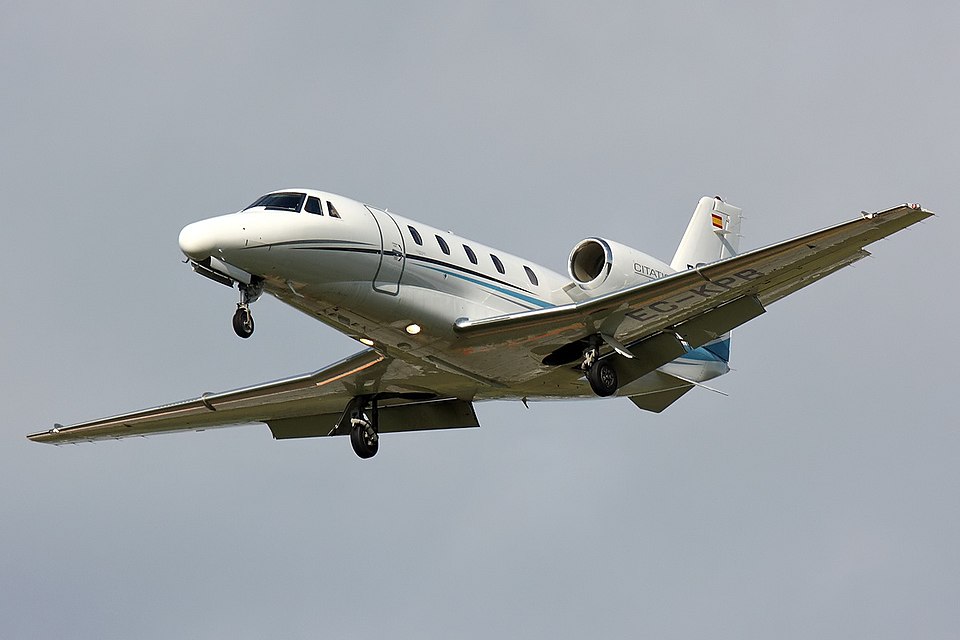
On 1 June 2022, a Cessna Citation 560XL, registration EC-KPB, was taxiing after a normal landing at RAF Northolt, South Ruislip, Middlesex. The crew heard an unusual noise and felt the front of the aircraft drop. The nosewheel had detached from the nose landing gear (NLG) leg and came to rest in the grass adjacent to the taxiway, leaving the forks on the NLG resting on the taxiway.
Aircraft information
The Cessna Citation 560XL is equipped with a tricycle landing gear. The NLG has a single strut with a single wheel attached to the fork. The nosewheel assembly on EC-KPB was last replaced in September 2021 and had accumulated 337 flying hours and 230 cycles. Prior to installation, the wheel assembly had been reconditioned according to the manufacturer's component maintenance manual and grease was applied. No maintenance was required or performed on the wheel after installation per the Aircraft Maintenance Manual. It could not be established whether the bearings were new or reused during reconditioning, but they would have been inspected at that time.
Examination of the wheel assembly
One of the conical bearings in the wheel assembly had failed. Due to extensive damage, laboratory examination could not determine the cause of the failure. However, examination of the non-failed bearing revealed multiple lines of material pitting along the rollers and a band of corrosion pitting around the shoulder. Similar indications were found on the cone and cup, indicative of corrosion pickup between rollers and races. The linear pitting suggested corrosion occurred while the bearing was stationary. Since both bearings operated in the same environment, it is likely the failed bearing was also corroded. A small amount of burnt grease remained on the failed bearing components, but grease was present in the wheel cavity and was consistent with the approved type. The grease seal, which protects against moisture and dirt ingress, was damaged during the failure, so its pre-failure condition could not be determined.
Failure sequence
Examination determined a possible failure sequence:
1. Corrosion pitting in the bearing races caused spalling and disintegration of the bearing cage. 2. This led to roller skidding, and frictional heating combined with loose material caused the bearing to seize, causing the axle to spin on the buckets that support it, generating more heat. 3. Heating and sideways loading caused the spacer on the failed bearing side to disintegrate. 4. The side load caused the axle to migrate toward the failed side, hot working the axle end and forming a flange. 5. The axle continued migrating until it disengaged from the bucket on the non-failed side, snapping the through bolt. 6. The wheel then twisted out of the forks and separated from the aircraft.
Conclusion
The detachment of the NLG wheel resulted from a failure of the conical wheel bearing within the hub. The cause of the bearing failure could not be directly established; however, the non-failed bearing exhibited evidence of corrosion. As the bearings operated in the same environment, it is possible that the failed bearing was also corroded, which likely played a part in its failure sequence. The cause of the onset of corrosion could not be determined.