Flight Details
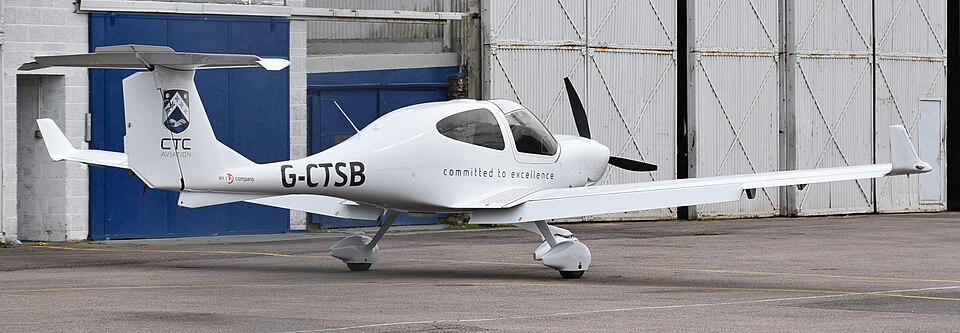
The accident occurred on 12 December 2020 at 0926 UTC at Cranfield Airport, Bedfordshire. The aircraft, a DA40 NG registered G-CTSB, was being used for an aerial work flight. The sole occupant, the pilot, sustained serious injuries, and the aircraft was destroyed.
Loading of De-icing Fluid
The pilot was an instructor with a large Approved Training Organisation. The evening prior, he was asked to complete student progress checks at Bournemouth Airport. On the day of the accident, he was requested to transport containers of de-icing fluid to Bournemouth. Upon arrival at Cranfield, with assistance from an operations staff member, the pilot loaded five 25-litre containers into the aircraft. One container was placed upright on the front right seat, one on each of the two rear seats, one in the rear left footwell, and the last in the front right footwell. The containers were not restrained, except possibly the one on the front seat by the seatbelt. The pilot checked that the flight controls had full and free movement after loading.
Accident Sequence
At 0920 hrs, the pilot requested taxi clearance and indicated an IFR departure towards the Compton VOR. At 0925 hrs, he was cleared for takeoff from Runway 21. ATC cameras recorded the aircraft becoming airborne after about seven seconds. Shortly after, the wings rocked, the right wing dropped and was recovered, followed by the left wing dropping. The aircraft descended from a height of about 100-200 ft, entered a left turn, and struck the ground beside the runway. The entire flight lasted approximately 12 seconds. The pilot was extricated and transported to hospital.
Aircraft Examination
Examination of the wreckage revealed that the container in the front right footwell was upright and had been punctured, consistent with moving forward during the impact. A scuff mark indicated it had moved under the instrument panel. A test with a similar DA40 showed that with an upright container in the right footwell, the control stick could not be moved forward beyond the neutral point. Even with the container at an angle, forward movement was severely restricted. The aircraft was found to have been near its maximum takeoff weight and aft centre of gravity limit.