History of the Flight
On 30 July 2021, during the briefing for a scheduled search and rescue (SAR) training flight, the co-pilot described an event from a previous flight on 5 July 2021. On that earlier flight, while acting as co-pilot in the pilot flying (PF) role, he had encountered unexpected flight path oscillations in pitch after selecting Transition Down (TD) mode during a Flight Management System (FMS)-directed Sector Search using Autonomous Groundspeed (NGSPD). The crew on that flight were uncertain whether the behavior resulted from incorrect parameter setup or switch selection, and they requested to replicate the conditions during the current training flight.
The crew discussed the autopilot configuration and switch selections that had seemingly caused the behavior and found no published guidance against that configuration. Concerned about the potential hazard in degraded visual environments, they decided to replicate the profile and configuration in day visual meteorological conditions (VMC) to see if the oscillations recurred. Weather at the time of the incident was scattered cloud at 2,500 ft amsl, visibility more than 10 km, and north-westerly wind around 10 kt.
After completing other planned training, the crew configured the helicopter for an FMS-directed Sector Search pattern and re-briefed the switch selections. The rear crew were advised to fasten their seatbelts as a precaution. The aircraft was above 1,000 ft agl over water with Altitude Hold (ALT) captured and Sector Search configured with NGSPD captured. As soon as the pilot monitoring (PM) selected TD mode, the aircraft began to oscillate in pitch. The crew described the sensation as “uncomfortable” with a feeling of lower g-force, but they could not determine the extent of pitch variation or which modes were annunciated on the primary flight display (PFD) as they were looking outside. They estimated a 20° nose-up followed by a 40° nose-down pitch change based on visual perception. The PF deselected the autopilot modes and returned the aircraft to normal stabilized flight.
After the flight, the commander submitted an Air Safety Report (ASR) to highlight the potential issue of selecting TD with NGSPD mode captured during a Sector Search.
Previous Flight – 5 July 2021
During the flight on 5 July 2021, after some training over land, the crew headed west toward open water. The PM set up for an FMS-directed Sector Search pattern with groundspeed set at 60 kt in the FMS. The PM selected lateral navigation (NAV) mode, and the Automatic Flight Control System (AFCS) subsequently captured NGSPD while at cruise speed when the Sector Search pattern activated; the aircraft then began to decelerate. Once over water, the PM selected TD, at which point the aircraft began to oscillate in pitch. The PM thought he momentarily saw Winch Trim (WTR) SAR upper mode annunciated on the PFD in the pitch channel before reverting to NGSPD. The PM described the aircraft behaving in a “nodding dog cycle,” which was not aggressive but sufficient for the PF to deselect all upper modes after observing several cycles, then re-select the desired modes. The PF described the oscillations as “not violent but uncomfortable.”
Weather at that time was scattered cloud at 1,000 ft amsl, visibility more than 10 km, south-westerly wind around 10 kt. During the debrief, the crew discussed the event but were unsure whether it was due to incorrect switch selections, entry parameters, or a behavior of the AFCS. They did not consider the event merited an ASR, but they briefed the oncoming crew.
Event Reporting
The degree of pitch oscillation on 5 July did not trigger an alert in the operator’s helicopter flight data monitoring (HFDM) programme. The operator’s safety department only became aware of the AFCS issue after the second event on 30 July. The operator raised a fault report with the helicopter manufacturer. Following assessment of data from the second event, the manufacturer and the operator separately informed the AAIB several days later.
Aircraft Information
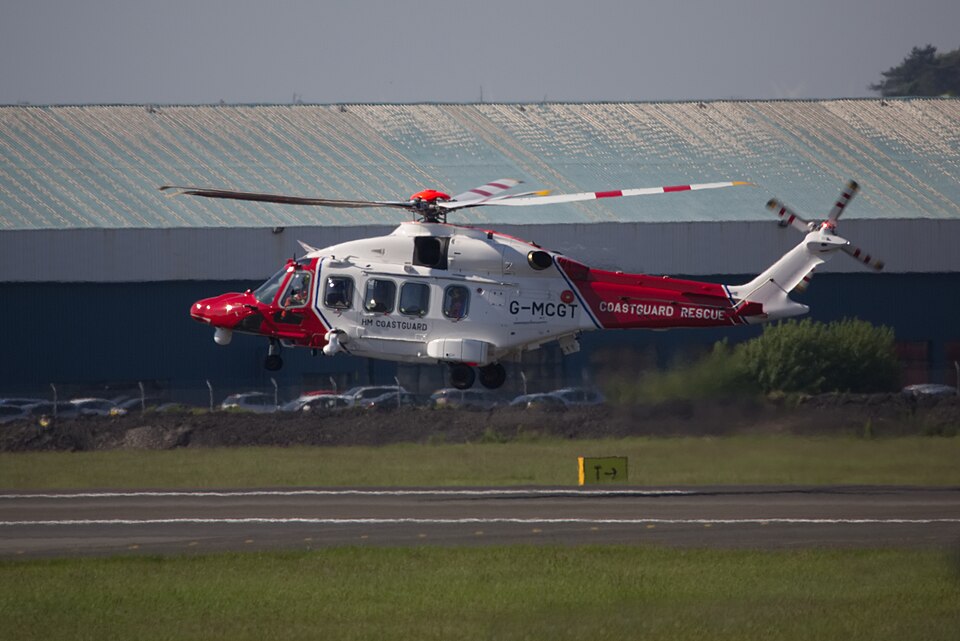
The aircraft was a Leonardo AW189, registration G-MCGT, manufactured in 2014. It was equipped with two General Electric CT7-2E1 turboshaft engines. The AFCS software was at Phase 5 for both events. The incident involved SAR modes, which are only enabled on helicopters configured for SAR operations via a dedicated configuration file specific to the serial number. The AFCS is a four-axis dual-duplex redundant electromechanical system. The Phase 5 software introduced new functionality including primary upper Ground Speed Mode (GSPD) and the SAR upper mode NGSPD.
The design shortcoming in the Phase 5 AFCS software caused unexpected pitch oscillations when selecting TD mode during a Sector Search with NGSPD captured, and also resulted in incorrect AFCS mode indications to the flight crew. To address the issue pending correction in the Phase 9 software release, the helicopter manufacturer issued a Technical Information Letter detailing actions for re-occurrence and updated the FMS Pilot’s Guide for Phases 5, 6, and 8. The manufacturer corrected the design shortcoming in the Phase 9 release. The operator implemented safety action regarding automation management and incident reporting.