History of the flight
The aircraft departed White Waltham Airfield at approximately 1255 UTC on 24 August 2019 for an aerobatic training sortie. The objective was to prepare the student for Sports-level aerobatic competitions. The student, operating from the rear cockpit, was on his third training flight. The exact sortie content is unknown, but the commander generally followed the AOPA Standard Aerobatic Course syllabus; at this stage, upset recovery and inadvertent spin entry recovery were likely exercises.
Two eyewitnesses over one mile away observed the aircraft maneuvering. They reported seeing the aircraft enter a spin, recover, climb, and then enter another spin. The second spin persisted for several turns, and the aircraft was still spinning when lost from sight. Neither witness saw the impact.
Accident site
Ground marks indicated the aircraft struck the ground in a steep nose-down attitude, with first contact by the right lower wing leading edge and nose. The ground was very hard, and the aircraft did not travel forward after initial contact, but moved left approximately 1-2 m with a small right rotation, consistent with spinning with right yaw. Both pilots were restrained within the aircraft and sustained unsurvivable injuries.
Recorded information
Primary radar data provided the flight path but no altitude information. Radar contact was lost at 1304 UTC.
Meteorology
Weather conditions were very benign, with visibility likely greater than 10 km, up to 30 km, and little to no cloud. Some cumulus or stratocumulus may have been present between 2,000 and 5,000 ft.
Personnel
The commander held a Private Pilot's Licence with a Class Rating Instructor endorsement and was an Unlimited category competition aerobatics pilot. He had approximately 710 flying hours, with about 172 on type. The student also held a PPL(A) with night and aerobatic ratings and had 197 hours total, with 1 hour 25 minutes on type. The student only flew with this commander because of weight limits.
Medical aspects
Post-mortem examination of the student found no relevant issues. The commander's post-mortem revealed significant narrowing of a cardiac artery, with no history of previous symptoms. The condition could have placed him at risk of sudden cardiac dysrhythmia. It is possible he suffered a significant alteration of cardiac output, sufficient to prevent aircraft control, likely with little or no warning.
Aircraft information
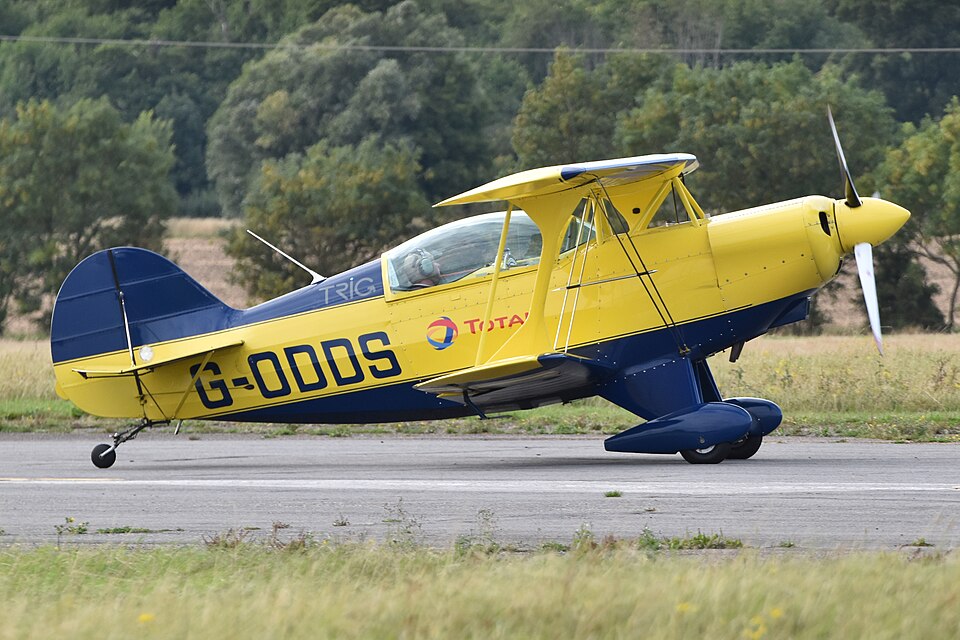
The Pitts Special S-2A is a two-seat aerobatic biplane. G-ODDS was built in 1980 and fitted with a Lycoming AEIO-360-A1E piston engine. The centre of gravity was out of limits aft, which would have reduced recovery capability from a spin and extended recovery time.
Rudder system
The rudder is operated by two steel cables connected to pedals in both cockpits. No adjustment of pedal or seat position is possible. Unapproved devices were found on the rudder cables, but they were unlikely to have been a contributory factor.
Aircraft examination
No anomalies were found with the airframe or engine. Both cockpits had additional seat cushions made of closed-cell foam. The rear cockpit storage locker contained items weighing 1.36 kg. All control cables were intact. Impact damage was noted to the left rudder and left elevator. The rudder stops were undamaged, and the trim tab was set to neutral.
Safety action
The operator took action regarding aircraft weight and balance to ensure accurate weights are used.