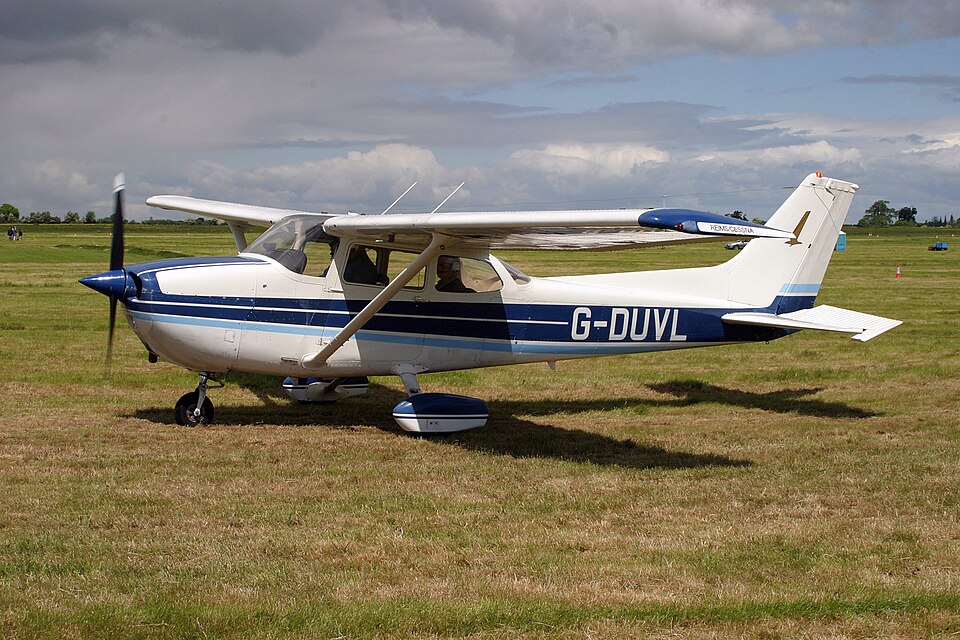
Accident Details
On 20 December 2016 at 16:04 UTC, a Reims Cessna F172N Skyhawk, registration G-DUVL, was landing on the grass runway at White Waltham Airfield, Berkshire. The pilot, the sole crew member and three passengers on board, reported a smooth touchdown. As the aircraft slowed to approximately 35 kt, a loud bang was heard and the right side of the aircraft dropped. The aircraft turned right by about 120 degrees before stopping. On exiting, the pilot observed that the right main wheel assembly had detached from the landing gear leg. No injuries were reported.
Aircraft Examination
The right main landing gear leg failed adjacent to the top fastener in the aerodynamic fairing covering the lower part of the leg, which is attached to the wheel spat. The fairing screws were found to be of different materials and lengths. The top two screws were magnetic and heavily corroded, while the bottom two were non-magnetic and bright. The screw lengths varied between 9 and 11 mm. The top fastener had made contact with the leg, forming a dent approximately 6.8 mm in diameter and 1.6 mm deep. Spots of discoloration and surface damage indicated that the other three screws had also contacted the leg.
Fracture Analysis
Microscopic examination of the fracture surface revealed multiple cracks emanating from the dent. The dent area was discolored and corroded, with beachmarks extending from the dent center to about 0.5 mm from the inner surface of the leg. These beachmarks are evidence of fatigue cracking that grew over time before the leg failed in overload. The corrosion and discoloration indicated the crack had been present for an extended period, though the exact duration could not be determined.
The four screws from the right fairing were compared to the correct screw (S1021Z6-6) specified in the parts catalog, which is 9 mm long, steel, and magnetic. Only two of the four screws, including the one involved in the crack, were magnetic and of correct length. The left main wheel fairing screws also showed witness marks of contact; only one was magnetic, three were correct length, and one was 2 mm longer. It could not be determined if the wheel spats had the correct profile and clearance from the landing gear leg.
Maintenance
A 150-hour check per Issue 1 of the CAA Light Aircraft Maintenance Programme (LAMP) had been completed on 10 October 2016, 34 flight hours and two months before the accident. The LAMP required examination of landing gear structural members, brakes, and wheel fairings. The brake pads were replaced during this check, which necessitated removal of the spats.
Comment
The right landing gear leg failed due to a fatigue crack initiated by damage from a screw in contact with the leg. The fracture surface condition indicated the fatigue crack was present for some time. Cyclic loads during landing and taxiing caused the crack to grow until overload failure during the ground roll. Witness marks on both main wheel spat fairings indicated screws had contacted the legs. Although some screws were longer than specified, the screw at the crack initiation site was of correct length, suggesting the fitting or profile of the wheel spat and fairing resulted in insufficient clearance.