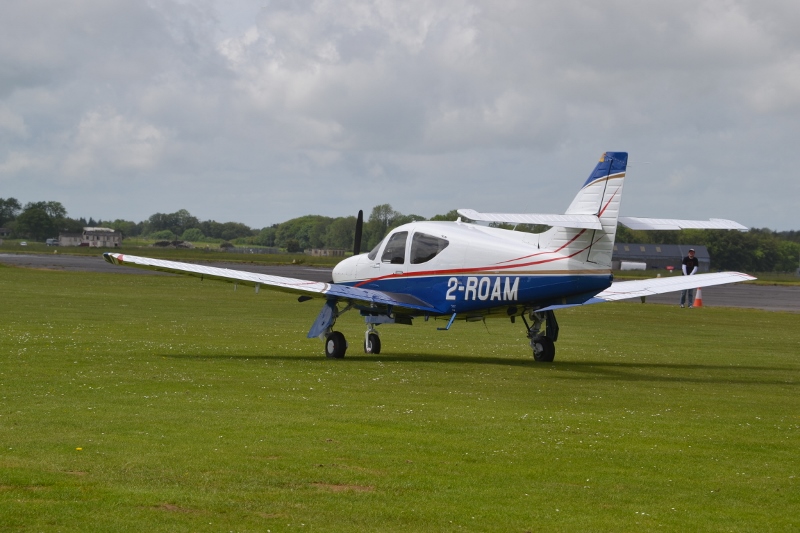
History of the Flight
The aircraft departed Ronaldsway at 0836 hrs on a private VFR flight to Blackpool. Radar and radio recordings indicate the pilot contacted Blackpool Approach at 0851 hrs, requesting a basic service. The controller provided weather information: visibility 2,000 m in light rain and mist, cloud few at 200 ft, scattered at 1,600 ft, broken at 3,600 ft. The pilot inquired about landing and was told it was his decision. He requested a straight-in approach for Runway 10.
The aircraft tracked eastward, descending stepwise: to 700 ft at 12 nm, then to 500 ft at 7 nm, and to 400 ft at 5 nm. Groundspeed reduced progressively, falling below 60 kt. At around 4 nm, the track turned north-east before returning toward the centreline at 300 ft. The final radar return, at 0907 hrs, showed the aircraft at 200 ft and 57 kt, slightly north of the centreline.
At 0908 and 0909 hrs, brief sounds possibly from 2-ROAM were recorded; the first included a high-pitched tone suggestive of an audible stall warning. The controller attempted contact from 0910 hrs but received no reply, initiating search and rescue.
Aerodrome Information
Blackpool Airport, on the Lancashire coast, has a single runway (10/28). It is equipped with a non-directional beacon and an ILS on Runway 28 but no radar. The controller provided a procedural service.
Meteorological Information
A Met Office aftercast indicated conditions consistent with a warm front crossing the area, bringing cloud, rain, and drizzle. The 0850z METAR at Blackpool reported wind 090/05 kt, visibility 2,000 m in light rain and mist, and cloud layers: 1–2 oktas stratus at 200 ft, 3–4 oktas stratocumulus at 1,600 ft, and 5–7 oktas at 3,600 ft. Temperature and dew point both 8 °C.
A band of low cloud (base below 200 ft) crossed the aerodrome at about 0820 hrs. In the prevailing wind, this band would have moved west approximately 3 miles by the time the aircraft disappeared from radar.
The investigation could not determine what weather information the pilot had accessed.
Pilot Information
The pilot, aged 73, held a Private Pilot’s Licence (issued late 2014) with a Single Engine Piston rating and no instrument flying qualification. His total flying experience exceeded 2,001 hours, with at least 100 hours on the Rockwell Commander 114B. Hours in the previous 90 and 28 days were unknown.
Aircraft Information
The Rockwell Commander 114B (1995, Guernsey register) is a four-seat, low-wing monoplane with retractable gear, powered by a Lycoming IO-540 fuel-injected piston engine and a three-blade variable-pitch propeller. It had a valid Certificate of Airworthiness and current airworthiness review. The aircraft was equipped with a moving-map GPS and autopilot; an avionics upgrade was planned.
Fuel uplift of 133 litres at Ronaldsway on 15 October 2015 was the last known; total fuel at takeoff is unknown. The pilot’s flight plan stated endurance of 4 hrs 36 min. Typical cruise speed is 120–130 KIAS; stall speed ranges 56–64 KIAS depending on configuration.
Location and Salvage
After radar loss, a multi-agency search located a fuel/oil slick in the last radar position area. Small debris—insulation, a rubber/neoprene seal with blue paint overspray—was recovered. The next day, a shoulder bag containing an instrument flying textbook and personal items was found by a member of the public. Beach searches yielded plastic wheel chocks and a likely interior light cover. Severe weather delayed seabed search until 14 December, which did not locate the wreckage.
The available evidence suggests the aircraft may have stalled at a height from which recovery was not possible.