Introduction
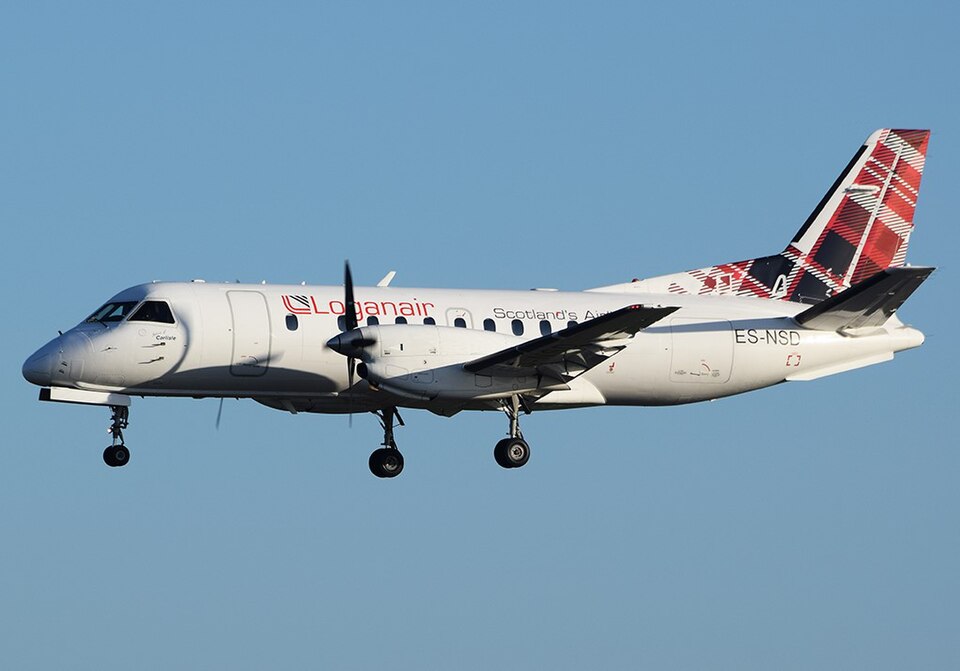
On 30 August 2019, at 0645 UTC, a Saab 340B (registration ES-NSD) operated a scheduled passenger flight from Carlisle Airport to London Southend Airport. The aircraft was carrying 3 crew and 13 passengers. No injuries or damage were reported.
History of the Flight
During the climb, at approximately 2,500 ft, the commander noted that the left engine propeller rpm was low and attempted to adjust the climb power. The adjustment was unsuccessful. The flight crew informed ATC of their intention to return to Carlisle due to climbing difficulties. ATC declared a local standby. The crew followed the checklist to shut down the left engine, and the commander declared an emergency. ATC upgraded the incident and alerted external emergency services. The flight continued without further event, and the aircraft landed at Carlisle 12 minutes after takeoff. Airport Rescue Firefighting Services attended but reported no assistance required; external services were stood down.
Engine Control System
The Saab 340B is equipped with two General Electric CT7-9B turboprop engines with Dowty propellers. Engine control is provided by separate power and condition levers mounted on the centre pedestal. Each lever is mechanically connected to the pitch control unit (PCU) and the hydromechanical unit (HMU) on the respective engine via a push-pull cable and a series of bellcranks and pulleys. The condition lever adjusts propeller blade pitch and sets propeller speed, while also providing inputs to the HMU for fuel metering.
Examination
Subsequent inspection of the left engine revealed damage to the section of the condition control cable running between the HMU and PCU. The operator noted a short section of plastic tubing secured by cable ties adjacent to the visible damage. The operator initially indicated that the cable appeared to have failed due to chafing against the accessory gearbox, attributing this to a large radius bend near the HMU end of the cable. The aircraft manufacturer reviewed photographs and assessed that the holes in the outer casing were consistent with chafing damage; the ball bearings were exposed and the outer race damaged. Chafing protection, although fitted, was not in the correct position and would not have protected the cable.
Manufacturer Information
The aircraft manufacturer stated that failures of engine control cables have occurred over the 35 years of Saab 340 operation. Service Bulletin (SB) 340-76-027 (issued 12 November 1988) provided instructions to fit chafing protection—a silicon tape and a 4-inch convolex tube at a specified location—to prevent chafing on the accessory gearbox. Compliance was recommended. SB 340-76-044 (issued 19 April 2016) addressed relocation of a standoff bracket to increase clearance. The manufacturer reviewed photographs of the damaged cable and confirmed that the chafing protection, although present, was not in the location specified in the SB. It could not be determined from the aircraft's maintenance records whether SB 340-76-027 or SB 340-76-044 had been embodied on ES-NSD.
Post-Incident Actions
Following the incident, the operator introduced a periodic inspection of the engine control cables into its maintenance programme. The aircraft manufacturer took action to update the aircraft maintenance manual to include detailed guidance on cable installation, specifically regarding how cables should be bent to avoid increased friction and wear.
No probable cause was explicitly stated by the investigation.