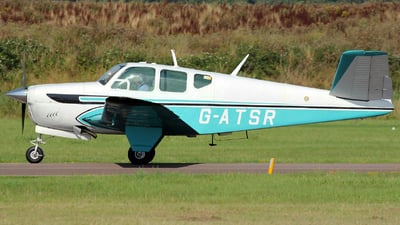
Incident Overview
On 6 December 1998, at approximately 1310 UTC, a Beech M35 (registration G-ATSR) was involved in an incident near Kingsland Church, Hereford and Worcester. The aircraft, manufactured in 1959 and powered by a single Continental IO-470-C piston engine, was being operated on a private flight with one pilot and one passenger on board. The pilot held a Private Pilot's Licence and had accumulated 1,023 total flying hours, including 16 hours on type.
Pre-Flight and Flight Details
Prior to departure, the pilot conducted a thorough inspection of the aircraft, including taking samples from all fuel drains and visually checking fuel tank contents. The two auxiliary tanks were full, and the main tanks were one quarter full. The aircraft had flown just over three hours since refuelling, leaving sufficient fuel for approximately two more hours of flight. After engine start, the pilot ran the engine for about one minute from each tank in turn. The take-off was uneventful, and the pilot climbed to 3,000 feet, establishing the aircraft in cruise with the right main fuel tank selected.
Power Loss and Forced Landing
Approaching the destination airfield after about 10 minutes in cruise, the pilot observed another aircraft in the circuit and stopped his descent at approximately 1,800 feet. Upon opening the throttle, he noted a lack of engine power. He switched fuel selection from the right main tank to the left main tank, but no improvement in engine power was observed. He then attempted to select the auxiliary tanks, a procedure that required moving the main fuel selector to AUX and then selecting the auxiliary tanks to ON by feeling for a detent in the auxiliary fuel selector. Still no power increase was noted. The pilot visually checked his fuel selections and engine controls, which all appeared satisfactory.
Concluding that reaching the airfield was unlikely, the pilot elected to make a forced landing in a field. The landing was completed satisfactorily, but the nose landing gear sustained substantial damage during the landing roll.
Pilot's Assessment
The pilot considered that the cause of the accident was his failure to select the tank containing the most fuel while in the cruise and his failure to select the electric fuel booster pump while changing tanks. He also believed that he may have been distracted by the complex procedure required to change from main to auxiliary fuel tanks. The pilot noted that similar difficulties in selecting fuel tanks on this aircraft type have been experienced by other users, and the problem appeared to be associated with the fuel selector detent not being sufficiently positive.