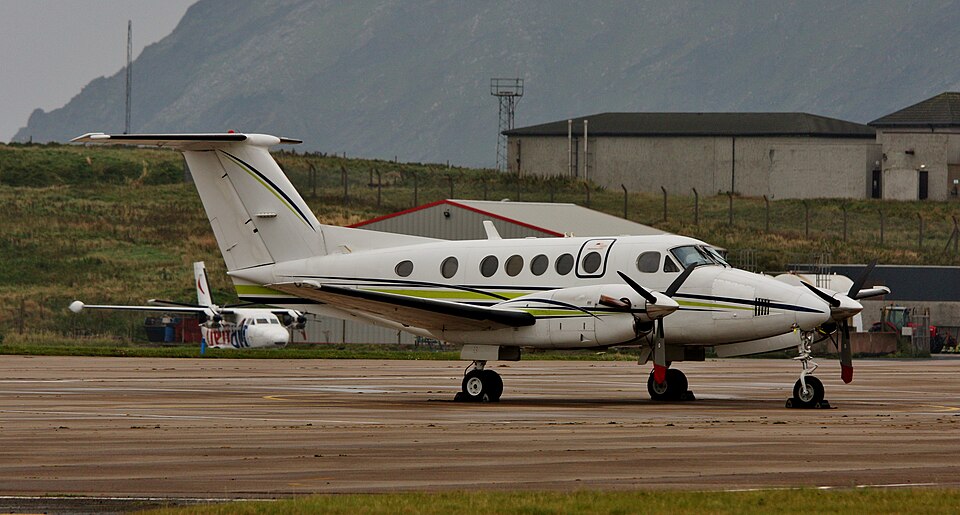
Accident Overview
On the day of the accident, G-BYCP, a Beechcraft King Air, was scheduled to operate a non-commercial flight from Stapleford Aerodrome to RAF Brize Norton. Two company employees were on board: a pilot occupying the left seat, who held a Commercial Pilot’s Licence (CPL), and another individual in the right seat, who held an Airline Transport Pilot’s Licence (ATPL) but was not qualified on the King Air. The right-seat occupant worked for the aircraft operator.
Pre-Flight and Departure
The pilot reported for work at approximately 0715 hours for a planned departure at 0815 hours. Due to poor meteorological visibility, the flight was delayed. General conditions included fog and low cloud with calm wind. At around 0850 hours, visibility was estimated at approximately 600 meters based on known distances from the operations room to a feature on the aerodrome. By approximately 0915 hours, trees were visible just beyond Runway 22L, indicating visibility of at least 1,000 meters. The pilot then deemed conditions suitable for departure.
At 0908 hours, the pilot contacted the en-route Air Navigation Service Provider (ANSP) via mobile phone to request a departure clearance. He was instructed to remain clear of controlled airspace after takeoff and to contact London Tactical Control Northeast (TCNE) on 118.825 MHz. The planned departure involved a right turn after takeoff to intercept the 128° radial from Brookman’s Park VOR (BPK), heading towards the beacon, and climbing to a maximum altitude of 2,400 feet amsl to stay below the London TMA, which has a lower limit of 2,500 feet amsl.
Accident Sequence
The aircraft took off at 0921 hours and was observed climbing in a wings-level attitude until it faded from view shortly after. After takeoff, the aircraft climbed on a track of approximately 205° magnetic. When passing about 750 feet amsl (565 feet above aerodrome level), it began a right turn. The climb continued in the turn until reaching 875 feet amsl (690 feet aal), at which point the aircraft began to descend. The descent continued until the aircraft struck trees at the edge of a field approximately 1.8 nautical miles southwest of the aerodrome.
A witness walking approximately 30 meters northeast of the impact site reported hearing the aircraft suddenly, turning to see it in a nose-down attitude flying into the trees. The witness observed the aircraft briefly but clearly noted that the right wing was slightly low, the aircraft appeared intact, and it was not on fire. She stated the aircraft was “not falling” but flew “full pelt” into the ground.
Investigation Findings
Examination of the powerplants indicated they were probably producing medium to high power at impact. Evidence regarding whether the left inboard flap was fully extended at impact was contradictory, but it was concluded that the aircraft would have been controllable even with a flap asymmetry. The possibility of a preaccident control restriction could not be discounted, though the late change in aircraft attitude suggested that if a restriction existed, it cleared itself.
The evidence available suggested a loss of aircraft control while in instrument meteorological conditions (IMC), followed by an unsuccessful attempt to recover. While it is possible the pilot lost control due to lack of skill, this was deemed highly unlikely given his proper licensing and recent extensive supervised training. Incapacitation of the pilot, with attempted recovery by the additional crew member, was considered consistent with the evidence and supported by the post-mortem report. However, without direct evidence from the cockpit, it could not be stated unequivocally that the pilot became incapacitated. Loss of control from lack of skill, control restriction, or distraction due to flap asymmetry could not be entirely excluded.
On the balance of probabilities, it was likely that the pilot lost control of the aircraft due to medical incapacitation, and the additional crew member was unable to recover the aircraft in the height available.