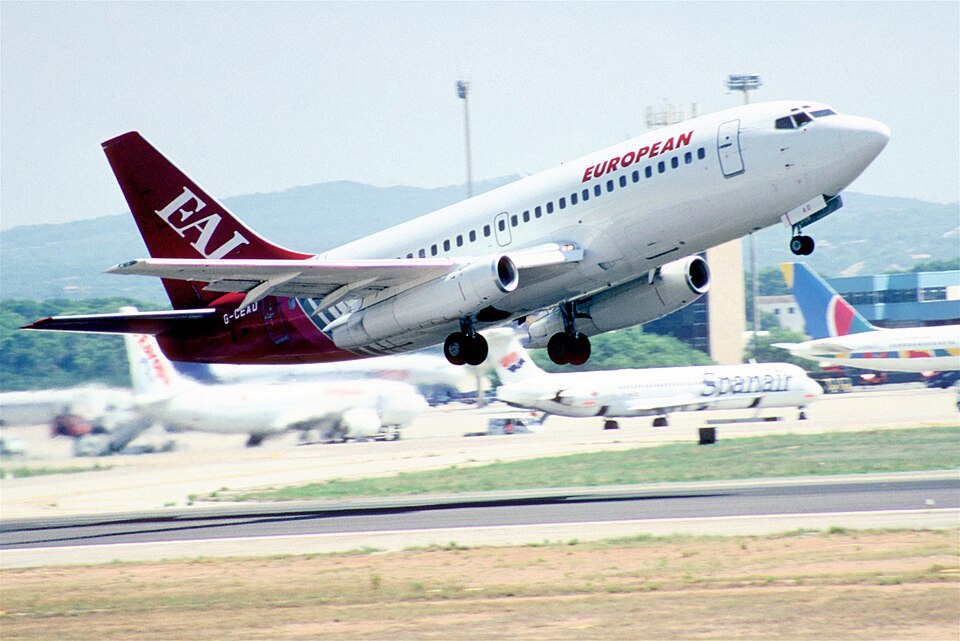
Incident
On 17 October 2000, at 0615 UTC, a Boeing 737-229, registration G-CEAD, experienced multiple bird strikes shortly after takeoff from London Stansted Airport. The aircraft had climbed to approximately 250 feet above ground level when the landing gear was being retracted. The flight crew heard a thump and observed a slight temporary reduction in the No 2 (right) engine pressure ratio (EPR) from 1.97 to 1.8. A burning smell was noted in the cabin. The crew declared a full emergency and flew a visual circuit at 1,500 feet above ground level, maintaining the takeoff flap setting of 5. The Airport Fire Service was alerted, and a normal two-engine landing was carried out on Runway 23 without further incident.
Aircraft and Crew
The aircraft was a Boeing 737-229, manufactured in 1975, powered by two Pratt & Whitney JT8D-15A turbofan engines. It was operating a public transport (passenger) flight with 7 crew members and 40 passengers on board. The commander, aged 47, held an Airline Transport Pilot's Licence and had accumulated 6,917 flying hours, including 403 hours on type. His recent flying experience included 207 hours in the last 90 days and 82 hours in the last 28 days. No injuries were reported among crew or passengers.
Aftermath
After landing and returning to the ramp, an inspection revealed evidence of bird strikes. Bloodstains were found on the No 2 engine inlet bullet fairing and the inboard lip of the intake, as well as on the left main landing gear and the Kruger flap at the inboard end of the left wing leading edge. A close inspection of the airframe did not reveal any significant damage. A visual inspection of the No 2 engine, including a borescope examination of the compressor, found no damage. The bird debris was thought to be from wood pigeons. After removal of the debris, a full and free check of the flying controls and full-power engine ground runs were performed satisfactorily. The aircraft was subsequently returned to service.