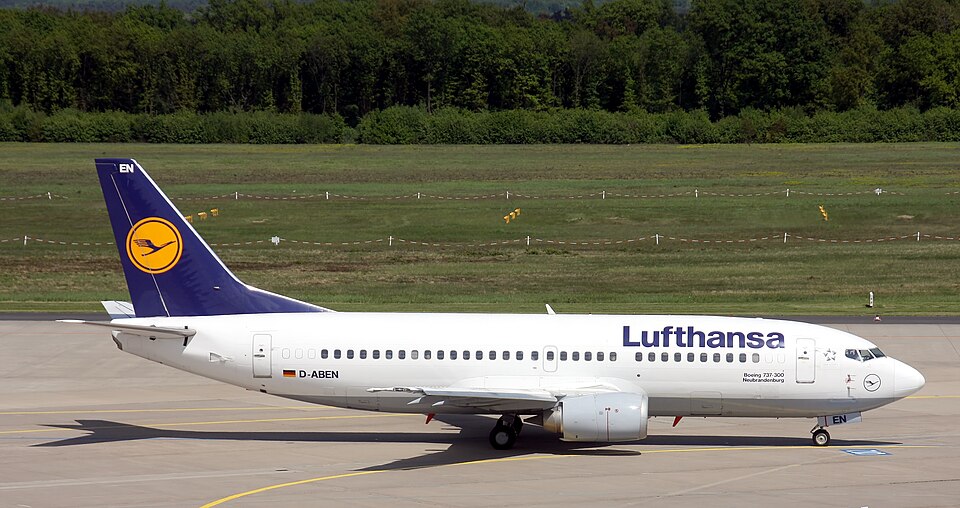
Incident
On 27 July 2002 at 2143 UTC, a Boeing 737-330, registration D-ABEN, was taxiing to park at Manchester International Airport following a flight from Frankfurt. The aircraft was originally assigned to Stand 22 of Pier C, but while passing Stand 32, Air Traffic Control advised the crew that they would park on Stand 28. The crew reported checking the area for obstacles before entering the stand. The commander taxied following the yellow guidance line, using the Azimuth Guidance Nose In Stands (AGNIS) and Mirror guidance system for alignment and stopping.
After parking, a ground crew member informed the flight crew that the aircraft's left wing had struck the upper structure of a Highloader vehicle.
Background
Stand 28 was rated for aircraft up to the size of an Airbus A320. The Highloader had been parked in the stand area by its driver, who believed the stand was not in use and was waiting to service an arriving Airbus A330 on Stand 26. The driver attempted to warn the flight crew by running to the front of Stand 28 and making hand signals.
The stand was lit in accordance with Civil Aviation Publication (CAP) 168. The flight crew later noted that there was equipment in dark areas outside the illuminated zone. There was insufficient space between Stands 26 and 28 for parked equipment, and no ground markings indicating obstacle clearance zones. An equipment parking area existed at the head of Stand 26, which included space for Highloaders. The practice of leaving equipment on vacant adjacent stands had become common, though the Airport Authority stated they did not approve.
Sequence of Events
Stand 28 was not originally intended for D-ABEN, and ground crew were unaware of the late change. The flight crew believed Stand 28 was clear before turning onto it. While turning, the commander likely focused on the AGNIS and Mirror systems, which require simultaneous attention to two points. In the dark, it was unlikely the crew noticed signals from ground personnel approaching from the left.
The Highloader was parked with its head and side lights on, parallel to the stand centreline at a distance of 9.6 metres. The semi-span of the Boeing 737-300 series is 14.44 metres. An inspection revealed the nearside headlamp was not working, though a smaller side light was operational. This did not meet the requirements of CAP 642 for airside vehicles. The vehicle had a serviceable orange flashing light, but it was unclear if it was illuminated at the time.
Stand allocation at Manchester International is controlled by an airside coordinator who notifies ATC and activates the Stand Entry Guidance (SEG) system. Stand 28 lacked an on-stand emergency override button for the SEG. The coordinator can monitor areas via remote CCTV cameras.
Findings
The investigation noted that the advice in CAP 642 states that handling staff should ensure a stand is clear before activating the SEG. The Airport Authority indicated they would publish a Safety Instruction prohibiting unattended equipment on stands and remind ramp personnel that aircraft may enter unoccupied stands at any time. The policy of remote SEG selection was being reviewed.