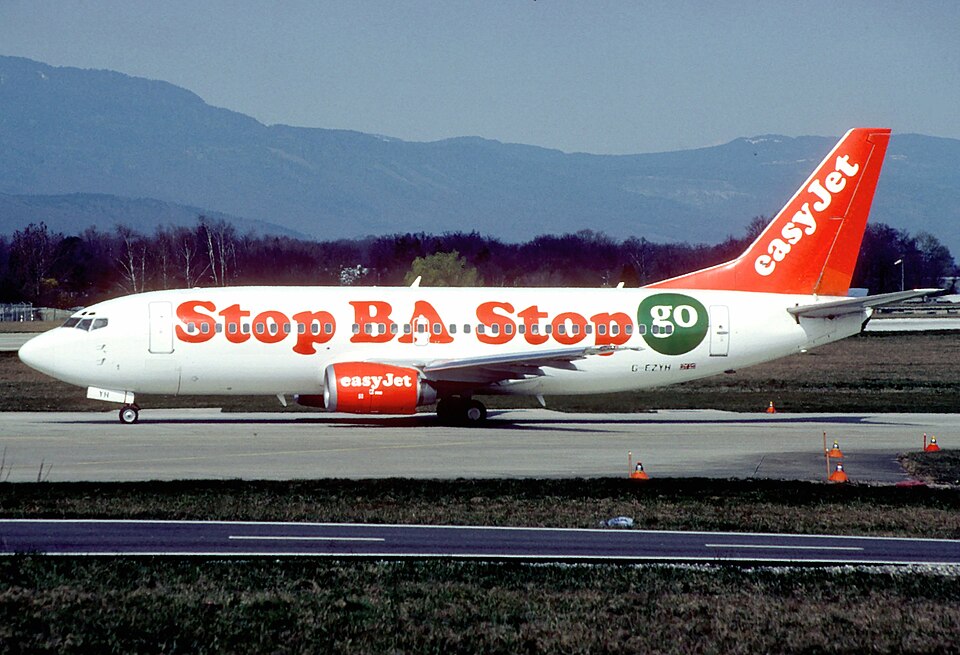
On October 30, 2000, a BOEING 737-33V (registration G-EZYH) was involved in an aviation accident near Liverpool Rwy 27, GB. This summary draws on records from the UK Air Accidents Investigation Branch (AAIB); 2 related events involving the same aircraft type or operator are linked below.
On 30 October 2000, a Boeing 737-33V, G-EZYH, suffered a light tail strike during takeoff from Liverpool Airport in gusty crosswind conditions. No injuries were reported, and the aircraft landed uneventfully at London Luton.
Incident Overview and Flight Details On 30 October 2000, at approximately 0703 UTC, a Boeing 737-33V, registration G-EZYH, operated by a public transport airline, experienced a tail strike during takeoff from Liverpool Airport. The aircraft, manufactured in 1998 and powered by two CFM56-3C1 turbofan engines, was carrying six crew members and 138 passengers. No injuries were reported to either crew or passengers. The incident resulted in damage to the rear fuselage underside skin, drain masts, and aerials. The flight was intended to proceed to London Luton Airport, and the aircraft made an uneventful landing there after the incident. ## Operational Context and Crew The commander, a 55-year-old Airline Transport Pilot, had 15,986 hours of flying experience, including 3,190 hours on the Boeing 737 type. In the 90 days prior to the incident, he had accumulated 153 hours, and in the 28 days prior, 62 hours. The commander was designated as the handling pilot because the first officer was not permitted to fly the sector in the prevailing weather conditions. A new cabin staff member, acting as supernumerary crew, occupied the jump seat for flight deck experience. ## Pre-Flight and Weather Conditions The crew reported for duty at approximately 0520 UTC for the first sector of the day. During pre-flight preparations, the commander was informed that the Chief Pilot had suspended all company operations at London Luton due to adverse crosswind conditions. The commander decided to continue with pre-flight preparations and briefed the passengers on the delay. One passenger chose not to fly and was disembarked, with the loadsheet amended accordingly. The calculated takeoff weight was 50,624 kg, with a maximum takeoff weight of 56,472 kg, and the revised takeoff weight was 55,948 kg. A flexible thrust takeoff was planned for a weight of 53,020 kg at an assumed temperature of 42°C. Company policy dictated the use of takeoff speeds related to the actual takeoff weight. For a Flap 1 takeoff, the speeds were V1 = 134 kt, VR = 141 kt, and V2 = 146 kt. When London Luton was reported open, the commander initiated pushback and taxied the aircraft to holding point 'A1' for Runway 27. Weather conditions were poor, with strong gusting winds. During the control check, the commander noted that considerable force was required to move the rudder pedals. After receiving ATC clearance, the commander conducted a comprehensive takeoff brief, and the 'above the line' items of the takeoff checklist were completed. ## Takeoff and Incident Shortly before 0703 UTC, the aircraft was cleared for takeoff, with the surface wind reported as 320 degrees at 23 knots, maximum 30 knots. The aircraft taxied onto the runway, and takeoff checks were completed. The commander advanced the power levers to the 40% position and selected TO/GA once thrust was stable. He noted an initial asymmetrical power increase, though he could not recall which engine had the lower setting. The first officer recalled that the left engine had lagged by 2 to 3% and that he had adjusted it. As the aircraft accelerated, the commander applied significant left rudder to maintain the runway centerline, combined with a large into-wind control wheel deflection to keep the wings level. Normal takeoff calls were made, and in response to 'ROTATE', the commander concentrated on raising the nose at a steady rate to a pitch attitude of 15°. The first officer reported a positive initial rotation, followed by a slower rotation, and then a further positive rotation, considering the rotation rate higher than normal but not excessive. During the second part of the rotation, the first officer felt the main landing gear leave the ground, followed almost immediately by what he described as a 'secondary bump'. The commander reported having to 'work extremely hard' and, upon feeling the aircraft leave the ground, concentrated on keeping the wings level while removing the cross control applied during the ground roll. ## Post-Incident Actions and Damage The workload during the initial climb was high, and the first officer waited until they crosschecked the altimeters at FL55 to ask the commander if he had felt a 'secondary bump on departure'. The commander confirmed he had but did not believe it was a tail strike. The climb continued, and the after-takeoff checklist was completed. The crew appeared to be monitoring pressurization, with the first officer noting that the differential was increasing and the cabin altitude was at 1,500 feet, then calling FL100. Shortly after, a crew member seated at the rear of the aircraft entered the flight deck and reported hearing the tail hit the ground. After discussion, the commander decided to level at FL120 and called for the tail strike checklist, which required depressurizing the aircraft. He opted to descend to FL100 to perform the checklist. The flight then continued to London Luton, where the aircraft landed uneventfully. The lower fuselage exhibited damage consistent with a light, transient contact between the underside of the aircraft and the runway. This included abrasion of the lower fuselage skins over an area bounded approximately by stations 908 and 1088 and stringers 26L and 25R, resulting in localized penetration through the skin at frame locations. Secondary deformation of frame chords and attachment clips occurred in the same areas. Heavy contact ground damage was sustained by the drain mast, with associated deformation and cracking of the underlying skin panel. Abrasion damage was also noted on the inboard side of the Aft Toilet Services panel on the right side. ## Meteorological Data The following METARs were issued from Liverpool Airport: - 300620Z: 34026G39KT 6000 RA SCT008 BKN015 04/03 Q0959 - 300650Z: 31028G43KT 6000 RASN SCT010 BKN020 03/02 Q961 - 300720Z: 32024KT 6000 RASN SCT008 BKN015 03/02 Q964 A SPECI at 0704 UTC reported the surface wind as 32021G32KT, and another at 0718 UTC as 32025G36KT. The current ATIS was 'Z', indicating the runway condition as WET-WET-WET. ## Flight Data and Analysis The Cockpit Voice Recorder (CVR) was a Honeywell solid-state recorder with a two-hour duration. For the final 30 minutes, it recorded on four independent channels: one for each flight crew member, one for the PA, and one for the cockpit area microphone. For the total two-hour duration, it also recorded two separate channels: the crew and PA channels combined, and the area microphone channel. The Flight Data Recorder (FDR) was a Honeywell solid-state recorder designed to accept data at up to 256 words per second. As the aircraft system provided 64 words per second, the total duration of the record was approximately 190 hours. Recorded data indicated that the aircraft started its takeoff roll with left rudder and right aileron applied to counteract the crosswind, and with forward stick applied. Throughout most of the takeoff roll, the headwind component varied between 11 kt and 17 kt, with a mean of about 15 kt. From 50 kt to the initiation of rotation, rudder was held between 2° and 21° to the left, averaging about 6° to the left in the later stages. The control wheel was held between 19° and 25° right wing down, and the column about 1° to 2° forward. At an indicated CAS of 115 kt, 23 seconds after the start of the takeoff roll, the recorded CAS began to rise at an increased rate. Two seconds later, the headwind component increased to 25 kt. Two seconds after that, about 27 seconds after the start of roll, rotation was initiated at an airspeed of 141 kt. Immediately following, airspeed recordings showed a decrease from 141.5 kt to 137.5 kt over one second, while groundspeed increased normally from 118 kt to 122 kt, indicative of wind shear with the headwind component reducing from about 23 kt to 15 kt. The control column was pulled back to just over 6° and held between 5.8° and 6.8° for about 4 seconds. The aircraft began to pitch up, with a peak pitch rate between 5° and 6.5° per second. The aircraft started to lift off at about 10° of pitch and continued to pitch up continuously to just over 16° at a radio altitude of 9 feet. Between these times, the tail struck the runway. After liftoff, the aircraft climbed away normally. The degree of control wheel used during the takeoff roll and rotation was sufficient to deploy the roll control spoilers on the right wing. It was initially thought this could have affected the pitching moment and overall lift, but the manufacturers examined the recorded data and concluded that the small roll spoiler deflection had an insignificant effect on the aircraft's pitching characteristics and overall lift coefficient. An analysis of the previous 18 takeoffs showed that 12 (66%) had derived pitch rates of less than 4°/sec, and 6 (33%) had pitch rates between 4 and 5°/sec. Two of the latter had momentary excursions to just over 5°/sec. In comparison, the incident flight had a period of just over 5°/sec, with a possible momentary excursion to 6.5°/sec.