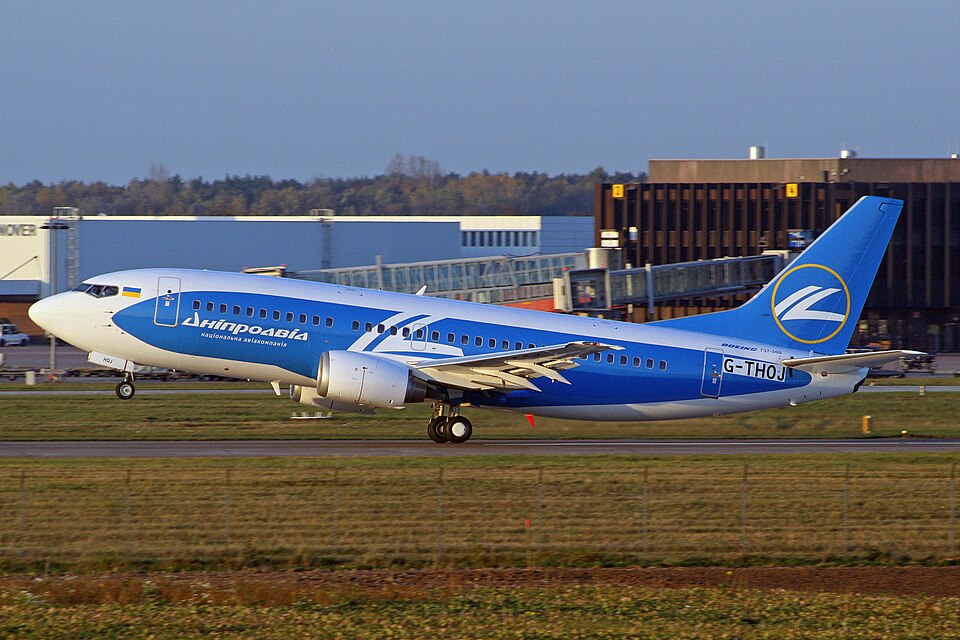
Background
The Boeing 737-36Q, registration G-THOJ, was built in 1997 and powered by two CFM 56-3C1 turbofan engines. On 13 August 2006, while in cruise at Flight Level 350 from Cardiff to Malaga, a failure of the DC Battery Bus occurred. This incident followed a similar event on 11 August and a subsequent taxi failure on 13 August.
Incident on 11 August
On 11 August, while en route from Malaga to Cardiff at Flight Level 340, the flight crew observed a yellow 'SPD LIMIT' caution on both Electronic Attitude Direction Indicators (EADIs). On the overhead panel, the following captions were illuminated: 'SPEED TRIM FAIL', 'MACH TRIM FAIL', and 'AUTO SLAT FAIL'. Engine N1 and fuel flow indications were lost; the standby attitude indicator (ADI), both clocks, and the master caution panel (MCP) failed; the DC Battery Bus showed zero voltage; and both EADIs became monochromatic. Although the 'equipment cooling supply' OFF light was not illuminated, the crew recognized the monochromatic EADIs as indicating a loss of cooling air flow. They switched the cooling fan power supply to 'ALTERNATE', which restored normal displays. After reviewing system status, the crew confirmed no degradation to approach and landing capabilities and continued to Cardiff. During landing gear deployment, all previously lost systems were restored, and the aircraft landed uneventfully. Post-flight inspection and testing found no defects, and the aircraft was returned to service.
Incident on 13 August and Subsequent Failure
On 13 August, at FL350 en route from Cardiff to Malaga, a 'click' was heard from the P6 circuit breaker panel, and the DC Battery Bus failed again with identical symptoms. The crew referred to the Quick Reference Handbook (QRH) but found it of limited use. After establishing an HF radio link with their engineering department, they restored some systems and continued to Malaga without further incident. After landing, an engineer inspected the suspected R1 relay but found it apparently serviceable. The aircraft was dispatched for the return flight. However, while taxiing, a third DC Battery Bus failure occurred. The aircraft returned to the stand. A replacement R1 relay was flown from the UK, installed, and after satisfactory system checks, the aircraft was returned to service with no further problems reported.
Investigation and Defect History
The investigation focused on the R1 relay. The EADIs are designed to operate without cooling for at least 90 minutes, but an overheat condition causes immediate shutdown, leaving only the Standby Attitude Indicator (SAI) powered by the DC Battery Bus. Loss of the DC Battery Bus removes power to the SAI and the equipment cooling low-flow sensors, preventing the 'equipment cooling OFF' light from illuminating. The SAI fitted to G-THOJ, powered by the DC Battery Bus, would topple after a delay when power was lost. Had the crew not recognized the monochromatic EADIs as a cooling failure, they could have lost all attitude information.
On 20 July 1997, a similar incident occurred to B737-500 EI-CDT, investigated by the Danish Air Accident Investigation Board, resulting in Flight Operations Technical Bulletin 737-300/400/500 98-1. Manufacturer Service Letter 737-SL24-120 recommended specific relays for the R1 position, but the failed relay on G-THOJ was of the recommended type. On 22 March 2005, B737-300 G-EZYN suffered a similar R1 relay failure, prompting AAIB investigation (Bulletin 4/2006) and Safety Recommendation 2005-65. In response, Boeing issued Alert Service Bulletin 737-21A1156 in June 2006 to separate the normal power supply for equipment cooling fans from that for the low air flow sensor, ensuring the equipment cooling OFF light would illuminate after a DC Battery Bus failure.
Conclusions
The R1 relay is an electromechanical device that, despite improvements, occasionally suffers mechanical failure. Such failures may be intermittent, as seen when systems were restored after landing gear deployment in the first event and after crew actions in the subsequent flight, prior to complete relay failure. The combination of the existing Flight Operations Technical Bulletin and the new Alert Service Bulletin, which alerts crews to possible DC Battery Bus failure, addresses the potential loss of all attitude information following an R1 relay failure.