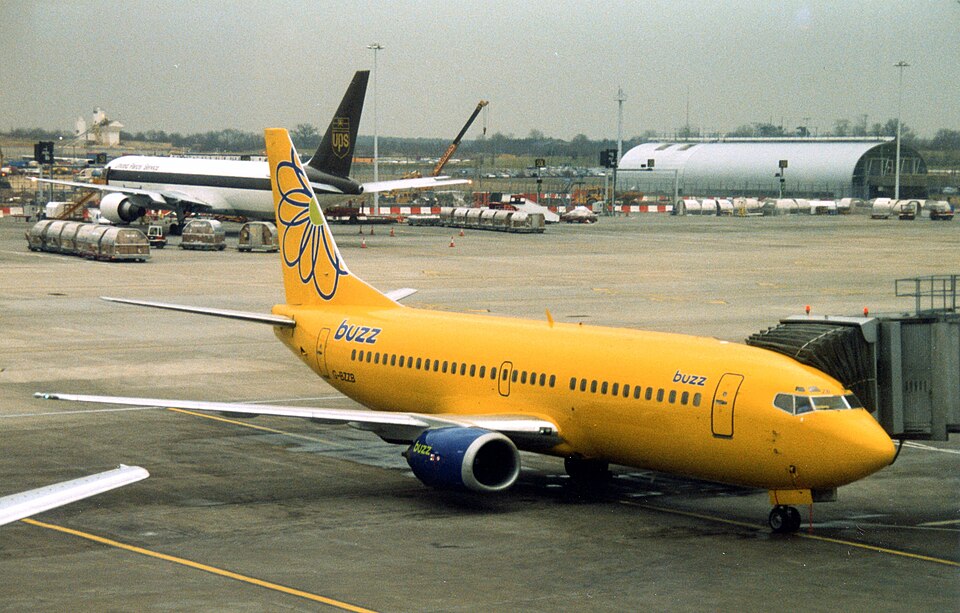
Incident Overview
On December 17, 2002, at 0651 UTC, a Boeing 737-3L9 (registration G-BZZB) was parked on Stand C43R at Stansted Airport, preparing for a scheduled passenger flight to Amsterdam. The aircraft, powered by two CFM56-3B2 turbofan engines, had 5 crew and 79 passengers on board. No injuries occurred.
Sequence of Events
After the aircraft doors closed, the leading hand of the pushback crew conducted a visual walk-around inspection of the pushback area to ensure it was clear. He then positioned himself on the right side of the aircraft to communicate with the flight crew.
An Airbus A321 occupied the adjacent stand (C43L) to the left of the 737. Before the pushback began, a ground servicing vehicle that had been catering the A321 reversed from the aft right side of the A321 and parked in the clearway between the paths of the two aircraft wingtips. The clearway was demarcated by discontinuous white parallel lines approximately 6 meters apart.
The nosewheel of the 737 was offset to the right of the stand centerline, so the tug driver began the pushback with a correction to realign the nosewheel. During the pushback, the left wingtip of the 737 struck the parked servicing vehicle. Both the vehicle and the aircraft sustained minor damage.
Contributing Factors
The commander assessed that reduced vigilance by the pushback crew while monitoring the start of the right engine and limited clearance between the wingtips of aircraft on adjacent stands contributed to the incident. The Airport Authority's report indicated that both pushback operators were aware of the vehicle but misjudged the available clearance. Both crew members of the servicing vehicle were outside but could not warn the tug driver in time.
The Airport Authority had previously issued a Director's Notice (12 October 2000) prohibiting vehicle parking in interstand roads/clearways unless the driver remained with the vehicle. Equipment areas were provided for parking near stands.