Sequence of Events
After receiving air traffic control clearance, the crew of N90AG started the engines at 1156 hours and were cleared to taxi at 1201 hours. The commander, seated in the right cockpit seat, made all radio calls during the accident flight. During taxi, the crew completed their normal Before Takeoff Checks, confirming control checks and noting that anti-ice might be required after takeoff. Flap 20 was selected for takeoff. The crew calculated and briefed takeoff speeds: V1 137 knots, VR 140 knots, and V2 147 knots.
At 1206 hours, the aircraft was cleared to line up on Runway 15. One minute later, clearance for takeoff was issued with a surface wind of 140 degrees at 8 knots. The pilot in the left seat was handling the controls. The takeoff appeared normal up to lift-off. Rotation began at about 146 knots with the elevator position increased to 8 degrees nose-up, resulting in an initial pitch rate of approximately 4 degrees per second. Lift-off occurred two seconds later at about 153 knots and a pitch attitude of about 8 degrees nose-up.
Once airborne, the elevator was reduced to 3 degrees nose-up while the pitch rate increased to about 5 degrees per second. Immediately after lift-off, the aircraft began banking to the left. The rate of bank increased rapidly, reaching 50 degrees of bank two seconds after lift-off. At that point, the heading had diverged about 10 degrees to the left. The crew applied opposite aileron followed closely by right rudder; full right aileron and full right rudder were applied within one second and maintained until the end of the recording. As the bank angle continued to increase, progressively more nose-up elevator was applied. Stick-shaker activation occurred 3.5 seconds after lift-off, and the recorders ceased two seconds later.
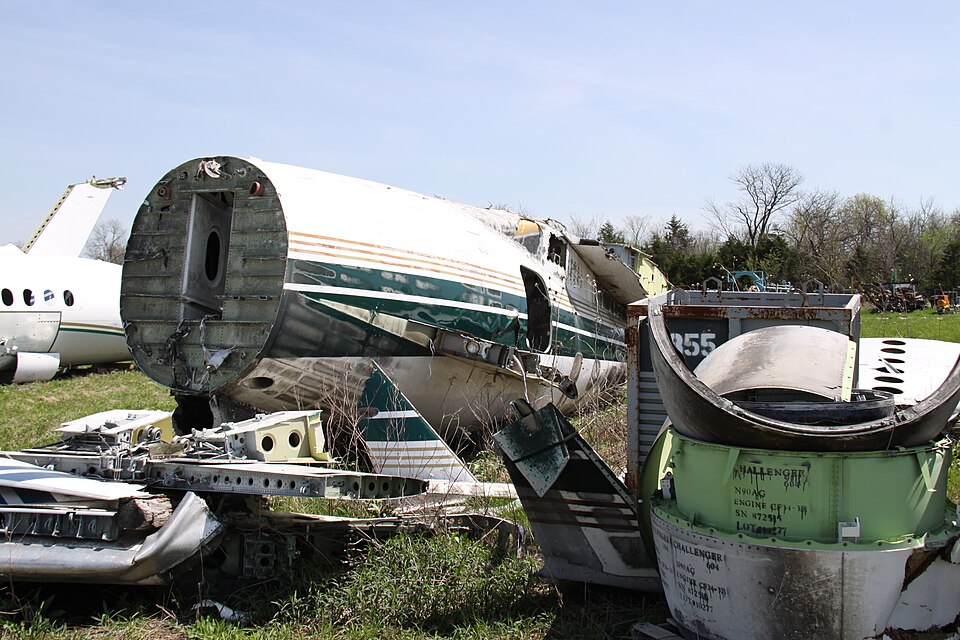
The aircraft struck the ground inverted adjacent to the runway. The last recorded aircraft attitude was approximately 111 degrees left bank and 13 degrees nose-down pitch, with a final heading of about 114 degrees magnetic. The aircraft was destroyed by impact forces and a post-crash fire. All five occupants, including John Shumejda, President of the Massey-Ferguson Group, and Ed Swingle, Vice President, were killed. The aircraft was leased by AGCO Massey-Ferguson.
Probable Cause
The official investigation identified three causal factors: 1. The crew did not ensure that N90AG's wings were clear of frost prior to takeoff. 2. Reduction of the wing stall angle of attack, due to the surface roughness associated with frost contamination, to below that at which the stall protection system was effective. 3. Possible impairment of crew performance by the combined effects of a non-prescription drug, jet-lag and fatigue.