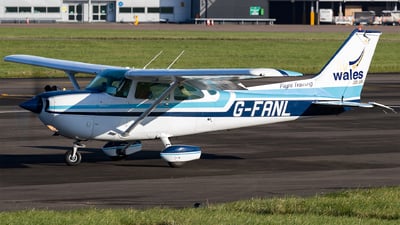
Accident Overview
At 0840 UTC on 2 October 2010, a Cessna R172K Hawk XP, registration G-FANL, was involved in an accident at Haverfordwest Airport, Pembrokeshire. The aircraft, manufactured in 1978, was powered by a single Continental Motors Corp IO-360-KB piston engine. The flight was a private circuit-training session with only the pilot on board. The pilot, aged 59, held a Private Pilot's Licence and had accumulated 149 flying hours, of which 59 hours were on the accident type. In the previous 90 days, he had logged 7 hours, with 5 hours in the last 28 days.
Sequence of Events
The pilot was conducting circuits at Haverfordwest Airport under good weather conditions with a 15-knot southerly wind, using Runway 21. The first circuit was normal, although the pilot noted some light wind shear and turbulence on final approach. During the landing flare of the second circuit, in mild turbulence, a greater than normal sink rate was experienced, and the aircraft bounced. The pilot applied full power, but the aircraft pitched nose-down, rolled to the right, and landed heavily on its nosewheel, with the propeller striking the ground. The pilot recognized the heavy landing, closed the throttle, and taxied back to the parking apron, where he shut down the aircraft.
Damage and Injuries
A visual inspection revealed damage to the propeller, the lower fuselage, and the firewall, as well as distortion to the geometry of the nose landing gear. The pilot reported no injuries.
Pilot's Consideration
According to the pilot's report submitted via the Aircraft Accident Report Form, he considered that the accident was caused by the starboard wing stalling after the aircraft had bounced, resulting in the aircraft not remaining airborne when he applied full power.
Information Source
The information in this article is derived from the AAIB Bulletin 1/2011, report number EW/G2010/10/10, based on the pilot's submitted accident report form.