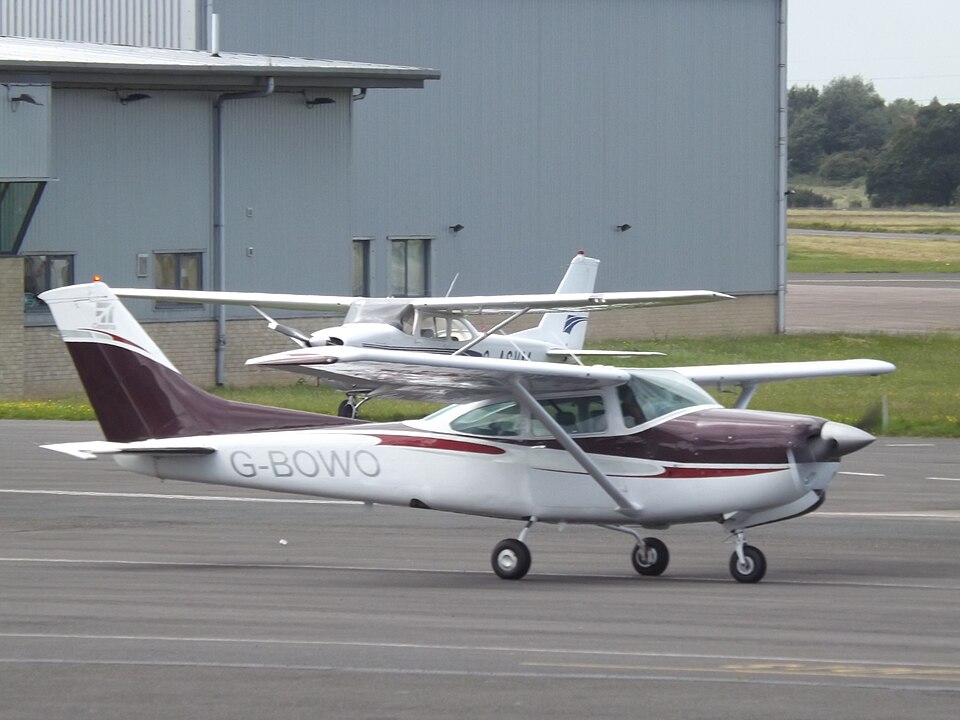
History of the Flight
The aircraft was approaching Wolverhampton following an uneventful flight when the pilot selected the landing gear down. However, he did not receive a green 'down and locked' indication. He re-cycled the landing gear several times, but to no avail. He then performed a low fly-past of the ATC tower and was informed that the left main landing gear was not fully down. He attempted to lower the landing gear using the manual hydraulic pump and attempted 'energetic' manoeuvres in roll and pitch in an attempt to dislodge the gear, all without success. Having briefed the passengers, the pilot carried out a landing on the grass Runway 10; the aircraft continued in a straight line until the left wing began to drop and the aircraft then departed to the left, coming to rest on the side of the adjacent tarmac Runway 10.
System Description
The aircraft has a hydraulically actuated, retractable, tricycle landing gear system; each landing gear leg is individually actuated by a hydraulic actuator supplied by an electrically operated hydraulic power pack. When the landing gear is selected down, hydraulic pressure causes a rotary actuator to operate a pivot assembly via a splined shaft, and each main landing gear strut rotates forward and outboard. Once the landing gear has locked down, microswitches for each gear leg trigger a respective green light in the cockpit, and the gear selector returns to the neutral position. An emergency hand pump is available for emergency extension of the gear. A nose landing gear squat switch prevents inadvertent retraction whenever the nose gear strut is compressed.
Metallurgical Examination
The detached pivot assembly was returned to AAIB for metallurgical examination. The pivot assembly had separated in the area of the splined shaft. The fracture surface had been partially damaged by smearing during rotational movement, most likely caused during the repeated attempts to operate the gear prior to the landing. A number of fatigue fracture initiation sites were found at the edge of the fracture face, adjacent to a lubricating hole. The examination concluded that the separation of the pivot assembly had resulted from a cyclic fatigue mechanism during normal functioning of the landing gear in service.
Previous Safety Action
A Service Bulletin (SB), reference SEB90-1 and entitled 'Main Landing Gear Pivot Inspection', was published in 1990. It is applicable to the Cessna 172 and 182 models with retractable landing gear, for which the pivot assembly design is similar; however G-BOWO, Serial Number R18200146, was amongst a number of R182 aircraft not affected by the SB. The SB required inspection of the main landing gear pivot for cracks in the spline area; replacement pivots were available which were designed with an improved fatigue life. The SB also states that 'this inspection must be repeated any time an airplane has experienced a landing gear overload condition or if the brakes have a “spongy” operation that cannot be attributed to brake component wear or improper servicing.' An accident occurred in 1991 to a Cessna Model 172RG, N9592B which made an intentional wheels‑up landing following repeated unsuccessful attempts to lower the landing gear. Metallurgical examination by the NTSB showed that the splined aluminium shaft on the right main landing gear pivot assembly had failed in torsional overload. The NTSB found that there have been a significant number of Service Difficulty Reports (SDRs) on the Cessna Model 172RG which indicated two failure modes related to the cracking or fracture of the pivot assembly shaft: loss of braking action or brake fluid due to cracks, and mechanical separation due to failure of the spline shaft. Several SDRs had also been submitted regarding spongy brake operation or loss of brake fluid in R182 aircraft due to cracked pivot assemblies. At that time on the R182, none of the cracks were related to accidents and there were no reports of failure of the main landing gear due to fracture of the splined shaft. The NTSB view was that the pivot assembly for the 172RG 'is not adequate for long term service and that the design on the new pivot assembly’s splined shaft should be changed to improve its structural integrity.' Three further SDRs were raised on R182 aircraft, in 1996, 2001 and 2002; all had cracked pivot assemblies and brake fluid leaks which were found during maintenance. The NTSB issued two safety recommendations to the FAA in 1993: to mandate Cessna SB SEB90-1 on 172RG aircraft with pivot assemblies in service for 2,000 hours or more, or subjected to excessive side loads or hard landing conditions (A‑93-74); and to require Cessna to change the design of the splined pivot shaft (A-93-75). The FAA responded in 1995 after conducting cyclic tests using original and improved forgings, reporting no failures in 900,000 cycles. The FAA published a General Aviation Airworthiness Alert in Advisory Circular 43-16 reminding pilots to report hard landing or severe conditions. In May 2001, the FAA issued an AD (2001-06-06) which mandated Cessna Service Bulletin SEB90‑1 at Revision 3 on the 172RG, but not on the R182. Revision 3 introduced a service kit modification for the pivot assembly for the 172RG. For the R182, Revision 3 only required removal of a bushing to facilitate inspection if not removed during an earlier inspection; if removed, compliance was not required. Due to minor design differences, Revision 3 is not effective for all R182 aircraft and G-BOWO, Serial Number R18200146, was one of those aircraft not affected.
Discussion
The metallurgical examination showed that separation of the pivot assembly had resulted from a cyclic fatigue mechanism during apparently normal functioning of the landing gear in service. Fracture of the splined shaft resulted in the separation of the pivot assembly and the gear strut from the hydraulic actuator, making mechanical extension of the landing gear impossible. The limited history of failures on the R182 might support the same conclusion as the NTSB had made on the 172RG, ie that the design is not adequate for long term service; however the work done by Cessna and the FAA failed to reproduce the failure mode. Also, the in-service history of G-BOWO raises questions about the exact cause of the failure in this case. Nonetheless, the work done by Cessna and the FAA, as well as this accident, show that it is important for owners and operators to be aware of damage which can result from operation outside the normal operating envelope.