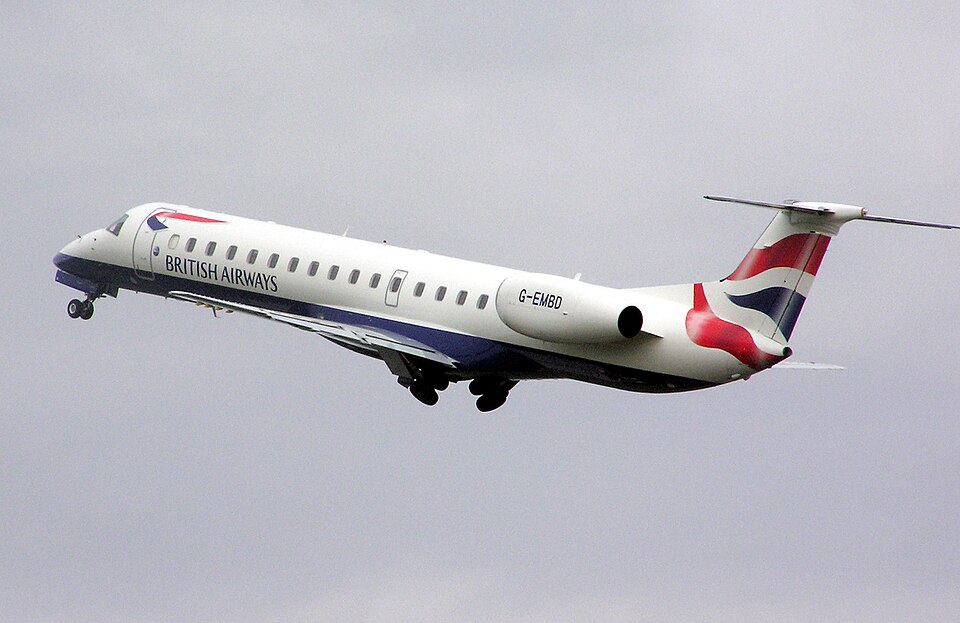
Incident
On 15 November 2003 at 1350 UTC, an Embraer EMB-145EP, registration G-EMBD, was departing from Venice Airport, Italy, on a public transport flight to Manchester. During the takeoff ground roll at rotation speed, the flight crew felt a sudden but moderate vibration. No abnormal system indications were observed, and the commander continued the takeoff. Venice Air Traffic Control conducted a runway inspection, which revealed tyre debris. The flight proceeded to Manchester, where an emergency was declared and an uneventful landing was made on Runway 24L.
Tyre Examination
The left inboard mainwheel tyre (number 2) had shed its tread and deflated. Tyre debris also severed wiring from the weight-on-wheels switch on the left main landing gear. The tyre, a retread (R2) with 107.5 hours and 68 landings since installation, showed tread separation around half of its circumference down to the carcass. The inner liner had a diagonal fracture, and the casing plies exhibited localized break-up. The tyre manufacturer concluded that the casing failure was advanced and severe for an R2 carcass, caused by over-deflection of the sidewall, typically associated with under-inflation or overloading.
Wheel Assembly Examination
Pressure testing of the reconstructed number 2 wheel assembly revealed an extensive air leak from the overpressure valve. The valve was not loose, but debris was found on its O-ring seal, and a blackened area was observed on the valve seat. Metallurgical examination identified that the blackened substance was aluminium corrosion product filling a cavity resulting from penetrative corrosion. The protective anodising layer around the unaffected area was normal but thinned dramatically near the cavity, and the threaded hole lacked a fully formed anodised layer. The O-ring had lost its elastic properties. The lubricant used on the O-ring, Molycote 111, was incompatible with silicone rubber, as per its datasheet.
Maintenance History
The number 2 wheel assembly had been manufactured in 1998 and accumulated 5,426 hours and 4,283 landings. It had undergone 10 workshop visits, with one overhaul in September 2000, during which the overpressure valve O-ring was last replaced. No repairs or damage to the valve seat were recorded. The aircraft's technical log from 1 November 2003 to the incident date showed no tyre pressure records or problems. The aircraft operator required tyre pressure checks every 48 hours; the last intermediate check was on 14 November 2003 at 0100 UTC.
Component Maintenance Manual (CMM)
The CMM instructed visual inspection of wheel halves for corrosion and damage at every tyre change without requiring removal of the overpressure valve. The manual recommended replacing all preformed packings (O-rings) at each tyre change and overhaul but allowed reuse if satisfactory. It specified use of Dow Corning 55, 33, or 4 lubricant on O-rings, all cautioned against use on silicone rubber.