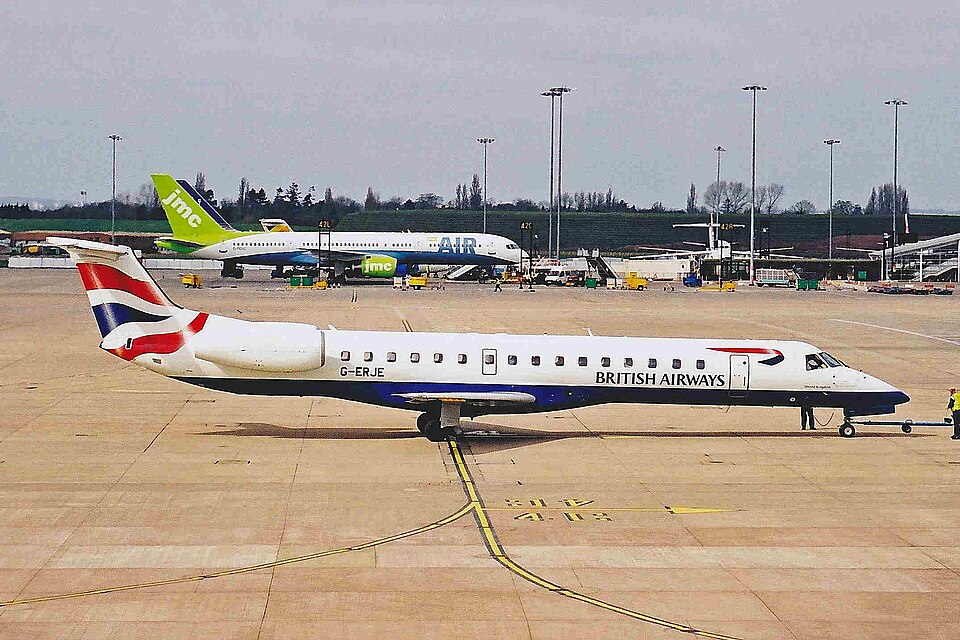
History of the Flight
The aircraft, an Embraer EMB-145EP registered G-ERJE, was operating a scheduled public transport service from Charles de Gaulle Airport, Paris to Bristol International Airport. Three crew members were on the flight deck: the commander as pilot flying, a first officer as pilot not flying, and an observer on the jump seat for familiarisation with the Flight Management System. The descent from cruise altitude began with the autopilot engaged, using Flight Level Change mode. After passing Compton VOR, further descent clearance to FL110 was obtained. To increase the rate of descent, the commander selected Vertical Speed mode with a target of 3,000 feet per minute. Bristol Approach cleared the aircraft to FL45 and then to 2,500 feet on QNH 1007 mb. Speedbrakes were deployed below FL100, triggering a "HIGH SPEED" overspeed warning. The commander selected Speed mode at 240 kt, and the rate of descent reduced to zero at FL80 before resuming. The Approach mode was armed, and localiser capture occurred at about 21 nm. The aircraft deviated to the south and then north of the localiser. The commander selected Heading mode, retracted speedbrakes, and disconnected the autopilot after another overspeed warning. The landing gear was selected down during the approach checklist. ATC advised the crew of the low altitude and instructed a climb. The observer heard a GPWS "SINK RATE" caution; the operating pilots did not recall it. The aircraft climbed to 2,400 feet amsl and completed a normal ILS approach and landing. After landing, the commander filed an Air Safety Report regarding the overspeed and poor localiser capture, but did not include the descent below glidepath or the GPWS alert.
Meteorological Conditions
The Bristol area was under an unstable westerly airflow behind a cold front. A Met Office aftercast indicated wind at 2,000 feet amsl from 250° at 15 kt, at 5,000 feet from 280° at 15 kt, and at 24,000 feet from 230° at 20 kt. Scattered/broken stratus cloud had a base of 500 to 1,200 feet amsl with tops to 1,500 feet, and further broken strato-cumulus layers with base 2,000 to 3,000 feet. The 0950 UTC METAR at Bristol recorded surface wind from 230° at 8 kt, visibility greater than 10 km, few clouds at 600 feet, broken cloud at 1,000 feet, temperature 14°C, dewpoint 13°C, and QNH 1007 mb.
Flight Crew Experience
The commander, aged 56, held an Airline Transport Pilot's Licence with 9,810 total flying hours, including 600 on type. He had flown 110 hours in the last 90 days and 31 hours in the last 28 days. He had initially attempted conversion to the Embraer 145 as a captain but was unsuccessful; he later completed conversion as a first officer and qualified as captain in June 2001, accumulating 400 hours in command. The first officer had about one year on type, and the observer was recently qualified and new to the company.
Recorded Data
Flight recorders were overwritten when the incident came to the AAIB's attention. Radar data from Clee Hill was used to construct horizontal and vertical profiles. The aircraft intercepted the localiser at an angle of 5° to 10°, passed through the centreline, and on a second attempt at 35°, passed through again. The lowest point of the glidepath deviation was over terrain at about 100 feet amsl, with local terrain up to 330 feet amsl.
Operating Procedures
The operator had two different FMS types with significant operational differences. A training programme required ground training and two observational flight sectors on the unfamiliar type. On this flight, the crew were not informed beforehand that the sector would be used for familiarisation. London Area Control procedures restricted descent below FL220 until after passing Compton VOR. The company standard operating procedure required the Approach checklist to be carried out after clearance below the Transition Altitude, which at Bristol is 3,000 feet.