Background
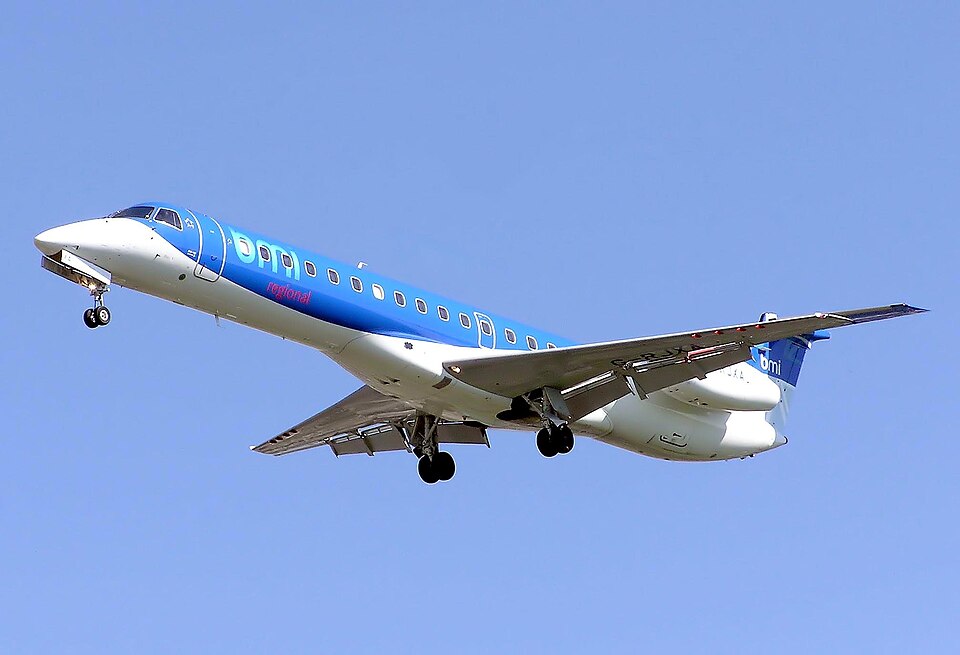
The incident occurred on 10 May 2007, involving an Embraer EMB-145EP registration G-RJXA, manufactured in 1999. The aircraft was powered by two Rolls-Royce AE 3007A turbofan engines. The flight was a scheduled commercial passenger service from Aberdeen (Dyce) Airport to Manchester Airport, with four crew and sixteen passengers on board. The commander held an Airline Transport Pilot's Licence, had 5,000 total flying hours with 3,000 on type, and the co-pilot had 2,200 hours with 700 on type. The co-pilot was pilot flying (PF) for this sector, which was the crew's fourth and final of the day.
History of the Flight
Start-up, takeoff, and initial climb were normal. Approximately four and a half minutes after takeoff, while climbing through FL116, the Engine Indicating and Crew Alerting System (EICAS) caution and Autopilot disconnect warnings sounded simultaneously. The commander's Primary Flight Display (PFD), Multi Function Display (MFD), and EICAS went blank, displaying a red 'X'. Smoke appeared from the left side of his seat, described as a "smoky haze" with an "acrid burning smell." The Radio Management Unit (RMU) switched to an Engine display. The commander declared an emergency to air traffic control (ATC) and initiated a return to Aberdeen. The aircraft was in instrument meteorological conditions (IMC), and the co-pilot flew manually.
During the descent, the commander manually selected the pressurization control switch to MAN and adjusted the controller to the 1 o'clock position without referring to the Quick Reference Handbook (QRH). He then briefed the senior cabin crew member via interphone using a NITS brief (Nature, Intentions, Time, Special instructions). The cabin crew reported a strong smell and smoky haze at the front of the passenger cabin. The commander told the co-pilot to forget all checks, stating there was only a little smoke and he was happy to continue without oxygen masks. Approximately 30 seconds later, he noted a strong odor and said they had to land as soon as possible.
Two minutes later, the cabin crew confirmed only a smell and haze at the front. The commander informed them he had turned off No 1 air conditioning pack. Radar vectors from ATC positioned the aircraft for an approach to Runway 34. They broke cloud at about 1,500 ft amsl, and the commander took control from the co-pilot. The Landing checklist was completed, and the commander asked the co-pilot to contact the cabin crew at about 300 ft aal to assess smoke in the cabin; they did not respond. The aircraft landed on Runway 34, 15 minutes after the incident began, with the red 'X' still displayed. It vacated onto Runway 32, stopped, and an evacuation was initiated with airport fire and rescue services in attendance. All passengers and crew vacated without incident.
Crew Actions and Decisions
At no time during the incident did the crew don oxygen masks, instruct cabin crew to don masks, deploy passenger oxygen masks, or refer to the QRH. The commander explained he did not use the mask because smoke was minor, and later, while concentrating on monitoring the co-pilot, felt it might hamper operations and cause passenger concern. He stated he would have used the mask if smoke returned or if he felt giddy. The co-pilot did not call for the QRH as he was focused on manual flying and feared his own screens might fail.
QRH and Procedures
The operator's QRH for the EMB 145 included three smoke checklists: 'Air Conditioning Smoke', 'Electrical System Fire Or Smoke', and 'Cabin Fire Or Smoke'. All three had four immediate actions from memory: don oxygen masks at 100%, don smoke goggles, establish crew communication, and push out the recirculation fan. The commander's symptoms (PFD/MFD/EICAS blank) were addressed by a 'Display Failure' checklist, which directed to an 'IC Failure' drill.
Weather Information
The METAR for Aberdeen at 1220 hrs reported wind from 020° at 9 kt, few clouds at 900 ft, broken clouds at 1,000 ft, temperature 8°C, dew point 7°C, and QNH 995 mb.
Flight Recorders
The aircraft was equipped with a flight data recorder (FDR) and a cockpit voice recorder (CVR). The FDR architecture acquired most parameters from No 1 IC-600. When that computer failed, the FDR continued recording but lost associated parameters, retaining only tri-axial accelerations, control column/wheel positions, rudder pedal positions, brake pressures, and clock data.
Conclusion
The No 1 Integrated Avionics Computer (IC-600) had failed, causing the display blanking and smoke.