History of the Flight
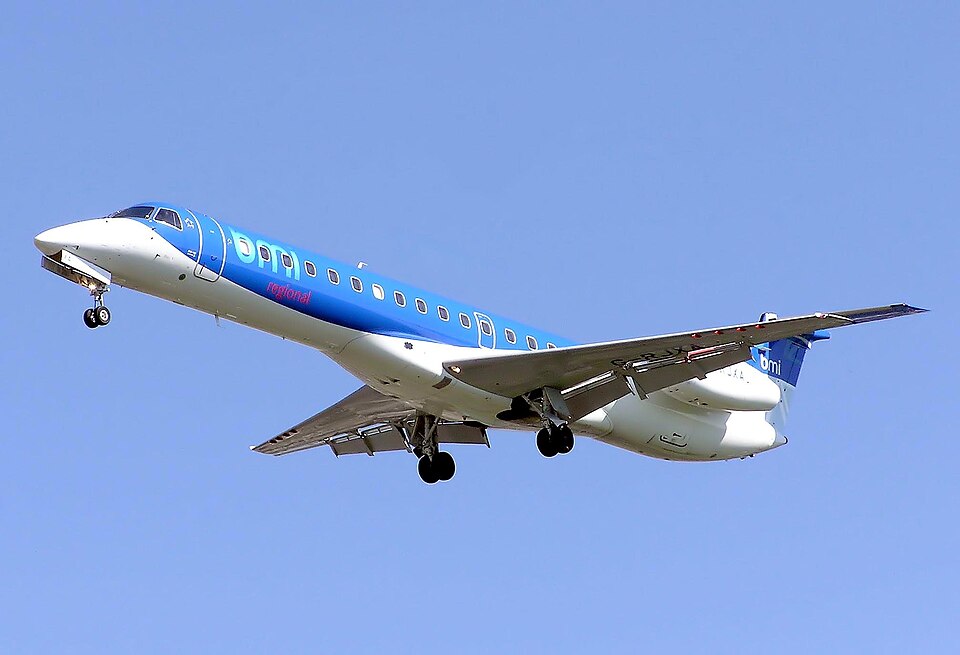
On 6 September 2001, an Embraer EMB-145EP (registration G-RJXA) was scheduled for a passenger flight from Glasgow to Manchester. The commander started the engines using APU bleed air, and all engine indications were normal during start and taxi. After takeoff from Runway 23, the co-pilot was flying while the commander communicated with ATC. About 105 seconds after applying alternate takeoff thrust, while climbing through 2,500 feet, a fire warning tone sounded with a Master Warning caption. The co-pilot identified an engine fire on the left engine, retained control, and handled communications. The commander confirmed the warning, pulled the left engine fire handle, and discharged a fire extinguisher shot, which stopped the warning. The aircraft was in visual meteorological conditions. The crew briefed the cabin, declared a MAYDAY, and returned to Glasgow for a single-engine ILS approach. The landing was uneventful, and emergency services confirmed no visible fire. Passengers disembarked normally.
Examination of the Aircraft
External damage was limited to a melted vent panel near the air turbine starter (ATS) exhaust. Inside the engine compartment, heat damage affected components near the ATS, including scorched cables and minor damage to the carbon fiber bypass duct. The ATS casing was blackened, and its data plate had fallen off due to melted adhesive. The annular exhaust grill revealed solidified molten remains of turbine blades. The start control valve (SCV) was found closed, and tests confirmed no malfunction of the SCV or its indication system. The ATS output shaft had not sheared but could not be rotated manually. The oil reservoir contained only sticky black residue, and the internal casing had fractured, releasing oil into the turbine area. The magnetic plug in the gear section was heavily contaminated with metallic debris.
ATS History and Examination
The ATS unit, fitted at aircraft build with 3,985 flying hours and 4,372 cycles, was of a type used on Embraer 135/145, Cessna Citation X, and Saab 2000 aircraft. The manufacturer reported eight occurrences since January 2000 involving failure of the ATS to disengage after engine start, three of which resulted in fires. A service bulletin (SB 145-80-0001) had been issued in June 2000 to address a misquoted dimension causing a slightly overlong output shaft, which imposed axial loads affecting the planetary gear system. Another bulletin (SB 145-80-0004) introduced a plug to prevent oil loss in case of shaft shear. At the time of the incident, the latter was not yet mandated by the UK Civil Aviation Authority.
Strip examination at the manufacturer's facility, observed by the FAA, concluded that the failure occurred when the overrun bearings within the clutch seized due to operation with excessive axial load from shaft interference, evidenced by witness marks on the output shaft.